 Twin Lakes, Alberta
Oct 23, 2021
It’s an unusually rainy October day in Calgary. Unlike our friends in other parts of the country, Calgarians are generally unprepared for rain. At Halloween we are used to snow. I remember planning my Halloween costume to ensure my snowsuit could fit underneath it. I remember the difficulty of collecting candy with my hands wrapped in thick mittens.
This year, parents may be modifying costumes to ensure their children stay dry rather than just warm. This isn’t unexpected – Canada’s Changing Climate Report (2019) tells us there is a shift toward less snowfall and more rainfall in many parts of the country – but when climate change starts to impact trick or treating, well, it starts to sink in.
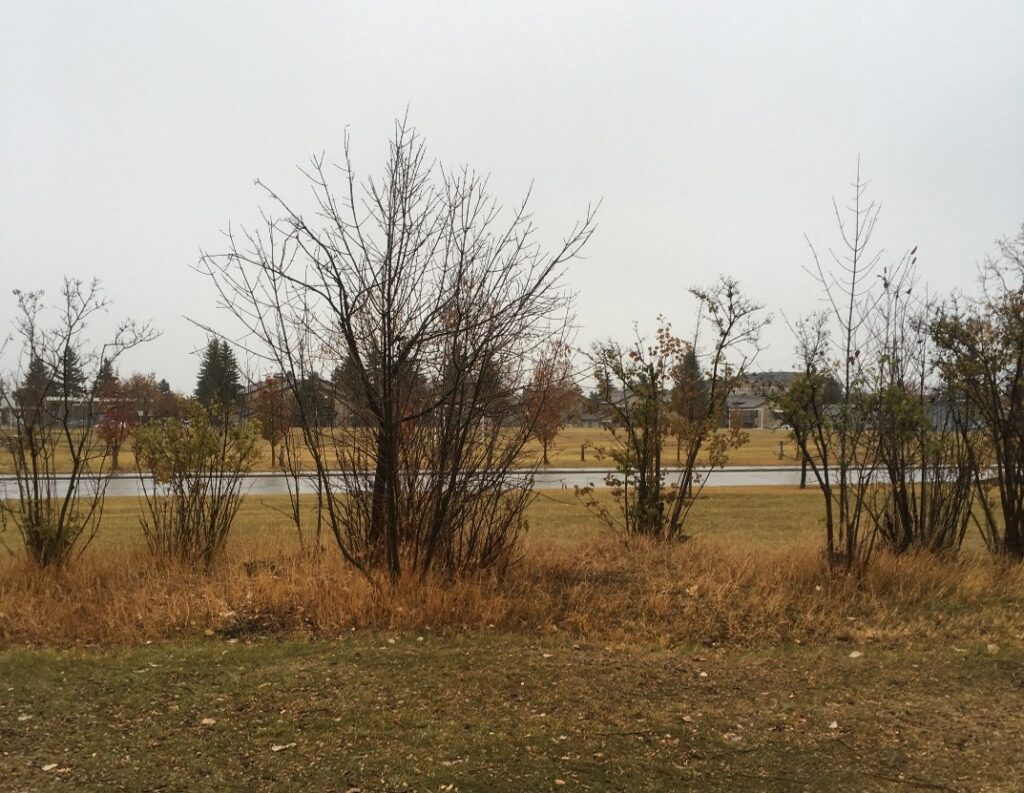
The rain is also impacting my sit spot. I’ve decided to pace my spot today – determined to engage with this space but avoiding my usual comfortable bench to keep my clothes dry. The rain is making everything look a little blurry – particularly the sparse bushes across the park. Colours are muted, and everything is morphing into a gray haze. This haze is beautiful in its own way.
However, the hazy logic and smoke and mirrors I saw play out in Alberta’s political sphere this week is anything from beautiful. In fact, it’s a perfect example of disinformation.
The final report of the Public Inquiry into Anti-Albertan Energy Campaigns was made public this week. This inquiry was launched in 2019 by the Alberta government to investigate funds from American foundations that were used in campaigns against Alberta’s fossil fuel industries. After three extensions and a million dollars over budget (Johnson, 2021), the final report came to light. The report concluded there was no evidence of legal wrongdoing by environmental groups (in fact, these groups were exercising their right to free speech), and the report’s author further concluded that “I am not in a position to find that these campaigns alone caused project delays or cancellations” of energy projects (Allan, 2021, p. 14). So, we can all rest easy knowing that our democracy is working as it should, and move on from this expensive and unnecessary inquiry, correct?
Unfortunately, no.
Minister of Energy Sonya Savage used this as an opportunity to share her opinion on the report. Despite the report finding there is no link between foreign funds entering Canada and the cancellation of energy projects, Minister Savage stated in an interview with CBC news, “you just have to look at our large pipeline projects… to see there is a clear link” (CBC News, 2021). This isn’t just misinformation – this is disinformation – intentionally ignoring the results of a public inquiry to fit a preplanned message. It was a deliberate attempt to misdirect the conversation away from the findings of the report.

At a press conference on Oct 21, Minister Savage shared: “In my 13 years working in the energy sector, I personally saw the evidence of these campaigns as they targeted pipelines… I could see the antics and tactics of these campaigns on the ground” (Government of Alberta, 2021). She continued, “While these [environmental groups] boasted, Albertans were hurt. People lost their jobs, businesses went under, families were hurt.” The actual results of the report were barely referenced at the press conference. Instead, we heard Minister Savage’s interpretation of the findings.
Minister Savage relied on several central tenants of effective communication and disinformation in her press conference speech. She relied on the fact that people trust messengers who hold similar views (Armstrong et al., 2018), so she emphasized that she had worked in the energy sector for more than a decade. She evoked populism, framing boastful well-funded environmental groups pitted against everyday Albertans, pointedly ignoring that many Albertans work for the same environmental groups she referenced. She also relied on personal anecdotes (“I personally saw…”) rather than emphasizing the conclusions of the report. Both techniques – relying on populist sentiments and personal anecdotes – have been identified by Lewandowsky as practices of disinformation (2020).

Our week 4 prompt asked us to tell an anecdote about an experience at our sit spot that connects to climate action. My experience – the heavy and unseasonal rain – makes me think about how Halloween is changing for kids in Calgary due to climate change. But the rain also makes me think about how truth is becoming cloudy and more difficult to discern. Everyone knows that Halloween is just playful deceit (using costumes to get candy from strangers). However, when an elected official intentionally spreads misinformation, there is nothing playful about it. Minister Savage is entitled to her feelings about the public inquiry report. What she is not entitled to is to use her feelings and her position as an elected official to misinterpret information for Albertans.
How can one respond effectively to disinformation and misdirection from elected officials about climate change?
References
Allan, J.S. (2021). Report of the Public Inquiry into Anti-Alberta Energy Campaigns. Government of Alberta. https://open.alberta.ca/dataset/3176fd2d-670b-4c4a-b8a7-07383ae43743/resource/a814cae3-8dd2-4c9c-baf1-cf9cd364d2cb/download/energy-report-public-inquiry-anti-alberta-energy-campaigns-2021.pdf
Armstrong, A.K., Schuldt, J.P., & Krasny, M.E. (2018). Establishing trust. Communicating climate change: A guide for educators. Cornell University Press. Ebook.
CBC News. (2021, October 22). Alberta public inquiry finds no wrongdoing by anti-oilsands activists [Video]. YouTube. https://www.youtube.com/watch?v=1mha4PX1_I8
Environment and Climate Change Canada. (2019). Canada’s Changing Climate Report. https://changingclimate.ca/site/assets/uploads/sites/2/2020/06/CCCR_FULLREPORT-EN-FINAL.pdf
Government of Alberta [YourAlberta]. (2021, October 21). Release of public inquiry report – October 21, 2021 [Video]. YouTube. https://www.youtube.com/watch?v=9cSZL62l-d4
Johnson, L. (2021, October 22). No evidence of wrongdoing found in Allan inquiry report into ‘anti-Alberta’ campaigns. Edmonton Journal. https://edmontonjournal.com/news/politics/long-awaited-allan-inquiry-report-into-anti-alberta-campaigns-released
Lewandowsky, S. (2020). Climate change disinformation and how to combat it. Annual Reviews of Public Health 42, 1-21.
Wong, L. (2021). Alberta Energy Minister Sonya Savage provided details on Thursday October 21, 2021 about the report of the public inquiry into anti-Alberta energy campaigns. [Photograph]. Postmedia. https://edmontonsun.com/news/politics/long-awaited-allan-inquiry-report-into-anti-alberta-campaigns-released/wcm/7dc18c13-0fac-471d-8087-3575ef337712
Hi Amy. You did an excellent job of tying Minister Savage’s communication techniques and use of misinformation back to our course material. It feels very rewarding to be able to apply what we learn in our readings to what is happening around us, doesn’t it?
Thank you Hanna! It does feel very rewarding to apply what we learn in the readings to real-world events, you’re right. I just wish it weren’t related to disinformation!
Amy,
This is such a solid analysis, and beautifully tied back to your sit spot. Thinking about those old winter Halloweens (I was just telling my kid and his friends that we always wore snowsuits at Halloween in the Yukon and Northern Alberta!) really resonated. So you yourself are drawing on anecdote to make personal connection with your audience. And the analysis of Minister Savage’s disinformation tactics is really spot on. Well done!
Shandell
Thank you Shandell! I can’t imagine how cold trick or treating must be in the Yukon. I imagine costumes must be designed with a heavy snowsuit in mind!