Description
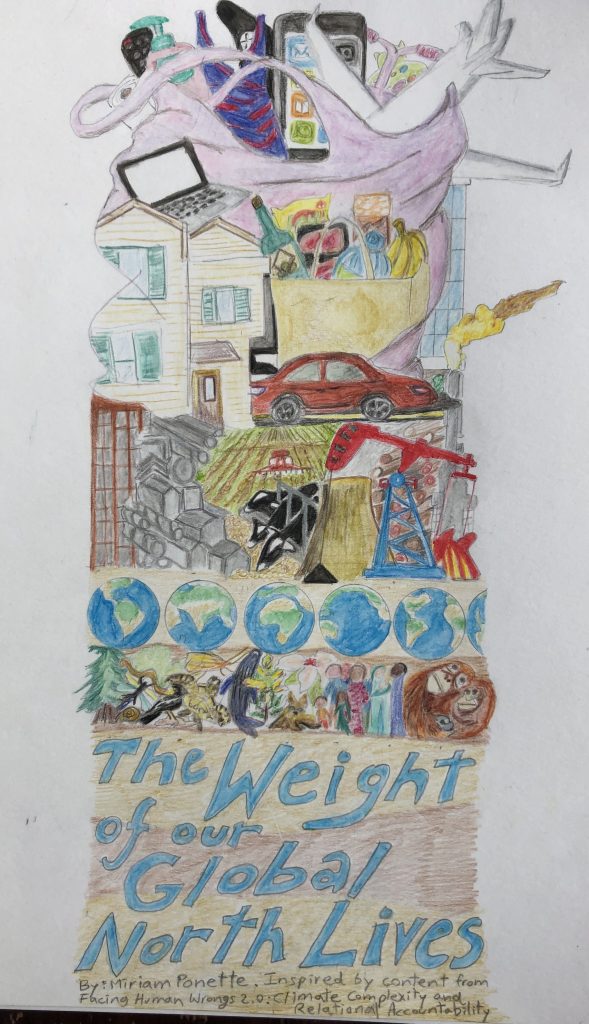
Drawing: Approximately 17.5 x 36cm, watercolour pencils on paper.
This drawing attempts to make visible the burden that ordinary consumption in the Global North puts on the rest of the biosphere and on citizens of the Global South. At the top of the drawing are everyday consumer goods: a liquid soap dispenser, a piece of clothing, an iPhone, a child’s scooter and toy, a remote control, an x-box controller, a paper towel roll and an airplane representing air travel. Below that are a typical suburban home, a bag of groceries including meat, cheese, tropical fruit, olive oil, chips and bottled water. A laptop, TV, personal vehicle and office building are also represented as well as an asphalt road. In choosing these objects, I attempted to focus on ordinary, mundane and commonplace purchases as well as built infrastructure that support our lifestyles. Many of these items we consider necessities or ‘staples’ such as food, clothing and shelter. Others – the toys and electronics for example – are non-essentials but ubiquitous in households of most income levels. While food, shelter and clothing are indeed basic needs, our excessive and wasteful approaches to meeting those needs as well as the global supply chains we have set up to produce them are neither essential, sustainable nor ethical. There are other housing types, food options and procurement methods (ex. local, circular) that produce vastly less waste and pollution and that are far more ethical. To live sustainably and ethically on a finite planet, we need to come to terms with the fact that we must consume far, far less. More than 4 planets less, to be precise (Moore, 2015). In her article on ecological footprints and the lifestyles needed to stay within planetary limits, Jennie Moore prescribed the following as lifestyles compatible with ‘one-planet living’:
“…a predominantly vegetarian diet of 2424 calories per capita per day, large households (e.g., five people on average) sharing a relatively small dwelling space (8 m2/ca), in which most appliance and consumable items, such as radios, telephones, televisions and computers are shared. On average, the dimensions of transformation needed commensurate with ecological carrying capacity include: a 73% reduction in household energy use, a 96% reduction in motor vehicle ownership, a 78% reduction in per capita vehicle kilometres travelled, and a 79% reduction in air kilometres travelled” (2015, p 4758-59).
The lower half of the image depicts the industries that produce the goods in the upper half of the drawing: factories, steel and other metal, industrial agriculture and farming, fossil fuel as well as renewable energy production, and logging. I am attempting to make visible the polluting and destructive activities occupying vast tracts of the planet that sustain our lifestyles. These industries are largely out of sight for many Global North consumers, with the exception of disproportionately BIPOC and low-income communities who are forced to live beside them and suffer from their environmental pollution. I included a nuclear power plant to indicate that even low-carbon activities have an environmental footprint and sustainability consequences. Below that are over 5 planet earths, representing the amount of materials required to sustain the lifestyle of a middle-class citizen of the Global North (Moore, 2015). Below that is the rest of all life on the planet: the biomes, plant and animal species as well as human communities in the Global South, who are being burdened by our way of life. These human and other-than-human relatives are shown as being physically compacted and compressed by the weight of consumption by Global North citizens. Human communities of the Global South are depicted alongside plant and animal species rather than above them, to acknowledge that many of these communities, including Indigenous communities, have respect for and view our other-than human relatives as equals, with an understanding of our interconnections and our place within the planetary web of life. Their lifestyles reflect that understanding and are therefore much more sustainable than ours. Almost all the flora and fauna drawn are endangered species.
Discussion – Addressing Denialism and Questioning the Universality and Superiority of Our Way of Life
In the Global North, our lives are so entrenched in an unsustainable way of life that it can be hard to imagine life without the destructive and questionably necessary products around us. Life without asphalt roads? Life without office buildings? Electronics? Meat and dairy raised on industrial farms and monocultured crops, packaged in plastic and sold at the grocery store? Plastic toys for our children, oversized homes, soap sold in plastic dispensers and paper towels? Most of these items are bought at all income levels and require global supply chains to sustain their production. Although many of us are aware that colonialism and our capitalist, consumption-hungry economy are at the root of climate change, it can feel overwhelming to consider radically reforming our society. As a result, in the climate action space we tend to resort to incremental changes within the existing framework, holding space for other worldviews but without radically uprooting our own from the drivers seat. During the MACAL Climate Action Leadership Summit in December 2023 and throughout the University of Victoria’s Facing Human Wrongs: Climate Complexity and Relational Accountability course, participants were asked to reflect on whether we and the climate actions we support are embracing incremental, radical or ‘beyond reform’ (systems uprooting) change. I spoke in my previous blog post about the lack of focus on overconsumption in climate action spaces, and suggested that fear may be holding many climate action professionals back from embracing beyond reform change and tackling the root causes of the climate crisis (Ponette, 2024). Throughout the Facing Human Wrongs course, I deepened and further informed my thinking around the psychological barriers preventing citizens of the Global North from embracing beyond reform change, and came to the conclusion that denialism is another important element. The course is framed around the layered ‘socially sanctioned denials’ that our Global North Society encourages us to perpetuate, to maintain and uphold the current capitalist system. These sanctioned denials are of systemic violence, unsustainability, entanglement and of the magnitude of the challenges (V. Andreotti, January 21, 2024). Another important learning that was addressed in MACAL but further elaborated on in the Facing Human Wrongs course was the concept of the western worldview being imposed as a single legitimate story of progress, development and civilization (Royal Roads University, 2023, 24:30). My learnings through the course helped me to better understand how our dominant worldview that is based on separability and the hierarchization of living things is holding us back from considering or imagining other possible futures (V. Andreotti, January 21, 2024). Through this drawing, I’m inviting viewers from the Global North to witness their complicity in global harm, but also to question the absolutism of our way of life and to question its quality. What are we giving up to maintain this way of life – for the rest of life on the planet, but also for ourselves and our own well-being? What other lifestyles are possible that might bring about even greater well-being for us? What do we give up from our humanity each day, when we participate in systems that are harmful to other humans and to other forms of life? And are we risking our own survival on this planet by insisting on perpetuating a lifestyle based on dominion, appropriation, hierarchization and exploitation? Our inability to imagine other possible futures, or our inability to let those who can imagine those futures take the drivers seat is deeply tied to climate action as well. How can a liveable and equitable future be built within the systems and by the forces of power who created the crisis?
References
Moore, J. (2015). Ecological Footprints and Lifestyle Archetypes – Exploring Dimensions of Consumption and the Transformation Needed to Achieve Urban Sustainability. Sustainability. https://www.mdpi.com/2071-1050/7/4/4747
Ponette, M. (2024, January 9). Extraction and exploitation on a finite planet. Climate for All. Extraction and exploitation on a finite planet – Climate For All (royalroads.ca)
Royal Roads University. (2023, December 5). Royal Roads University Climate Week – Climate, Complexity and Relational Accountability – Climate, Complexity and Relational Accountability. [recorded presentation]. YouTube. https://www.youtube.com/watch?v=IBvcR2H-L_0&list=PL_F04p4cdLDn7tAHaktAaKlGqjFt_Fxr5&index=3&t=3234s