The lovely fragrance of Virginia Bluebells growing in the nearby shade greets me as I settle into my sit spot. Once a rarity here, as her home became increasingly strange and foreign she found her way northwards, resettling and taking root in a more hospitable place. I nod in welcome to this new one that seems to be thriving here. Latin music wafts across the river as a group gathers for an outdoor bbq at the wheelchair-accessible public docks – our community now includes many Hondurans, Guatemalans and Nicaraguans who joined us after the heat and catastrophic storms of the 2040s made Central America unliveable. Behind them, a few small apartment complexes dot the village skyline – in the 2020s our municipal council changed the zoning to diversify housing options in response to the affordable housing crisis and to urban expansion that has now reached our small town from the nearby metropolis. A buzzing hum sounds faintly on the distant shore and an electric commuter train weaves its way over the hill, slowing to a stop in the village. While it has made our village much busier, most villagers now use public transport to get into the city and urban residents flock to our shores for respite from the city heat and intensity. I hardly ever hear the highway anymore; now it’s the quiet whir of electric vehicles passing by on the road behind me.
From my vantage point on this side of the river, small gatherings of people dot along the river’s edge – come to soak in the sunshine and the tranquillity. When I moved here, the shoreline was monopolized by private properties that stood vacant most of the time while city visitors and locals without waterfront homes had to squeeze into the few public access spots. But since then, the government has grandfathered the right to own waterfront and any new sales have been bought back for public access.
A canoe floats by – public lands have been returned to indigenous governance and the Kitigan Zibi Anishinabeg are stewarding a river restoration program. Among many important programs, the dam upriver has been retrofitted to allow for safe migration of species searching northwards for a new home. I see many locals clearing debris from last month’s windstorm; my power supply is out but I take this moment to have a break from technology.
I close my eyes and feel the warmth of the sun on my face. A lot has changed since I first started this sit spot practice 25 years ago – this place is much busier than it once was, but the gratitude that I felt for this sacred space is now shared with many others and we are working to care for it together.
Home is a Shared Space
Academic citations and connections:
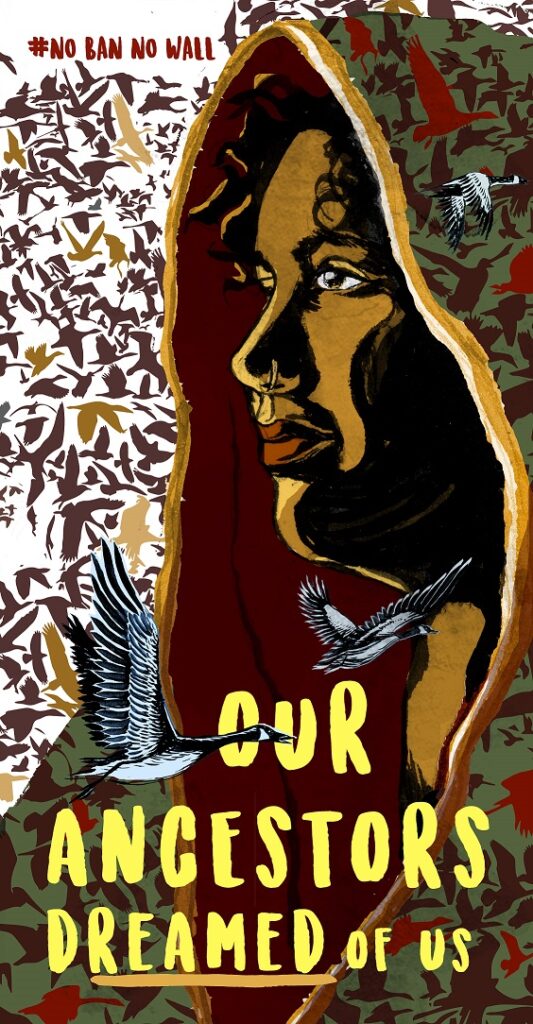
This post uses a gain-framed messaging approach, describing the ways in which my community could be enhanced as a result of climate change (Connor et al., 2016). It is also influenced by Kimmerer’s work, using ‘the grammar of animacy’ when describing the bluebells (2014, p. 21) and responds to her call for more gratitude (2014). The theme of migration and the dismantling of artificial borders and property ownership (the graphic, the movement of people across political boundaries, the dams impeding free movement of animals along the river, public access to the river, respect for indigenous land title and governance) are influenced by indigenous ways of being that have always resisted these constructs. Ben Okri, as cited by Sium & Ritskes (2013, p. 5), points out that stories have the power to make people and nations sick; positive stories therefore can also have the power to heal individuals and societies. I am inspired and empowered to dream that telling the right stories can be a transformative process that slowly reconstructs our collective reality.
(Tiny Ecology Post 3)
References
Alam, J. & Snow, J. X. (2017). Our Ancestors Dreamed of Us [graphic]. Justseeds Artists’ Cooperative. https://justseeds.org/graphic/our-ancestors-dreamed-of-us/
Connor, P.; Harris, E.; Guy, S.; Fernando, J.; Shank, D.; Kurz, T.; Bain, P. & Kashima, Y. (2016). Interpersonal communication about climate change: How messages change when communicated through simulated online social networks. Climatic Change 136(3-4), 463–476. doi: 10.1007/s10584-016-1643-z
Kimmerer, R. W. (2014). “Returning the Gift.” Center for Humans and Nature. https://www.humansandnature.org/returning-the-gift-article-177.php
Sium, A. & Ritskes, E. (2013). Speaking truth to power: Indigenous storytelling as an act of living resistance. Decolonization: Indigeneity, Education & Society, 2(1), 1-10. https://jps.library.utoronto.ca/index.php/des/article/view/19626
Ah Miriam, this is so beautiful! Telling stories like this is so important. It enables a way of taking seriously both the effects and risks of climate change (such as with the storms you mention), but also demonstrates the possibility in making a better world in the face of those storms. I hope you continue through this kind of thinking in your work — imagining a hopeful future, and then putting into practice the steps and processes that will help us all get there.
Thanks,
Shandell
Hey Miriam,
Wow. I was so captivated and moved by your story. I could visualize the Virginia Bluebells and the gatherings on the river side. Really profound. Looking towards the future the way you so eloquently wrote about is beautiful. It’s nice to read something that makes me think of hope not despair. I hope that what you dreamed in your story can come to life with your guidance and leadership within community. Wonderful and thanks for sharing.
Tony
Thank you so much for your feedback Tony! I really appreciate it. This course has been a great confidence-building exercise, to practice coming out of my shell a little bit and telling these stories that float around in my head, that I thought no one would ever be interested in hearing. 😉
I really hope this comes true too. We’ll see – if enough of us dream these things and talk about them, certainly some progress can be made in the right direction.
All the best,
Miriam
This was really fun to read, Miriam! I love all of the threads of a hopeful future that you were able to weave in. I also really like that you imagined yourself visiting the same sit spot in 25 years – wouldn’t that be an amazing experience, to visit the same spot regularly for that long?
Thanks so much for your comment Hanna! Yes, I imagine it will be quite surreal to look back on this place 25 years from now. So much will have changed, one way or another…