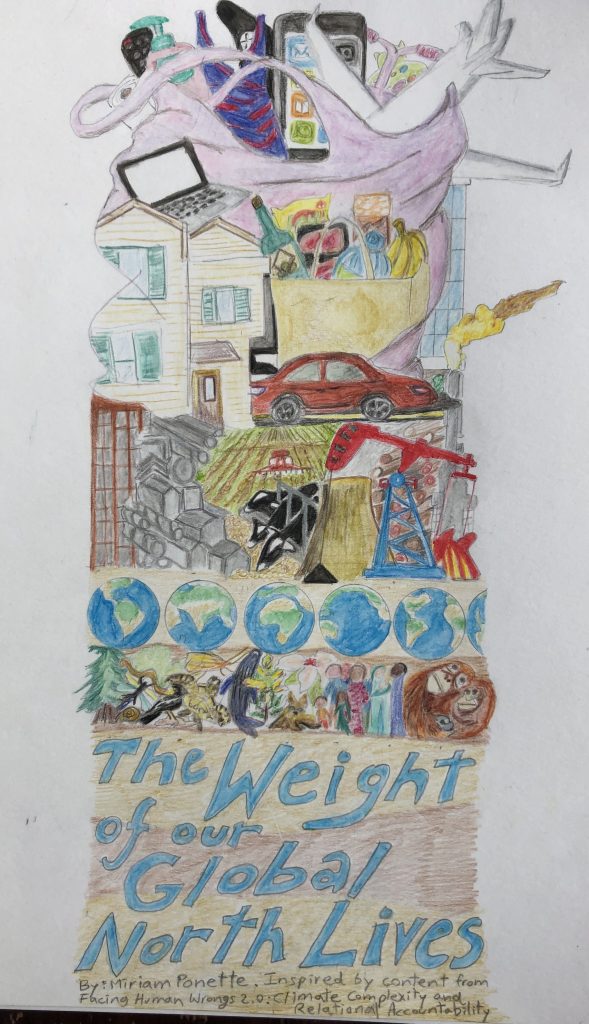
The Weight of Our Global North Lives

Description

Drawing: Approximately 17.5 x 36cm, watercolour pencils on paper.

This drawing attempts to make visible the burden that ordinary consumption in the Global North puts on the rest of the biosphere and on citizens of the Global South. At the top of the drawing are everyday consumer goods: a liquid soap dispenser, a piece of clothing, an iPhone, a child’s scooter and toy, a remote control, an x-box controller, a paper towel roll and an airplane representing air travel. Below that are a typical suburban home, a bag of groceries including meat, cheese, tropical fruit, olive oil, chips and bottled water. A laptop, TV, personal vehicle and office building are also represented as well as an asphalt road. In choosing these objects, I attempted to focus on ordinary, mundane and commonplace purchases as well as built infrastructure that support our lifestyles. Many of these items we consider necessities or ‘staples’ such as food, clothing and shelter. Others – the toys and electronics for example – are non-essentials but ubiquitous in households of most income levels. While food, shelter and clothing are indeed basic needs, our excessive and wasteful approaches to meeting those needs as well as the global supply chains we have set up to produce them are neither essential, sustainable nor ethical. There are other housing types, food options and procurement methods (ex. local, circular) that produce vastly less waste and pollution and that are far more ethical. To live sustainably and ethically on a finite planet, we need to come to terms with the fact that we must consume far, far less. More than 4 planets less, to be precise (Moore, 2015). In her article on ecological footprints and the lifestyles needed to stay within planetary limits, Jennie Moore prescribed the following as lifestyles compatible with ‘one-planet living’:

“…a predominantly vegetarian diet of 2424 calories per capita per day, large households (e.g., five people on average) sharing a relatively small dwelling space (8 m2/ca), in which most appliance and consumable items, such as radios, telephones, televisions and computers are shared. On average, the dimensions of transformation needed commensurate with ecological carrying capacity include: a 73% reduction in household energy use, a 96% reduction in motor vehicle ownership, a 78% reduction in per capita vehicle kilometres travelled, and a 79% reduction in air kilometres travelled” (2015, p 4758-59).

The lower half of the image depicts the industries that produce the goods in the upper half of the drawing: factories, steel and other metal, industrial agriculture and farming, fossil fuel as well as renewable energy production, and logging. I am attempting to make visible the polluting and destructive activities occupying vast tracts of the planet that sustain our lifestyles. These industries are largely out of sight for many Global North consumers, with the exception of disproportionately BIPOC and low-income communities who are forced to live beside them and suffer from their environmental pollution. I included a nuclear power plant to indicate that even low-carbon activities have an environmental footprint and sustainability consequences. Below that are over 5 planet earths, representing the amount of materials required to sustain the lifestyle of a middle-class citizen of the Global North (Moore, 2015). Below that is the rest of all life on the planet: the biomes, plant and animal species as well as human communities in the Global South, who are being burdened by our way of life. These human and other-than-human relatives are shown as being physically compacted and compressed by the weight of consumption by Global North citizens. Human communities of the Global South are depicted alongside plant and animal species rather than above them, to acknowledge that many of these communities, including Indigenous communities, have respect for and view our other-than human relatives as equals, with an understanding of our interconnections and our place within the planetary web of life. Their lifestyles reflect that understanding and are therefore much more sustainable than ours. Almost all the flora and fauna drawn are endangered species.

Discussion – Addressing Denialism and Questioning the Universality and Superiority of Our Way of Life

In the Global North, our lives are so entrenched in an unsustainable way of life that it can be hard to imagine life without the destructive and questionably necessary products around us. Life without asphalt roads? Life without office buildings? Electronics? Meat and dairy raised on industrial farms and monocultured crops, packaged in plastic and sold at the grocery store? Plastic toys for our children, oversized homes, soap sold in plastic dispensers and paper towels? Most of these items are bought at all income levels and require global supply chains to sustain their production. Although many of us are aware that colonialism and our capitalist, consumption-hungry economy are at the root of climate change, it can feel overwhelming to consider radically reforming our society. As a result, in the climate action space we tend to resort to incremental changes within the existing framework, holding space for other worldviews but without radically uprooting our own from the drivers seat. During the MACAL Climate Action Leadership Summit in December 2023 and throughout the University of Victoria’s Facing Human Wrongs: Climate Complexity and Relational Accountability course, participants were asked to reflect on whether we and the climate actions we support are embracing incremental, radical or ‘beyond reform’ (systems uprooting) change. I spoke in my previous blog post about the lack of focus on overconsumption in climate action spaces, and suggested that fear may be holding many climate action professionals back from embracing beyond reform change and tackling the root causes of the climate crisis (Ponette, 2024). Throughout the Facing Human Wrongs course, I deepened and further informed my thinking around the psychological barriers preventing citizens of the Global North from embracing beyond reform change, and came to the conclusion that denialism is another important element. The course is framed around the layered ‘socially sanctioned denials’ that our Global North Society encourages us to perpetuate, to maintain and uphold the current capitalist system. These sanctioned denials are of systemic violence, unsustainability, entanglement and of the magnitude of the challenges (V. Andreotti, January 21, 2024). Another important learning that was addressed in MACAL but further elaborated on in the Facing Human Wrongs course was the concept of the western worldview being imposed as a single legitimate story of progress, development and civilization (Royal Roads University, 2023, 24:30). My learnings through the course helped me to better understand how our dominant worldview that is based on separability and the hierarchization of living things is holding us back from considering or imagining other possible futures (V. Andreotti, January 21, 2024). Through this drawing, I’m inviting viewers from the Global North to witness their complicity in global harm, but also to question the absolutism of our way of life and to question its quality. What are we giving up to maintain this way of life – for the rest of life on the planet, but also for ourselves and our own well-being? What other lifestyles are possible that might bring about even greater well-being for us? What do we give up from our humanity each day, when we participate in systems that are harmful to other humans and to other forms of life? And are we risking our own survival on this planet by insisting on perpetuating a lifestyle based on dominion, appropriation, hierarchization and exploitation? Our inability to imagine other possible futures, or our inability to let those who can imagine those futures take the drivers seat is deeply tied to climate action as well. How can a liveable and equitable future be built within the systems and by the forces of power who created the crisis?

References

Moore, J. (2015). Ecological Footprints and Lifestyle Archetypes – Exploring Dimensions of Consumption and the Transformation Needed to Achieve Urban Sustainability. Sustainability. https://www.mdpi.com/2071-1050/7/4/4747 

Ponette, M. (2024, January 9). Extraction and exploitation on a finite planet. Climate for All. Extraction and exploitation on a finite planet – Climate For All (royalroads.ca)

Royal Roads University. (2023, December 5). Royal Roads University Climate Week – Climate, Complexity and Relational Accountability – Climate, Complexity and Relational Accountability. [recorded presentation]. YouTube. https://www.youtube.com/watch?v=IBvcR2H-L_0&list=PL_F04p4cdLDn7tAHaktAaKlGqjFt_Fxr5&index=3&t=3234s

Extraction and exploitation on a finite planet

Extraction, extraction, extraction.

Vast tracts of homeland in the global south are pillaged to sustain the global north’s lifestyle, at the expense of the complex ecosystems, Indigenous peoples and other citizens of the global south who live there. Lands are overtaken to grow mono-cultured crops and raise livestock that stock the global north’s grocery shelves and restaurants, in excessive and wasteful proportions. Lands across the planet are polluted and stripped to extract raw materials, while factories are built to produce low-quality, disposable goods (frequently with horrendous human and environmental impacts) – all in order to fuel our consumption-centric lifestyle. In her article on ecological footprints, Jennie Moore provides data on the average urban ecological footprint for different countries, indicating that it would take more than four planet earths to sustain the average urban Canadian lifestyle (2015, p. 4749, p.4751). Myself and everyone in my network are on the consuming end of this transaction, and we are rarely called on to consider our place in this highly destructive and inequitable economic system. Although colonialism and capitalism are now sometimes brought up as root causes for climate change (and have been named by Indigenous activists for a long time), how often do we as global north consumers think concretely about our very personal, very tangible complicity in that system? We may buy products that are fair trade or more sustainably produced, but are we prepared to significantly reduce our consumption altogether and to make drastic lifestyle changes in order to respect planetary boundaries? As an example, an average of “96% reduction in motor vehicle ownership” is required in urban areas, in order to live within planetary boundaries (Moore, 2015, p. 4757). To what extent do we take into consideration our fair consumption of resources when planning for adaptation in the global north, and to what extent are our climate action plans, for example encouraging the switch to personal EVs, perpetuating a way of life that is in and of itself totally unsustainable? These questions are vitally important and yet in my experience as a citizen of the global north, they are far too rarely part of discussion.

During RRU’s Climate Week, both Eriel Tchekwie Deranger in the Indigenous Climate Action: Decolonizing Solutions presentation and Dr. Vanessa Andreotti during the Climate, Complexity and Relational Accountability session drew attention to these fundamental but under addressed issues (Royal Roads University, 2023). In her presentation, Dr. Andreotti describes “4 socially sanctioned denials (including) 1) the denial of systemic violence and complicity in harm: the fact that our comforts, securities and enjoyments … happen at the expense of other people, species and the land (and) 2) the denial of the limits of the planet – the fact that the planet cannot sustain exponential growth and consumption indefinitely” (Royal Roads University, 2023, 14:11). These denials are also part of the graphical representation of the house of modernity that Dr. Andreotti shared – a house that is built on extraction, exploitation and inequity and that is completely unsustainable given planetary boundaries (Royal Roads University, 2023, 23:11). What I wonder is why are these topics not focused on more substantially in climate action, and what are the psychological barriers preventing many of us from centering them in our conversations and our climate work?

               For myself, the answer to the above question is fear. In our Accelerator workshops during Climate Week we discussed ‘soft reform’, ‘radical reform’ and ‘beyond reform’ as potential pathways for addressing climate change (personal communication, December 7, 2023). I am undeniably drawn to ‘beyond reform’ change, where those of us living within the ‘house of modernity’ acknowledge that it is a flawed construct that cannot support a healthy planet for all, so we must completely dismantle it and adopt other dramatically different ways of being and living (personal communication, December 7, 2023). I know that this is the most hopeful path and it’s the future I want for myself, my children and future generations. I am open to making radical changes to my way of life in support of this approach. That said, when it comes to focusing my career on this path and having conversations about it within my networks, I’m confronted with fears. I’m scared of not being taken seriously – that this is an unattainable goal and that my credibility will be weakened if I promote lofty and unrealistic ideals. It is also a fear of wasting precious time – this crisis needs every moment it can harness and I fear that type of transformative change will take too long to be adopted by the majority of the global population, especially by the highest consuming citizens. I suspect that many other climate activists and climate professionals harbour similar fears; I would be interested to hear in the comments to this blog post about what, if anything, holds you back from embracing ‘beyond reform’ change.

When describing the work of the GTDF collective, Dr. Andreotti described that it involves expanding “our collective capacity and stamina to face difficulty and pain and navigate complicity and complexity, without feeling overwhelmed, immobilized, demanding quick fixes or to be rescued from discomfort and without drowning in sadness, anger, frustration, guilt or shame” (Royal Roads University, 2023, 8:58). In addition to fear, these aptly summarize the internal challenges that I’m grappling with right now. How should I focus on the deep and lifelong work of unlearning and decolonizing my perspective without being paralyzed into inaction? How can I tame my temptation to rush for solutions to the climate crisis and to seek quick fixes? How can I sit with the discomfort and ‘stay with the trouble’ of these wickedly complex and overlapping crises, while still making a positive contribution to this work? How do I want to embrace soft, radical and/or beyond reform change in my praxis? As I reflect on my takeaways from RRU’s climate week and plan for the next steps in my learning journey, these are the learnings that feel most salient for me and that I hope to build capacity and stamina for.

References

Moore, J. (2015). Ecological Footprints and Lifestyle Archetypes: Exploring Dimension s of Consumption and the Transformation Needed to Achieve Urban Sustainability. Sustainability. 7, 4747-4763; doi:10.3390/su7044747  

Royal Roads University. (2023, December 5). Royal Roads University Climate Week – Climate, Complexity and Relational Accountability – Climate, Complexity and Relational Accountability. [recorded presentation]. YouTube. https://www.youtube.com/watch?v=IBvcR2H-L_0&list=PL_F04p4cdLDn7tAHaktAaKlGqjFt_Fxr5&index=3&t=3234s

Driving Climate Action through Community-Based Empowerment, Knowledge Mobilization and Capacity-Building

Greenhouse gas (GhG) emissions reductions continue to fall well short of meeting the IPCC’s goal of limiting global warming to 1.5 degrees, and the horrific and deeply inequitable effects of warming beyond that threshold are now irrefutable (IPCC, 2022). Meanwhile, the solutions to this crisis are abundant and readily available (Hoff, M.). As well, the majority of people in North America are concerned about climate change – pre-election polls in 2019 indicated that “69% of Canadians believe addressing climate change to be a top priority” (Klein, 2020, p.79). That said, research points toward the weak correlation between thoughts and action when it comes to concern for the environment (Kollmuss & Agyeman, 2002). What, then, is holding us back from acting on our concerns and contributing to solutions?

My Personal Theory of Change

This has been the central question in my mind as I’ve progressed through the MACAL degree, because I believe that higher levels of civic engagement in climate action are necessary not only for individual behaviour change, but also to accelerate mitigation in the public and private spheres. I agree with Newell, Twena and Daley (2021) that action must take place concurrently in all of these spheres, and that these actions can be mutually reinforcing. As an example, more sustainable options becoming available in the private sector could facilitate individual behaviour change, which then could foster political will for stronger regulatory changes, causing a virtuous feedback loop (Newell, Twena and Daley, 2021). These feedbacks can happen interchangeably across all elements in the system.

In answer then to the question of individuals’ concern failing to lead to action, my focus has turned towards the role of community-based empowerment and capacity building. To understand the disconnect between individuals’ concern for climate change and their willingness to act, academics are increasingly focusing their attention on the psychological motivators and deterrents for action. Iype, Sheppard, Cote and Salter (2015) discuss social mobilization as a tool for action; they recommend working through local citizen groups to bolster trust, as well as the power of engaging at the group level (p.5). Fritsche and Masson also discuss the power of collective climate action, citing “in group identification, social norms, emotions, and collective efficacy” as predictors for collective climate action (2021, p.115). Harth also researched the power of group-based emotions in driving climate action (2021).

While collective action is powerful and motivating, there are many additional reasons for focusing on local-level engagement. Firstly, municipalities play a pivotal role in reducing emissions, with half of GhG emissions in Canada falling within their sphere of influence (FCM, n.d.). By acting locally, therefore, community members are well-positioned to influence municipal emissions. Working together locally also allows community members to build solutions that are tailored to their unique context and needs, and these initiatives could potentially contribute to local green job creation. In addition, working together with others builds feelings of pride, optimism and courage, which promote further action (Harth, 2021) and contribute to personal well-being. Lastly, working together strengthens community social fabric, thus fostering social resilience in the face of climate impacts.

The Need for Knowledge Mobilization, Capacity-Building and Empowerment to Increase Engagement

In their research to understand what is needed to drive public-sphere action, Doherty and Webler (2016) found that “those who acted did so because they believed similar others were acting, they trusted in their personal ability, and had confidence in the effectiveness of their individual and collective efforts” (p.882). Not only are these important drivers, but individuals often underestimate the degree to which others care (Bouman and Steg, 2020, p.14). I myself am guilty of this misperception; even though I’ve been exposed to research proving otherwise, I still find it hard to believe that the majority of Canadians care when I don’t see their concern being translated into words and action. Fritsche and Masson also discuss the important impact of social norms, stating that “even if people would consider their personal contribution important, the anticipated inaction of others de-motivate(s) people to personally invest in the collective good of climate change mitigation” (2021).

To add to these psychological barriers, the general public lacks clarity around which actions have the most impact. Most people, even environmentalists, “tend to focus on (climate) actions with small benefits. There is a wide gulf between the environmental behaviors most people think about and adjust (such as recycling or turning off lights) and their behaviours with large impact” (Wynes & Nicholas, 2017). There is also a lack of accurate information being shared with the general public, through government and in schools for instance: researchers found that ten Canadian high-school textbooks suggested incremental emissions reductions strategies rather than informing students of high-impact options. Similarly, “government resources on climate change from the EU, USA, Canada, and Australia also focus(ed) recommendations on lower-impact actions” (Wynes & Nicholas, 2017). This lack of clarity slow progress because well-meaning individuals fail to advocate for the most important initiatives. I further believe that Canadians are reluctant to make big adjustments to their behaviour until we are getting a clear message from our federal leaders to do so (Klein, 2020). Unless we see that there is a national mobilization to make these changes as a collective, we are likely to feel like ‘a drop in the bucket’.

For all these reasons, my Theory of Change is centered around providing information that is empowering, that debunks misperceptions around how much others care, that builds capacity for collective action and that provides accurate information about meaningful mitigation efforts. I believe that if individuals are more engaged in collective action at a local level and are empowered to understand their own agency, this will produce a virtuous cycle: due to the power of descriptive social norms, as individuals engage in climate actions they will break the misperception of others not caring about this issue, thus inspiring more engagement.  This engagement will in turn bolster political will at all levels, with politicians seeing that their constituents are ready for substantial action.

Equity Considerations

All of this being said, it is essential that equity be taken into account in the delivery of this proposed approach. On one level, this community-based capacity-building has the potential to reduce barriers to education by making knowledge more accessible and providing free training opportunities. Importantly, it fosters development of locally-relevant solutions that are tailored to community members’ unique needs and contexts, and could foster local green job creation. It would be important, however, to ensure that knowledge mobilization opportunities reach all communities in culturally-appropriate ways, in order to ensure equitable access and reduce barriers to participation. Efforts should be made to support initiatives led by equity-deserving communities, and community members should be paid for sharing their expertise when involved in focus groups, committees and any other activities where they are providing insights on their experiences (Mohnot, Bishop & Sanchez, 2019). In addition, it would be important to advocate for funding to ensure that new initiatives can quickly transition from volunteer-dependent initiatives to programs with hired staff (S. Fralin, personal communication, November 14, 2023).

References

Bouman, T. & Steg, L. (2020). Motivating Climate Action [chapter] Applied Psychology Around the World.- Climate Change and Environmental Psychology. International Association of Applied Psychology. IAAP Bulletin. Vol. 2, Iss. 3. ISSN: 2639-652

Fritsche, I. & Masson, T. (2021) Collective climate action: When do people turn into collective environmental agents? Science Direct. Elsevier.

Empower Me. (n.d.). What We Do. Empower Me. Retrieved November 24, 2023, from https://empowerme.ca/what-we-do-bc/

Harth, N. (2021). Affect, (group-based) emotions, and climate change action. Science Direct. Elsevier. 42:140-144

Hoff, M. (2022). Project Drawdown updates & expands its climate solutions set. Project Drawdown.  https://drawdown.org/news/insights/project-drawdown-updates-expands-its-climate-solutions-set 

IPCC. (2022). Press Release: Climate change: a threat to human wellbeing and health of the planet. IPCC Sixth Assessment Reporthttps://www.ipcc.ch/report/ar6/wg2/resources/press/press-release/

Iype, M.; Sheppard, S.; Cote, S. & Salter, J. (2015). Synthesis of Social Mobilization Research: Preliminary Report. Pacific Institute for Climate Solutions.

Klein, S. (2020). A Good War – Mobilizing Canada for the Climate Emergency. ECW Press.

Kollmuss A, Agyeman (2002). J: Mind the gap: why do people act environmentally and what are the barriers to pro-environmental behavior? Environ Educ Res, 8:239–260, https://doi.org/10.1080/13504620220145401.

Mohnot, S.; Bishop, J.; & Sanchez, A. (2019). Making Equity Real in Climate Adaptation and Community Resilience Policies and Programs: A Guidebook. The Greenlining Institute. https://greenlining.org/wp-content/uploads/2019/08/Making-Equity-Real-

     in-Climate-Adaption-and-Community-Resilience-Policies-and-Programs-A-Guidebook-1.pdf 

Newell, P.; Twena, M. & Daley, F. (2021). Scaling behaviour change for a 1.5-degree world: challenges and opportunities. Global Sustainability. https:// doi.org/10.1017/sus.2021.23

Ponette, M. (2023). Personal Theory of Change [Unpublished manuscript]. School of Environment & Sustainability. Royal Roads

     University.

Stoknes, P.E.. (2017). How to transform apocalypse fatigue into action on global warming. [Video]. TED.

Go slow to move fast – reflections on climate action leadership

Climate anxiety and an urgent desire to do something about climate change and biodiversity loss is what drove me to enroll in this Masters. The United Nations implores us to act with urgency in the hopes of remaining under 1.5 degrees of warming and warns us of the disastrous and irreversible impacts if we fail to do so (IPCC, 2022). I worry about the lives – both human and other than human – that are lost with each passing day of insufficient global action, as I grapple with my own hesitation to speak more publicly or to take on a more active role in climate mitigation work. All of this being said, while that sense of urgency still grips me, many different learnings over the past year in this program have reminded me of the importance of slowing down.

One such reminder has come from the work of Linda Tuhiwai Smith. In her book, Decolonizing Methodologies: Research and Indigenous peoples, Smith unpacks the colonial worldview and brings to light many of its underpinnings: the idea that the West positions itself as the pinnacle of legitimacy, for example (2012, p. 114) and as a standard to be measured against (2012, p. 93). As Foucault asserts, to be a part of Western culture is to be unconscious of it; as the dominant worldview it is taken for granted (Tuhiwai Smith, 2012, p.95).  As a white, cisgender settler, these teachings have helped me to bring some of those unconscious biases and assumptions to light, but they’ve also been a reminder to slow down and take the time to situate myself in the process – checking how my assumptions and worldview are influencing my perspective. Rather than proposing my own initiatives or solutions, I’m reminding myself to start by looking for diverse voices, to follow their lead and lend my support to their solutions.

Another reminder has been to consider accessibility and inclusion at every stage: when engaging stakeholders for risk assessments, for example: who is at the table? If they aren’t at the table is it because they weren’t invited, or are there barriers to their participation? If they are there, is the environment comfortable enough for them to contribute openly?

Yet another learning that has reminded me to slow down is the idea of listening deeply in the spirit of ‘right relations’: “to first and foremost listen: Listen to the perspectives, concerns and needs of the community in question and work to ensure that these are at the center of the research endeavour” (Gram-Hanssen, Schafenacker, & Bentz, 2021, p.6). Our sit spot practice in CALS502 also inspired me to listen deeply, this time to the earth and to the place I inhabit. Slowing down and making time and space for deep listening is not only important for my relationships with others and my connection to the world around me, it is also important for my mental health. Over the past year I’ve come to terms with the fact that I will be working in the climate action space for the next few decades and that I need to find a pace and attitude that will allow me to sustain my energy and find peace within this stressful context.

I still grapple with this tension of whether or not to hurry or slow down; it might always remain a tension and ultimately I will likely need to embrace both. In their literature review on transformative adaptation, authors Fedele et al. provide several suggestions for opportunities as catalysts for transformation, among them: identifying leaders and bridge organizations to be catalysts for change, fostering collaboration across sectors and among diverse stakeholders, investing in innovation and experimentation, working to expand successful initiatives and ensuring longevity of changes through institutionalization and policy-making (2019, p. 121). These suggestions give me hope: we are facing an unbelievably complex and monumental challenge, but there are many talented people dedicated to this work and a path forward is emerging. By slowing down enough to check my own assumptions, following the lead of diverse voices, listening deeply and considering inclusion and accessibility at all stages, I can be in a better starting position to act. From that starting point, by working collaboratively and on multiple levels with strategic and sophisticated planning, we can dismantle the harmful systems that have created this crisis, return to our place as respectful members of the natural world and build societies that are liveable for all.

References

Fedele, G., Donatti, C. I., Harvey, C. A., Hannah, L., & Hole, D. G. (2019). Transformative adaptation to climate change for sustainable social-ecological systems. Environmental Science and Policy101, 116–125.

Gram-Hanssen, I., Schafenacker, N., & Bentz, J.(2021). Decolonizing transformations through ‘right relations’. Sustainability Science. DOI https://doi.org/10.1007/s11625-021-00960-9

IPCC. (2022). Press Release: Climate change: a threat to human wellbeing and health of the planet. IPCC Sixth Assessment Reporthttps://www.ipcc.ch/report/ar6/wg2/resources/press/press-release/

Tuhiwai Smith, L. (2012).Decolonizing methodologies: Research and Indigenous peoples (2nd edition). ZedBookshttps://ebookcentral.proquest.com/lib/royalroadsebooks/detail.action?docID=1426837

3.5% Is All We Need to Achieve Transformative Change

In their literature review on transformative adaptation, authors Fedele et al. conclude that transformative adaptation might be “the only suitable response to climate change and other complex global environmental issues”, stating that transformative adaptation is needed to “help reach an impact that is commensurate to the extent of the issue, as well as avoid costs and delays due to failures of coping or incremental adaptation” (2019, p.122). The Intergovernmental Panel on Climate Change’s latest report highlights the three intertwined crisis of climate, biodiversity loss and inequity, emphasizing the need for much more ambitious action than incrementalism (IPCC, 2022). “Half measures are no longer an option” said Hoesung Lee, IPCC Chair (IPCC, 2022).

It is clear, then, that transformative adaptation is what is needed to address the interconnected crisis of climate change, biodiversity loss and global and societal inequities. If all this is true, then what is holding us back? What rational do we still have for choosing incrementalism as a strategy? Certainly, transformative adaptation is not the easiest solution and many barriers stand in our way. As Fedele et al. describe, it runs the risk of encountering social or political resistance, it can be intimidating because it challenges the status quo, be hindered by rigid funding and institutional frameworks, or be sabotaged by those who benefit from the current systems that transformative change seeks to dismantle (2019, p. 117). As well, it is incredibly complex, ambitious and challenging to implement, requiring cross-sectoral and multi-stakeholder collaboration and requiring shifts at both large-scale institutional levels as well as deeply personal ones, such as worldviews, norms, value systems and lifestyle changes (Fedele et al., 2019). In addition, while transformative adaptation has the potential to uproot inequities and transition us to a fairer state, the destabilizing nature of these major changes could have negative outcomes for the most vulnerable in the short-term (Pelling, O’Brien, & Matyas, 2015, p.124).

All of these challenges and complexities do not, however, erase the fact that transformative change is more effective and desirable; they simply acknowledge how challenging it will be. We know that incrementalism will only get us halfway there, but we are daunted by the scale and magnitude of the changes that are truly necessary. Ultimately, what I think is holding most of us back from choosing transformative adaptation as a strategy then, is fear. We are scared that the challenge is too big, that we will fail, that we will do more harm than good or slow the transition by aiming too high instead of focusing on a manageable (but ultimately inadequate) goal.

Possibly the most inspiring piece of research that has informed my thinking over the past few years and that has helped me to overcome that fear is Erica Chenoweth’s work and findings around “the 3.5% rule” (Robson, 2019). Based on an extensive literature review covering 323 civil resistance movements spanning the globe from the past century, she found that once active participation in these movements reached 3.5% of the population, success was virtually guaranteed. “There weren’t any campaigns that had failed after they had achieved 3.5% participation during a peak event,” says Chenoweth (Robson, 2019). While the focus of her research was on civil resistance aimed at overturning repressive political regimes, I interpret her findings as applying to transformational change in general. That the conflicts in her research took place in highly challenging political contexts make her findings that much more inspiring for me. If it takes 3.5 % of the population standing behind an idea to ensure its success (no matter how revolutionary or transformational it may seem), then that gives me enormous hope that we can achieve transformational change within the context of climate change and the multitude of societal and environmental crisis that we face. If the people who participated in the nonviolent protests studied by Chenoweth were brave enough to confront the status quo, I think most of us should reflect on our own political context and privilege, asking ourselves whether the hurdles we face really are so high or so insurmountable.

So, then, to me the question is not if or whether transformational adaptation is the right approach, but how do we go about it. According to climate scientist Katharine Hayhoe, one of the most powerful things we can do is talk about it (2018). In her TED talk, she discusses polarization and explains that most people agree that climate change is real; their resistance to addressing it centres around ideology and identity (Hayhoe, 2018). In his book ‘A Good War’, Seth Klein shares polling data from 2019 revealing that 75% of Canadians are worried about climate change (2020, p.69). Hayhoe explains that talking about the science to someone who is not on board with progressive change could cause them to further entrench themselves in their position, but that speaking from the heart, finding common ground through shared values, interests and priorities and then “connect(ing) the dots between the values they already have and why they would care about a changing climate” is all we really need to do to shift the dial (Hayhoe, 2018). Chenoweth, meanwhile, explains that the success of the campaigns she researched centered around the domino effect and the influence of social and familial networks (n.d.). For one, as more people became noticeably involved in a movement, others were inspired to participate (Chenoweth, n.d.). Secondly, as the number of protestors began to approach the 3.5% threshold, the personal connections and relationships between protestors and politicians, law enforcement and other key influencers began to have an impact (Chenoweth, n.d.). Because we are all connected by family and social relationships, the sheer number of protestors meant that everyone knew someone who was involved, and those personal connections began to play a role in influencing key decision-makers (Chenoweth, n.d.).  

Transformational change is without a doubt an extremely complex and daunting undertaking, that will require unimaginable levels of effort, coordination, perseverance, cooperation, goodwill and expertise. That being said, if we can inspire the people within our society operating at different levels to embark on this change with us, we can succeed.

References

Chenoweth, E. The success of nonviolent civil resistance: Erica Chenoweth at TEDxBoulder. TEDxBoulder. https://www.youtube.com/watch?v=YJSehRlU34w

Fedele, G., Donatti, C. I., Harvey, C. A., Hannah, L., & Hole, D. G. (2019). Transformative adaptation to climate change for sustainable social-ecological systems. Environmental Science and Policy101, 116–125.

Hayhoe, K. (2018). The most important thing you can do to fight climate change: talk about it. [recorded talk]. TEDWomen. https://www.ted.com/talks/katharine_hayhoe_the_most_important_thing_you_can_do_to_fight_climate_change_talk_about_it?language=en

IPCC. (2022). Press Release: Climate change: a threat to human wellbeing and health of the planet. IPCC Sixth Assessment Report. https://www.ipcc.ch/report/ar6/wg2/resources/press/press-release/

Klein, S. (2020). A Good War – Mobilizing Canada for the Climate Emergency. ECW Press.

Pelling, M., O’Brien, K., & Matyas, D.  (2015).  Adaptation and transformation.  Climatic Change, 133.  113- 127.

Robson, D. (2019). The ‘3.5% rule’: How a small minority can change the world. BBC.  https://www.bbc.com/future/article/20190513-it-only-takes-35-of-people-to-change-the-world

Is Self-Interest the Best Driver for Climate Action?

In her chapter on different motivators for climate action, economist Julie Nelson exposes the contrast between Christiana Figueres’ motivational speeches at COP 21 with Figueres’ own personal motivations for climate action (2019). Nelson describes how in her role directing the climate summit, Figueres attempted to inspire world leaders to agree to mitigation targets together by emphasizing how doing so would be in each nation’s economic best interest (2019, p. 112). Nelson then went on to explain how focusing on economic self-interest to motivate climate action is ineffective and risky; moreover, she argues that other more noble motivations such as ethics and concern for others are stronger influences for human behaviour and that they should be used to drive action in global climate negotiations (2019, p. 119, 120). The contrast between Figueres’ approach to motivating others and her own motivations really resonated with me.  I agree with Nelson in that I think many of us, including politicians and business leaders, feel personally motivated by values such as a desire to protect and care for our loved ones, a sense of morality and/or a desire for fairness. That said, I think there are complex dynamics at play; for instance, I believe those same individuals can be swayed to act against their values based on perceived societal or corporate pressure. Figueres herself seems to exemplify this: she argues with one rationale in her political role, but describes a completely different set of personal motivations (Nelson, 2019, p. 120). Whether or not our assumptions are founded, we look around us and see everyone else following the status quo, so we do the same and perpetuate a vicious cycle. I think this tendency to conform makes Nelson’s call to disrupt the status quo and bring more noble rationale into public discourse all the more important and potent: Encouraging leaders and citizens to act based on what is just and fair could have a ripple effect by normalizing those motivations. Having said this, I think that shifting the status quo would be more challenging for someone lacking job security or seniority and/or for those experiencing forms of oppression such as BIPOC and women. Because of existing power dynamics and inequality within political, professional and public spaces, I think it should be especially incumbent on those of us who have enough privilege (e.g. financial comfort, seniority), influence (e.g. a leadership role) and/or immunity (e.g. anonymity) to take those risks.

All of this being said, I actually think self-interest still has a role in motivating climate action. Rather than self-interest itself, I would argue that it’s our western, humanistic worldview that’s problematic – more specifically the separation and elevation of (white) human beings above everyone else and the lack of reciprocity in our culture. Influenced by Greek philosophers, the western worldview is underpinned by a deeply engrained idea that human beings are not a part of nature (Tuhiwai Smith, 2012, p.100-101). This separation applies to the economy as well, separating it from the natural world that sustains it. In contrast, most Indigenous worldviews recognize nature as the sustaining system within our lives and therefore, very logically, are committed to protecting it. Central to many Indigenous worldviews is also a deep respect and egalitarian attitude towards plants, animals and other aspects of our ecosystems such as water and the land (Kimmerer, 2014, p. 21), whereas the humanistic worldview has placed humans in a hierarchical position of superiority (Tuhiwai Smith , 2012, p. 101). As argued earlier, I think human beings generally have the capacity and desire to care for those around us, but if we view others as inferior then we are less likely to take them into account. As beautifully stated by Robin Wall Kimmerer, “for much of humans’ time on the planet, before the great delusion, we lived in cultures that understood the covenant of reciprocity—that for the Earth to stay in balance, for the gifts to continue to flow, we must give back in equal measure for what we are given” (2014, p. 19). Through an Indigenous worldview, then, self-interest is not divorced from the needs of the other: we can tend to our personal needs while accounting for our impact on those around us, including the non-human world. Ultimately, because we are all part of and dependent on the natural world, it is in our own self-interest to protect it. 

I realize that shifting the discourse and introducing or uplifting these concepts within a corporate or political context based on economic growth, dominance over nature and exploitation is a monumental undertaking. This is also just part of a dynamic interplay of factors, influences and motivations to consider, with different audiences and each situation requiring a tailored approach. That said, like the climate crisis itself, we can’t see the enormity or complexity of the problem as a reason not to tackle it.

References

Kimmerer, R. W. (2014). “Returning the Gift.” Center for Humans and Nature. https://www.humansandnature.org/returning-the-gift-article-177.php

Nelson, J.A. (2018). Climate Change and Economic Self-Interest. In R. Kanbur & H. Shue (Eds.), Climate Justice:  Integrating Economics and Philosophy (pp. 112-122). Oxford University Press. DOI:10.1093/oso/9780198813248.001.0001

Tuhiwai Smith, L. (2012).Decolonizing methodologies: Research and Indigenous peoples (2nd edition). Zed Books. https://ebookcentral.proquest.com/lib/royalroadsebooks/detail.action?docID=1426837

CALS 503 – Analysis of the Climate Change Risk Assessment for the City of Sault Ste. Marie

The City of Sault Ste. Marie’s conducted a climate change risk assessment consisting of two workshops held with City employees from different departments as well as several regional and provincial organizations working in the areas of conservation, health and natural resources.  (Climate Risk Institute, 2020, p. 3). In the first workshop, participants identified risks for municipal services and for its residents; in the second workshop, participants ranked the risks identified in the first workshop in order of gravity and likelihood (Climate Risk Institute, 2020, p. 3). This risk assessment used a mixed-methods approach, benefiting from the specialized knowledge and perspective of local participants from different city departments as well as key external stakeholders, while also relying on the presentation of climate data, guidance and expertise provided by external consultants to frame the discussion (Climate Risk Institute, 2020, p. 9-10). The scope of the assessment was quite high-level and broad, covering all departments and a wide spectrum of consequences for “people, economy, environment and city” as well as for community members (Climate Risk Institute, 2020, p. 3, p. 21; Guidance on good practices in climate change risk assessment, 2021, p. 11).

This assessment made effective use of a hybrid approach (top-down and bottom-up) to benefit from the advantages of these different strategies. For instance, facilitators with climate change expertise were able to frame and guide the discussions of workshop participants who brought sector-specific knowledge; engaging with local stakeholders also promoted buy-in (Climate Risk Institute, 2020, p. 13). One significant shortcoming of this assessment was that indigenous communities were not consulted. For instance, the Missanabie Cree First Nation and Garden River First Nation, both local indigenous communities, should have been engaged. As well, the assessment’s objectives included  identifying risks for “the lives and livelihoods of residents in the city and region” (Climate Risk Institute, 2020, p. 3), community stakeholders were not consulted. In addition to providing valuable local knowledge and lived experience, community stakeholder participation could have been included with attention paid to demographic diversity, in order to include a variety of perspectives and experiences related to “income levels, housing situations, ages, genders, disability and health status, urban versus suburban residents, employment type (e.g. outdoor workers versus downtown office workers) and immigration status” (Ponette, 2022, p.5). These varied perspectives and lived experiences would have provided a much more accurate understanding of the actual vulnerabilities and risks affecting the community.

No next steps appear to have been planned for the assessment, although there were several recommended actions and uses provided (Climate Risk Institute, 2020, p. 35; Sault Ste. Marie, Climate Change Adaptation section). As I have previously mentioned, as per their website the City has chosen to focus primarily on mitigation rather than adaptation for the time being (Sault Ste. Marie, Greenhouse Gas Emissions Reduction Plan section).

References

Canadian Council of Ministers of the Environment(2021). Guidance on Good Practices in Climate Change Risk Assessment. https://ccme.ca/en/res/riskassessmentguidancesecured.pdf

Climate Risk Institute. (2020). Climate Change Risk Assessment – City of Sault Ste. Marie. https://saultstemarie.ca/Cityweb/media/Community-Services/GHG/Final-Report-Climate-Change-Risk-Assessment_SSM.pdf

Ponette, M. (2022). Assignment 2: Critical Evaluation of Climate Assessment Typologies [Unpublished Essay]. Faculty of Environment & Sustainability, Royal Roads University.

Sault Ste. Marie (n.d.). Climate Change Adaptation. Retrieved February 3, 2022 from  https://saultstemarie.ca/City-Hall/City-Departments/Community-Development-Enterprise-Services/FutureSSM/Environment/Greenhouse-Gas-Reduction-Plan/Climate-Change-Adaptation.aspx

Sault Ste. Marie (n.d.). Greenhouse Gas Emissions Reduction Plan. Retrieved February 3, 2022 from   https://saultstemarie.ca/City-Services/City-Departments/Community-Development-and-Enterprise-Services/FutureSSM/Environment/Greenhouse-Gas-Emissions-Reduction-Plan.aspx

Adding Value and End-User Leadership

As we’ve been honing out concept and reiterating our design in Unit 3, I’ve been reflecting on the need for uniqueness in our design. In the feedback provided by instructors, it was clear that we need to ensure our design is either adding something new or building off what already exists. Following up on this feedback has led me to discover many  exciting youth programs that already exist and that closely resemble our project; one such program is Youth Climate Lab. The Youth Climate Lab is a youth led organization that uses design thinking and works in partnership, including internationally and with indigenous communities, to “accelerate youth-led climate policy, projects and businesses” (Youth Climate Lab, n.d., Who We Are Section). As I explore these existing initiatives, I am stalled in my progress with our design concept: what is the value of creating something new – in our case a program for high-school students that guides them through the design thinking process to build climate solutions – rather than lending our support to a youth-led initiative such as Youth Climate Lab? As we learned in CALS502 – Communication for Climate Action and as shared in instructor feedback, youth are much more motivated to learn from a trusted source and from their peers (Hodson, 2019; personal communication, December 17, 2021). As well, youth often feel stifled by adult leadership. In one study, for example, young climate activists described adult-led initiatives as having aims and approaches that are sometimes incongruous for youth; research participants also felt that unless executive power was in youth’s hands, hierarchical power dynamics are inevitable (Elsen & Ord, 2021, Enabling Empowerment Section). I realize that we are welcome to build off existing initiatives in our design challenge; that said, I can’t help but feel regret that we didn’t consult with end users right from the beginning. It seems problematic to design something for youth, without centring their priorities and perspectives from the outset. I agree that “we gain empathy through conversations with end users. Design thinking holds that the person who experiences the problem has part of the solution and has an understanding of the context to/within which the solution will need to respond” (Royal Roads University, n.d., p.3). What power dynamics exist between us as designers and youth, and are we reinforcing those dynamics through our process? What is my value-added as an adult in designing a program for youth and how can it be right to initiate a project for them, unless they are leading from the beginning?

As I continue to work on decolonizing my perspective in CALS503– Climate Risk Management, I find myself slowing down to uncover underlying assumptions and taken for granted approaches. As Tuhiwai Smith explains, the dominant Western worldview that I was raised with contains oppressive and hierarchical rules and approaches that are taken for granted and thus often unconscious (2012, p.93-96). While Tuhiwai Smith’s work explores the impacts of the Western worldview on Indigenous Peoples in a research context, I see parallels with how youth might experience working and learning relationships with adults. This reflection brings me back to the drawing board when it comes to our design concept – as adults, is it even appropriate for us to be designing a youth program? These questions, as disruptive to our process as they may be, are helping me to unpack my assumptions and centre the end-user as I question my role and contributions to Climate Action Leadership.

References

Elsen, F., & Ord, J. (2021). The Role of Adults in “Youth Led” Climate Groups: Enabling Empowerment. Frontiers in Political Science. 3. https://doi.org/10.3389/fpos.2021.641154

Hodson, J. (2019). An ecological model of climate marketing: A conceptual framework for understanding climate science related attitude and behavior change. Cogent Social Sciences 5(1), 1-15. https://doi.org/10.1080/23311886.2019.1625101

Royal Roads University (n.d.) CALS 501 Learning Intensive – Design Thinking Process Worksheet. Retrieved February 15, 2022, from https://commons.royalroads.ca/cals501/wp-content/uploads/sites/97/2021/05/CAL-501-Design-Thinking-Learning-Intensive-Process-Worksheet-May-11-2021.pdf

Tuhiwai Smith, L. (2012).Decolonizing methodologies: Research and Indigenous peoples (2nd edition). Zed Bookshttps://ebookcentral.proquest.com/lib/royalroadsebooks/detail.action?docID=1426837

Youth Climate Lab (n.d.) Who We Are Section. https://www.youthclimatelab.org/team

Alternative Narratives for Reconciliation, Repair and a Utopic Future

The dominant stories that often frame climate change narratives are dystopian, apocalyptic ones (Whyte, 2018. P. 224). These stories often describe a positively framed, peaceful and pleasant past, with a brief period of societal disintegration devolving into an apocalyptic future where a white, affluent protagonist adapts to a desolate and chaotic dystopic future world. As Whyte shares, these stories are told from the lens of settlers, who are only now beginning to feel the destructive effects of colonialism that has been inflicting apocalyptic and dystopian realities on indigenous peoples for hundreds of years (Whyte, 2018; Whyte, 2017).

In light of Whyte’s insights, an important alternative then to those dominant narratives would be to tell stories that center the perspectives of those whose realities are already dystopic – indigenous communities as well as Black and other oppressed communities. Dionne Brand describes the harmful media line promising we will ‘get back to normal’ after the COVID-19 pandemic (2020). This rally cry infers that our pre-pandemic status quo was utopic, when in fact our society was and continues to be violent and gravely unfair for so many oppressed groups (Black, Indigenous, LGBTQIA2+, differently-abled, geographically displaced peoples and so many others). Brand goes on to describe how these groups are always being promised a better future after we address the current emergency (in this case the pandemic), to quietly endure and bear the injustice until some future time that is always just out of reach, when we will have the time and money to address the needs of oppressed groups (2020).    

Alternative narratives can also be empowering and hopeful, as with the following beautiful prose:

We the first peoples of this land have Armageddon in our bones and utopia in our souls. Generations of trauma are imprinted on our chromosomes, linking our DNA to the sorrow of our ancestors.

Halcyon memories of continent-wide freedom resonate from our songs, shaking the souls of our Elders and calling our children to dance. We have inherited the dreams and nightmares of forebears — hereditary chiefs and abducted children, fierce warriors and ingenious artists, loving grandmothers and vagabond uncles.

We live in an era of reconciliation, but it would take an unprecedented transformation for the immense wrongs perpetrated against our people to be put right. To begin, we must peer into the abyss of these injustices.

Julian Brave noisecat

While laying bare the horrors of colonial past and present, NoiseCat at the same time celebrates the resilience, creativity, power and solidarity of indigenous peoples (2021). As a Canadian settler, I am moved by his call to ‘peer into the abyss’ and must of course start with myself.

The process of decolonizing my perspective and unlearning my colonial worldview is a messy, iterative and humbling process. I found Whyte’s descriptions of spiralling time in indigenous ways of experiencing past, present and future to be helpful in my own reflections on reconciliation and repair (2018). He describes the process of indigenous peoples engaging in dialogue with both their ancestors and descendants and how, through this process, “we can connect ourselves to the errors of our ancestors and work to change how we do things today so as to learn needed lessons to pass on to future generations” (Whyte, 2018, p. 238). I think this spiralling time approach is something I can learn from as a settler – I need to engage in constant dialogue between my past and future relatives to work through the process of decolonizing my perspective: first unpacking and acknowledging the mistakes of my ancestors, then using that new understanding when co-creating a better future, building something that is worthy of all future generations.

(Tiny Ecology Post 4)

Note: This post was in response to Tiny Ecology Prompt 5, 2nd prompt: “… Describe at least one dominant story you see operating in climate discussions. What does the story tell you is possible for the future? What does the story suggest is not possible? Who are the main actors in the story? Who is left on the outside? Are there alternative stories?”… (S. Houlden, personal communication, October 25, 2021).

References

Brand, D. (2020). Dionne Brand: On narrative, reckoning and the calculus of living and dying. Toronto Star. https://www.thestar.com/entertainment/books/2020/07/04/dionne-brand-on-narrative-reckoning-and-the-calculus-of-living-and-dying.html

NoiseCat, J.B. (2021).  Armageddon in Our Bones, Utopia in Our Souls. Indigenous Peoples Atlas of Canada; Forewords. Canadian Geographic. https://indigenouspeoplesatlasofcanada.ca/forewords/armageddon-in-our-bones-utopia-in-our-souls/.

Whyte, K. (2018). Indigenous science (fiction) for the Anthropocene: Ancestral dystopias and fantasies of climate change crises. Sage Journals. https://doi.org/10.1177/2514848618777621

Whyte, K. (2017). Indigenous Climate Change Studies: Indigenizing Futures, Decolonizing the Anthropocene. English Language Notes55(1), 153-162.

Double Content Remix – Academic Analysis and References

CALS502 – Assignment #4

For Assignment 3 I wrote an article aimed at Canadian adults, specifically parents and expectant parents, who could be defined as ‘Concerned’ according to the Global Warming’s Six Americas research report: those who acknowledge the seriousness of the climate crisis but are not actively addressing it (Leiserowitz, Maibach & Roser-Renouf, 2009). Using a narrative storytelling approach, I wrote two fictional first-person narratives – one told from the perspective of the reader’s child 25 years in the future, the other a present-day story told by someone in the Global South having lived through climate-related disasters (with an accompanying video). My objective was to inspire my audience to be more concerned and engaged in climate change activism and in advocating for the rights of Global South communities.

For Assignment 4, my audience is Canadian youth. For my first communications piece, I created an audio recording to be used as a writing exercise prompt in high school classrooms; for my second communications piece, I created an Instagram Post using the same content but in a written/visual format. Although the audience within a high school classroom and on Instagram includes young people representing a range of attitudes and beliefs around climate change, I was particularly focused on those who could be classified as ‘Alarmed’ according to Leiserowitz, Maibach & Roser-Renouf’s report (2009). According to a study involving 10,000 youth in 10 countries, the majority of youth are exceedingly worried about climate change, with almost half of the study’s respondents describing “feelings of fear and worry (about climate change affecting) their ability to function” (Pruitt-Young, 2021). As with Assignment 3, my goal is to elicit my audience’s engagement in climate change activism and in advocating for the rights of citizens in the Global South. I am also continuing with the use of storytelling. However, with the aforementioned youth mental health crisis in mind, I wanted to take a very different approach than I had used for the ‘Concerned’ adults of my previous assignment. Stevenson and Peterson found in their research that adolescents’ levels of engagement in climate change efforts were adversely affected by feelings of despair, but that feelings of concern and even more significantly of hope were powerful motivators for action within this age group (2016). With this in mind, I framed these two pieces with much more optimism, hoping to bolster my audience’s mental resilience and sense of agency while continuing to highlight the realities of citizens in the Global South. The storytelling approach is also being utilized differently with this audience; I thought that encouraging the youth to write their own future stories would have much more potential for empowerment. The hopeful frame for both pieces is inspired and influenced by Part 1 of The Future Earth – A Radical Vision for What’s Possible in the Age of Warming (Holthaus, 2020). Other influences include Hayhoe’s assertion that talking about climate change with those around us is one of the most powerful tools for change (2019). References to the realities of Global South communities are drawn from the IPCC’s Special Report on the impacts of global warming of 1.5°C (Masson-Delmotte et al., 2018), while reference to the sixth mass extinction event is tied to the findings of Ceballos, Dirzo and Ehrlich (2017).

The audio recording for classroom use and the Instagram post provide different options for experiencing the content based on a variety of accessibility considerations as well as audience preferences. In their Design for Diversity™(D4D) framework, Project Inkblot propose the question “Who might you be excluding?” as a path to identifying individuals who may not have access to the products or services you’re crafting (2019). Since the audio recording is being offered as a high school teaching tool, Project Inkblot’s question prompted me to consider accessibility barriers for teenagers who have fallen out of the traditional high school system or who have already graduated. In addition to this consideration, the Instagram Post included Alt-text for those using visual assistive technology. As well, the Instagram post’s images of foliage and various green nature close-ups were chosen to provide a calming visual experience for those suffering from anxiety (London Image Institute, 2020). The audio recording, meanwhile, is accompanied by a transcript for those who are either unable to benefit from the audio option or who are more comfortable reading the text-based version (Rallo et al., 2019). As well, the absence of background noise or any layered sounds in the audio recording was an accessibility consideration for those who have difficulty distinguishing between sounds (Rallo et al., 2019, p. 11).

References:

Ceballos, G.; Dirzo, R. & Ehrlich, P.E. (2017). Biological annihilation via the ongoing sixth mass extinction signaled by vertebrate population losses and declines. Proceedings of the National Academy of Sciences of the United States of America (PNAS). https://www.pnas.org/content/114/30/E6089

Hayhoe, K. (2019). The most important thing you can do to fight climate change: talk about it. TED. https://www.youtube.com/watch?v=-BvcToPZCLI&t=14s

Holthaus, E. (2020). The Future Earth – A Radical Vision for What’s Possible in the Age of Warming. [book] HarperOne.

Leiserowitz, A.; Maibach, E.; & Roser-Renouf, C. (2009). Global Warming’s Six Americas 2009. Yale Program on Climate Change Communication. https://climatecommunication.yale.edu/publications/global-warmings-six-americas-2009/

London Image Institute (2020). Color Psychology: How Do Colors Affect Mood & Emotions? London Image Institute. https://londonimageinstitute.com/how-to-empower-yourself-with-color-psychology/ 

Masson-Delmotte, V.; Zhai, P.; Pörtner, H.O.; Roberts, D.; Skea, J.; Shukla, P.R.; Pirani, A.; Moufouma-Okia, W.; Péan, C.; Pidcock, R.; Connors, S.; Matthews, J.B.R; Chen, Y.; Zhou, X.; Gomis, M.I.; Lonnoy, E.; Maycock, T.; Tignor, M.; Waterfield, T. (Eds.) (2018). IPCC, 2018: Summary for Policymakers. In: Global warming of 1.5°C.  An IPCC Special Report on the impacts of global warming of 1.5°C above pre-industrial levels and related global greenhouse gas emission pathways, in the context of strengthening the global response to the threat of climate change, sustainable development, and efforts to eradicate poverty. World Meteorological Organization. https://www.ipcc.ch/sr15/chapter/spm/

Project Inkblot (2019). How to begin designing for diversity. The Creative Independent. https://thecreativeindependent.com/guides/how-to-begin-designing-for-diversity/?ref=ksr_tci

Pruitt-Young, S. (2021). Young People Are Anxious About Climate Change And Say Governments Are Failing Them. NPR. https://www.npr.org/2021/09/14/1037023551/climate-change-children-young-adults-anxious-worried-study

Rallo, A., Forest, E., Kuo, J., Boutilier, R., & Li, E. (2019). Access Ability 2: A practical handbook on accessible graphic design. Revised + Supersized Second Edition. The Association of Registered Graphic Designershttps://www.rgd.ca/database/files/library/RGD_AccessAbility2_Handbook_2019_06_01(1).pdf 

Stevenson, K., & Peterson, N. (2016). Motivating action through fostering climate change hope and concern and avoiding despair among adolescents. Sustainability8(1), 6. https://doi.org/10.3390/su8010006