Alternative Narratives for Reconciliation, Repair and a Utopic Future

The dominant stories that often frame climate change narratives are dystopian, apocalyptic ones (Whyte, 2018. P. 224). These stories often describe a positively framed, peaceful and pleasant past, with a brief period of societal disintegration devolving into an apocalyptic future where a white, affluent protagonist adapts to a desolate and chaotic dystopic future world. As Whyte shares, these stories are told from the lens of settlers, who are only now beginning to feel the destructive effects of colonialism that has been inflicting apocalyptic and dystopian realities on indigenous peoples for hundreds of years (Whyte, 2018; Whyte, 2017).

In light of Whyte’s insights, an important alternative then to those dominant narratives would be to tell stories that center the perspectives of those whose realities are already dystopic – indigenous communities as well as Black and other oppressed communities. Dionne Brand describes the harmful media line promising we will ‘get back to normal’ after the COVID-19 pandemic (2020). This rally cry infers that our pre-pandemic status quo was utopic, when in fact our society was and continues to be violent and gravely unfair for so many oppressed groups (Black, Indigenous, LGBTQIA2+, differently-abled, geographically displaced peoples and so many others). Brand goes on to describe how these groups are always being promised a better future after we address the current emergency (in this case the pandemic), to quietly endure and bear the injustice until some future time that is always just out of reach, when we will have the time and money to address the needs of oppressed groups (2020).    

Alternative narratives can also be empowering and hopeful, as with the following beautiful prose:

We the first peoples of this land have Armageddon in our bones and utopia in our souls. Generations of trauma are imprinted on our chromosomes, linking our DNA to the sorrow of our ancestors.

Halcyon memories of continent-wide freedom resonate from our songs, shaking the souls of our Elders and calling our children to dance. We have inherited the dreams and nightmares of forebears — hereditary chiefs and abducted children, fierce warriors and ingenious artists, loving grandmothers and vagabond uncles.

We live in an era of reconciliation, but it would take an unprecedented transformation for the immense wrongs perpetrated against our people to be put right. To begin, we must peer into the abyss of these injustices.

Julian Brave noisecat

While laying bare the horrors of colonial past and present, NoiseCat at the same time celebrates the resilience, creativity, power and solidarity of indigenous peoples (2021). As a Canadian settler, I am moved by his call to ‘peer into the abyss’ and must of course start with myself.

The process of decolonizing my perspective and unlearning my colonial worldview is a messy, iterative and humbling process. I found Whyte’s descriptions of spiralling time in indigenous ways of experiencing past, present and future to be helpful in my own reflections on reconciliation and repair (2018). He describes the process of indigenous peoples engaging in dialogue with both their ancestors and descendants and how, through this process, “we can connect ourselves to the errors of our ancestors and work to change how we do things today so as to learn needed lessons to pass on to future generations” (Whyte, 2018, p. 238). I think this spiralling time approach is something I can learn from as a settler – I need to engage in constant dialogue between my past and future relatives to work through the process of decolonizing my perspective: first unpacking and acknowledging the mistakes of my ancestors, then using that new understanding when co-creating a better future, building something that is worthy of all future generations.

(Tiny Ecology Post 4)

Note: This post was in response to Tiny Ecology Prompt 5, 2nd prompt: “… Describe at least one dominant story you see operating in climate discussions. What does the story tell you is possible for the future? What does the story suggest is not possible? Who are the main actors in the story? Who is left on the outside? Are there alternative stories?”… (S. Houlden, personal communication, October 25, 2021).

References

Brand, D. (2020). Dionne Brand: On narrative, reckoning and the calculus of living and dying. Toronto Star. https://www.thestar.com/entertainment/books/2020/07/04/dionne-brand-on-narrative-reckoning-and-the-calculus-of-living-and-dying.html

NoiseCat, J.B. (2021).  Armageddon in Our Bones, Utopia in Our Souls. Indigenous Peoples Atlas of Canada; Forewords. Canadian Geographic. https://indigenouspeoplesatlasofcanada.ca/forewords/armageddon-in-our-bones-utopia-in-our-souls/.

Whyte, K. (2018). Indigenous science (fiction) for the Anthropocene: Ancestral dystopias and fantasies of climate change crises. Sage Journals. https://doi.org/10.1177/2514848618777621

Whyte, K. (2017). Indigenous Climate Change Studies: Indigenizing Futures, Decolonizing the Anthropocene. English Language Notes55(1), 153-162.

Double Content Remix – Academic Analysis and References

CALS502 – Assignment #4

For Assignment 3 I wrote an article aimed at Canadian adults, specifically parents and expectant parents, who could be defined as ‘Concerned’ according to the Global Warming’s Six Americas research report: those who acknowledge the seriousness of the climate crisis but are not actively addressing it (Leiserowitz, Maibach & Roser-Renouf, 2009). Using a narrative storytelling approach, I wrote two fictional first-person narratives – one told from the perspective of the reader’s child 25 years in the future, the other a present-day story told by someone in the Global South having lived through climate-related disasters (with an accompanying video). My objective was to inspire my audience to be more concerned and engaged in climate change activism and in advocating for the rights of Global South communities.

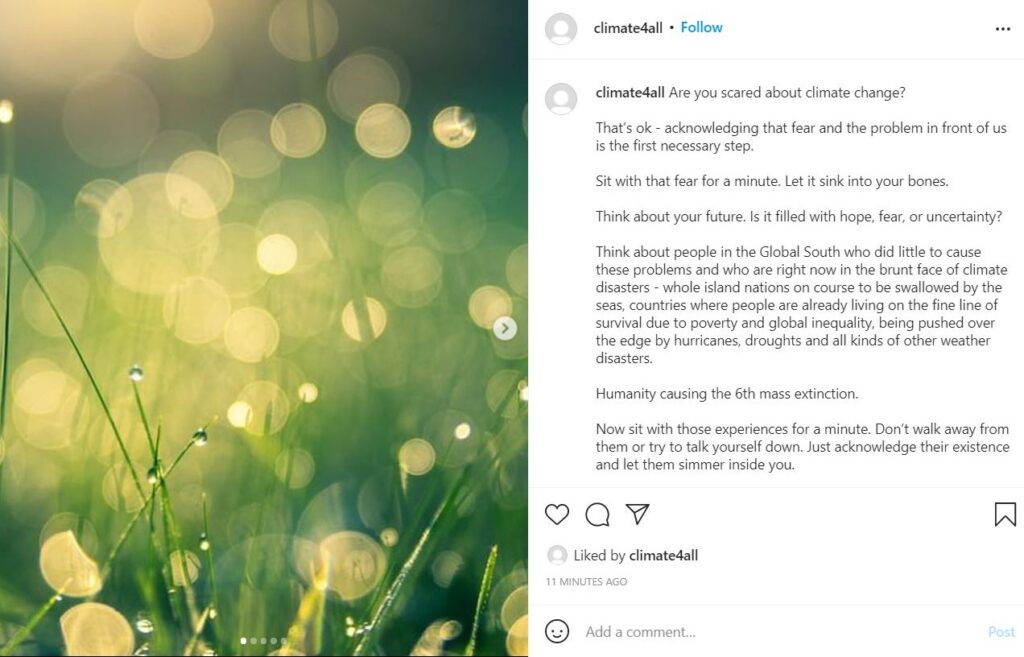
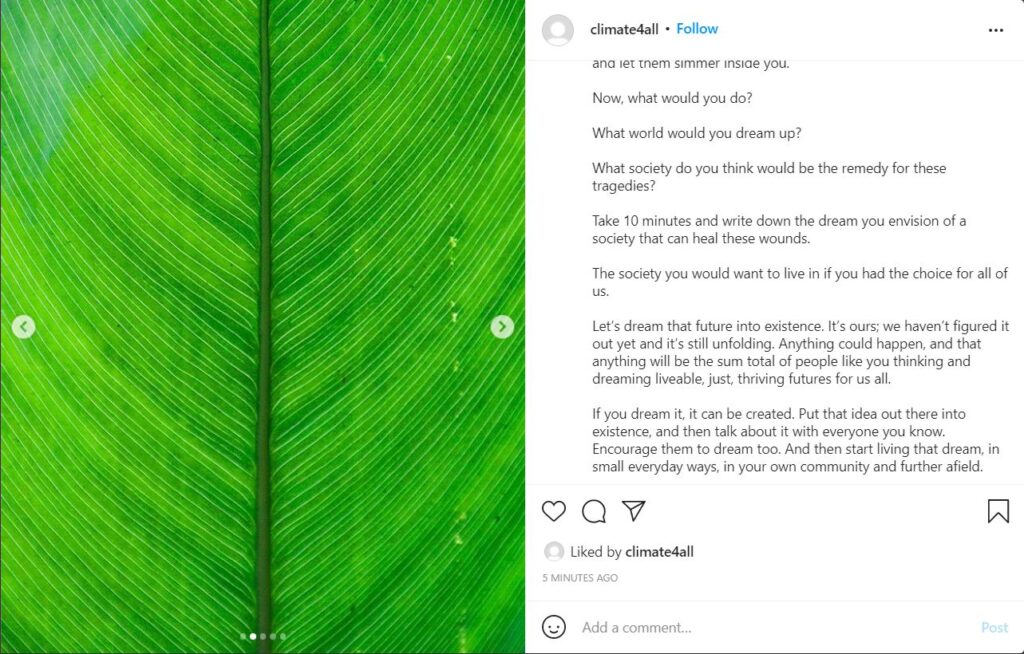
For Assignment 4, my audience is Canadian youth. For my first communications piece, I created an audio recording to be used as a writing exercise prompt in high school classrooms; for my second communications piece, I created an Instagram Post using the same content but in a written/visual format. Although the audience within a high school classroom and on Instagram includes young people representing a range of attitudes and beliefs around climate change, I was particularly focused on those who could be classified as ‘Alarmed’ according to Leiserowitz, Maibach & Roser-Renouf’s report (2009). According to a study involving 10,000 youth in 10 countries, the majority of youth are exceedingly worried about climate change, with almost half of the study’s respondents describing “feelings of fear and worry (about climate change affecting) their ability to function” (Pruitt-Young, 2021). As with Assignment 3, my goal is to elicit my audience’s engagement in climate change activism and in advocating for the rights of citizens in the Global South. I am also continuing with the use of storytelling. However, with the aforementioned youth mental health crisis in mind, I wanted to take a very different approach than I had used for the ‘Concerned’ adults of my previous assignment. Stevenson and Peterson found in their research that adolescents’ levels of engagement in climate change efforts were adversely affected by feelings of despair, but that feelings of concern and even more significantly of hope were powerful motivators for action within this age group (2016). With this in mind, I framed these two pieces with much more optimism, hoping to bolster my audience’s mental resilience and sense of agency while continuing to highlight the realities of citizens in the Global South. The storytelling approach is also being utilized differently with this audience; I thought that encouraging the youth to write their own future stories would have much more potential for empowerment. The hopeful frame for both pieces is inspired and influenced by Part 1 of The Future Earth – A Radical Vision for What’s Possible in the Age of Warming (Holthaus, 2020). Other influences include Hayhoe’s assertion that talking about climate change with those around us is one of the most powerful tools for change (2019). References to the realities of Global South communities are drawn from the IPCC’s Special Report on the impacts of global warming of 1.5°C (Masson-Delmotte et al., 2018), while reference to the sixth mass extinction event is tied to the findings of Ceballos, Dirzo and Ehrlich (2017).

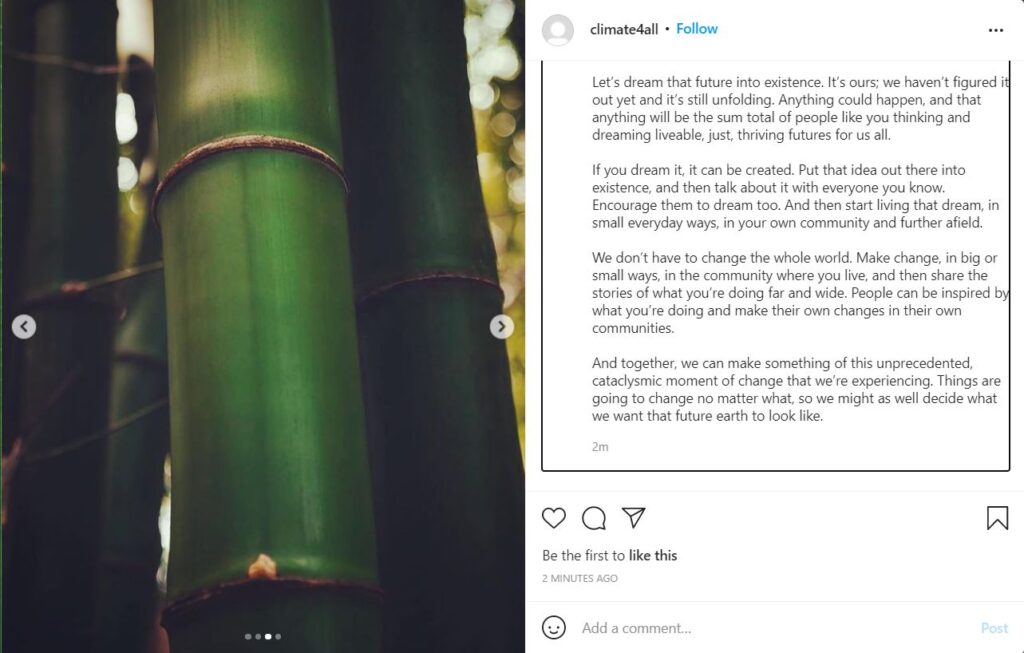
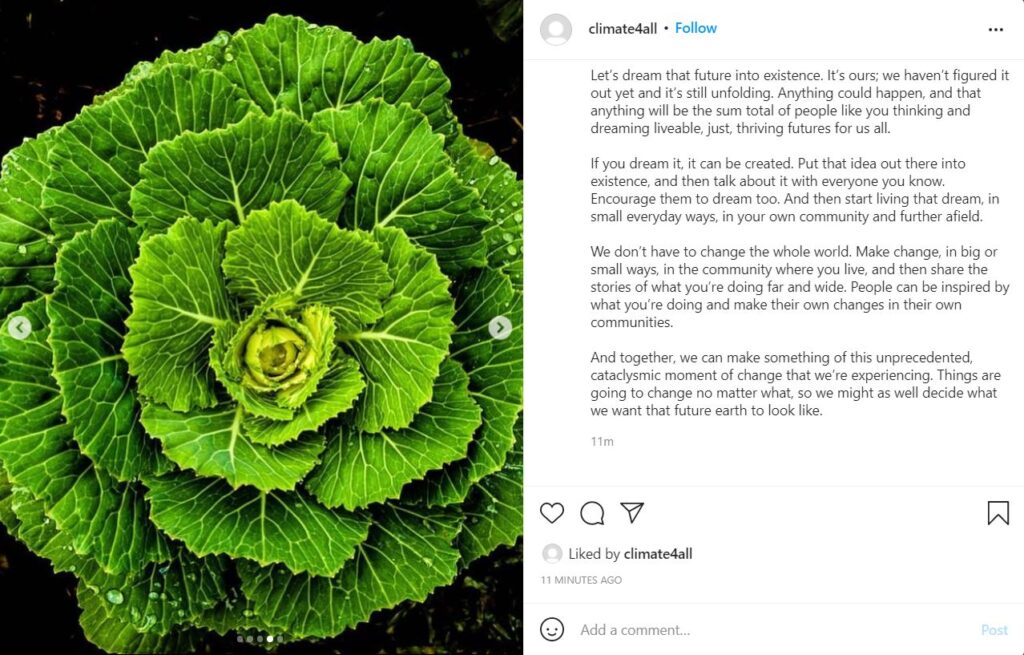
The audio recording for classroom use and the Instagram post provide different options for experiencing the content based on a variety of accessibility considerations as well as audience preferences. In their Design for Diversity™(D4D) framework, Project Inkblot propose the question “Who might you be excluding?” as a path to identifying individuals who may not have access to the products or services you’re crafting (2019). Since the audio recording is being offered as a high school teaching tool, Project Inkblot’s question prompted me to consider accessibility barriers for teenagers who have fallen out of the traditional high school system or who have already graduated. In addition to this consideration, the Instagram Post included Alt-text for those using visual assistive technology. As well, the Instagram post’s images of foliage and various green nature close-ups were chosen to provide a calming visual experience for those suffering from anxiety (London Image Institute, 2020). The audio recording, meanwhile, is accompanied by a transcript for those who are either unable to benefit from the audio option or who are more comfortable reading the text-based version (Rallo et al., 2019). As well, the absence of background noise or any layered sounds in the audio recording was an accessibility consideration for those who have difficulty distinguishing between sounds (Rallo et al., 2019, p. 11).

References:

Ceballos, G.; Dirzo, R. & Ehrlich, P.E. (2017). Biological annihilation via the ongoing sixth mass extinction signaled by vertebrate population losses and declines. Proceedings of the National Academy of Sciences of the United States of America (PNAS). https://www.pnas.org/content/114/30/E6089

Hayhoe, K. (2019). The most important thing you can do to fight climate change: talk about it. TED. https://www.youtube.com/watch?v=-BvcToPZCLI&t=14s

Holthaus, E. (2020). The Future Earth – A Radical Vision for What’s Possible in the Age of Warming. [book] HarperOne.

Leiserowitz, A.; Maibach, E.; & Roser-Renouf, C. (2009). Global Warming’s Six Americas 2009. Yale Program on Climate Change Communication. https://climatecommunication.yale.edu/publications/global-warmings-six-americas-2009/

London Image Institute (2020). Color Psychology: How Do Colors Affect Mood & Emotions? London Image Institute. https://londonimageinstitute.com/how-to-empower-yourself-with-color-psychology/ 

Masson-Delmotte, V.; Zhai, P.; Pörtner, H.O.; Roberts, D.; Skea, J.; Shukla, P.R.; Pirani, A.; Moufouma-Okia, W.; Péan, C.; Pidcock, R.; Connors, S.; Matthews, J.B.R; Chen, Y.; Zhou, X.; Gomis, M.I.; Lonnoy, E.; Maycock, T.; Tignor, M.; Waterfield, T. (Eds.) (2018). IPCC, 2018: Summary for Policymakers. In: Global warming of 1.5°C.  An IPCC Special Report on the impacts of global warming of 1.5°C above pre-industrial levels and related global greenhouse gas emission pathways, in the context of strengthening the global response to the threat of climate change, sustainable development, and efforts to eradicate poverty. World Meteorological Organization. https://www.ipcc.ch/sr15/chapter/spm/

Project Inkblot (2019). How to begin designing for diversity. The Creative Independent. https://thecreativeindependent.com/guides/how-to-begin-designing-for-diversity/?ref=ksr_tci

Pruitt-Young, S. (2021). Young People Are Anxious About Climate Change And Say Governments Are Failing Them. NPR. https://www.npr.org/2021/09/14/1037023551/climate-change-children-young-adults-anxious-worried-study

Rallo, A., Forest, E., Kuo, J., Boutilier, R., & Li, E. (2019). Access Ability 2: A practical handbook on accessible graphic design. Revised + Supersized Second Edition. The Association of Registered Graphic Designershttps://www.rgd.ca/database/files/library/RGD_AccessAbility2_Handbook_2019_06_01(1).pdf 

Stevenson, K., & Peterson, N. (2016). Motivating action through fostering climate change hope and concern and avoiding despair among adolescents. Sustainability8(1), 6. https://doi.org/10.3390/su8010006

Double Content Remix – Audio Recording for High School Classrooms

CALS502 – Assignment # 4

Dreaming Our Futures – Audio Recording for High School Classrooms

The following reflection is being offered as an exercise for high school teachers to play for their students. The exercise would be most appropriately inserted after a unit on the topic of climate change, and/or following class discussions on this theme. Each student will need writing materials (e.g. a pencil or pen and paper). Please allow 10-15 minutes for individual writing time between the two recordings and 30 minutes for group discussion afterwards.

Part 1 – to be played before the writing exercise :

Audio Recording – Part 1 – Dreaming Our Futures

Part 2 – to be played after the writing exercise :

Audio Recording – Part 2 – Dreaming Our Futures

Group discussion:

If the group is open to it, ask if anyone would like to share their stories. Encourage openness and zero critiquing. Follow up with resources for students to explore in relation to some of the ideas they came up with – e.g. organizations they could become involved with in their community, further learning on their areas of interest, etc.

Climate Science, Climate Communication and the Privilege of Bridging the Gap

CALS501 Assignment 4 – Unit 2

Although very different (or possibly precisely because they are), climate science and climate communication are inextricably intertwined. As I moved through the CALS500: Climate Science, Impacts and Services course, communication was the frame on which our learning rested: our assignments largely consisted of translating the science in a way that remained scientifically accurate while making it easier for general audiences to understand. These writing exercises allowed our instructors to assess whether we had understood the material, while at the same time providing essential practice opportunities for us to hone our science writing skills under their tutelage. An important message that I took away from our class discussions was that climate science is very limited in serving a broader audience outside the scientific community without communicators who help to translate the information, making it more relevant and easily understood by non-scientific audiences (personal communication, 2021).

While moving through the CALS500 course, I was aware of the power and privilege I was acquiring as I learned how to understand the science. Prior to taking this course, I lacked confidence and felt ill-equipped to create new content about climate change – I couldn’t move past simply passing on information and even then I was never sure if what I was reading was legitimate or misinformation, so I held back from sharing much. Now I have a new skill set that has been very empowering for me: I understand the technical vocabulary as well as the underlying principles and tools behind climate science and as a result, I can confidently interpret it. I have also been introduced to a wide variety of credible sources to draw from. That said, I now feel in some ways like I’ve joined the ranks of gatekeepers: unless these data interpretation skills and knowledge about which resources are credible is shared, audiences are reliant on a very small number of us to interpret and share the science with them; they are dependent on us and we become curators of information. How can I contribute to reducing that barrier to understanding so that access to this knowledge can be a shared privilege? This reflection leads me to think about my team’s design challenge concept – since our problem statement included a desire to “empower youth to design climate adaptation strategies” (Hunter et al., 2021), how can we help the youth to become their own science translators and communicators, rather than relying on someone like me to be a gatekeeper and conduit for that knowledge?

As I got a taste for the role of communications in translating climate science this summer, in CALS 502 my understanding of the interactions between science and communication deepened as I read in Segel’s article that “science narrative(s) become intuitions and a part of our identity” (2019). How fascinating – and true – that scientific facts become ingrained in our consciousness and embed themselves in the narratives we carry around about who we are, where we come from and where we’re going (Segel, 2019). Science as story is a powerful way to convey science in an accessible way. What Segal describes is masterfully demonstrated in indigenous storytelling practices – indigenous knowledge synergizes science and communication, embedding scientific knowledge into stories in a way that preserves crucial scientific information while making it useful and understandable for different audiences (First Nations Pedagogy Online, 2009). Interesting also that this approach is so intentionally inclusive and accessible: “In oral traditions such as ours, telling stories is how we pass on the history and the teachings of our ancestors. Without these stories, we would have to rely on other people for guidance and information about our past” (Hanna & Henry, 1995, p. 201, as cited by First Nations Pedagogy Online, 2009).

It is abundantly clear that youth need to be engaged more in climate mitigation and adaptation work (Moser 2017, p.10). As Laura shared in the feedback session following our Design Concept presentation during the Intensive, something that is lacking in terms of youth involvement is for youth to be engaged beyond tokenism and simply voicing their concerns, instead empowering them to meaningfully enter decision-making spaces (Hunter et al., 2021). Could focusing on tools and training to help youth interpret the science and to know where to look for reliable information be an important and unmet need to meaningfully empower youth, and is this something my design challenge team could consider? I think the potential for empowerment is all the more potent for indigenous youth, who could harness their indigenous knowledge and scientific understanding in combination to address the wicked problems of this crisis.

References:

First Nations Pedagogy Online (2009). Storytelling. [web content] https://firstnationspedagogy.ca/storytelling.html

Hunter, E., Kippenhuck, C., Paul, A. & Ponette, M. (2021). TeamBraidingInitialConceptPresentation.mp4 [recording]. https://moodle.royalroads.ca/moodle/local/kalturamediagallery/index.php?courseid=8518  

Moser, S., Coffee, J., and Sevile A. (2017) Rising to the Challenge, Together: A Review and Critical Assessment of the State of the US Climate Adaptation Field. Kresge Foundation, 106 pp.

Segel, M. (2019). To fix the climate movement, tell better stories: The missing climate change narrative. Nautilus. http://nautil.us/issue/75/story/to-fix-the-climate-tell-better-stories-rp 

My Town 25 Years in the Future

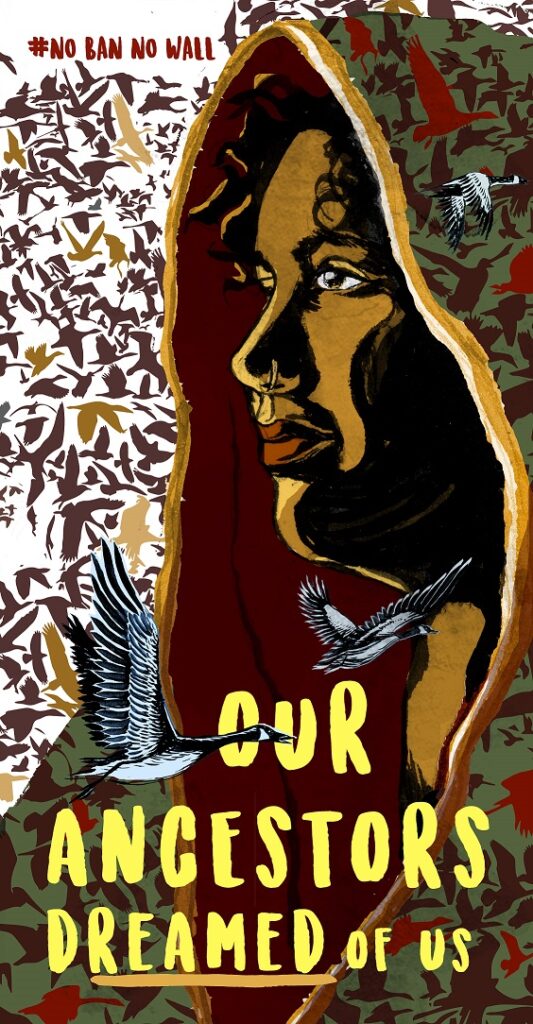
Graphic created by Jess X. Snow and Jordan Alam. Shared with permission.

The lovely fragrance of Virginia Bluebells growing in the nearby shade greets me as I settle into my sit spot. Once a rarity here, as her home became increasingly strange and foreign she found her way northwards, resettling and taking root in a more hospitable place. I nod in welcome to this new one that seems to be thriving here. Latin music wafts across the river as a group gathers for an outdoor bbq at the wheelchair-accessible public docks – our community now includes many Hondurans, Guatemalans and Nicaraguans who joined us after the heat and catastrophic storms of the 2040s made Central America unliveable. Behind them, a few small apartment complexes dot the village skyline – in the 2020s our municipal council changed the zoning to diversify housing options in response to the affordable housing crisis and to urban expansion that has now reached our small town from the nearby metropolis. A buzzing hum sounds faintly on the distant shore and an electric commuter train weaves its way over the hill, slowing to a stop in the village. While it has made our village much busier, most villagers now use public transport to get into the city and urban residents flock to our shores for respite from the city heat and intensity. I hardly ever hear the highway anymore; now it’s the quiet whir of electric vehicles passing by on the road behind me.

From my vantage point on this side of the river, small gatherings of people dot along the river’s edge – come to soak in the sunshine and the tranquillity. When I moved here, the shoreline was monopolized by private properties that stood vacant most of the time while city visitors and locals without waterfront homes had to squeeze into the few public access spots. But since then, the government has grandfathered the right to own waterfront and any new sales have been bought back for public access.

A canoe floats by – public lands have been returned to indigenous governance and the Kitigan Zibi Anishinabeg are stewarding a river restoration program. Among many important programs, the dam upriver has been retrofitted to allow for safe migration of species searching northwards for a new home. I see many locals clearing debris from last month’s windstorm; my power supply is out but I take this moment to have a break from technology.

I close my eyes and feel the warmth of the sun on my face. A lot has changed since I first started this sit spot practice 25 years ago – this place is much busier than it once was, but the gratitude that I felt for this sacred space is now shared with many others and we are working to care for it together.

Home is a Shared Space

Academic citations and connections:

This post uses a gain-framed messaging approach, describing the ways in which my community could be enhanced as a result of climate change (Connor et al., 2016). It is also influenced by Kimmerer’s work, using ‘the grammar of animacy’ when describing the bluebells (2014, p. 21) and responds to her call for more gratitude (2014). The theme of migration and the dismantling of artificial borders and property ownership (the graphic, the movement of people across political boundaries, the dams impeding free movement of animals along the river, public access to the river, respect for indigenous land title and governance) are influenced by indigenous ways of being that have always resisted these constructs. Ben Okri, as cited by Sium & Ritskes (2013, p. 5), points out that stories have the power to make people and nations sick; positive stories therefore can also have the power to heal individuals and societies. I am inspired and empowered to dream that telling the right stories can be a transformative process that slowly reconstructs our collective reality.

(Tiny Ecology Post 3)

References

Alam, J. & Snow, J. X. (2017). Our Ancestors Dreamed of Us [graphic]. Justseeds Artists’ Cooperative. https://justseeds.org/graphic/our-ancestors-dreamed-of-us/

Connor, P.; Harris, E.; Guy, S.; Fernando, J.; Shank, D.; Kurz, T.; Bain, P. & Kashima, Y. (2016). Interpersonal communication about climate change: How messages change when communicated through simulated online social networks. Climatic Change 136(3-4), 463–476. doi: 10.1007/s10584-016-1643-z

Kimmerer, R. W. (2014). “Returning the Gift.” Center for Humans and Nature.  https://www.humansandnature.org/returning-the-gift-article-177.php 

Sium, A. & Ritskes, E. (2013). Speaking truth to power: Indigenous storytelling as an act of living resistance. Decolonization: Indigeneity, Education & Society, 2(1), 1-10. https://jps.library.utoronto.ca/index.php/des/article/view/19626