CALS502 – Assignment #4
Published on: climate4all Instagram
CALS502 – Assignment #4
Published on: climate4all Instagram
CALS502 – Assignment # 4
The following reflection is being offered as an exercise for high school teachers to play for their students. The exercise would be most appropriately inserted after a unit on the topic of climate change, and/or following class discussions on this theme. Each student will need writing materials (e.g. a pencil or pen and paper). Please allow 10-15 minutes for individual writing time between the two recordings and 30 minutes for group discussion afterwards.
Part 1 – to be played before the writing exercise :
Part 2 – to be played after the writing exercise :
Group discussion:
If the group is open to it, ask if anyone would like to share their stories. Encourage openness and zero critiquing. Follow up with resources for students to explore in relation to some of the ideas they came up with – e.g. organizations they could become involved with in their community, further learning on their areas of interest, etc.
CALS501 Assignment 4 – Unit 2
Although very different (or possibly precisely because they are), climate science and climate communication are inextricably intertwined. As I moved through the CALS500: Climate Science, Impacts and Services course, communication was the frame on which our learning rested: our assignments largely consisted of translating the science in a way that remained scientifically accurate while making it easier for general audiences to understand. These writing exercises allowed our instructors to assess whether we had understood the material, while at the same time providing essential practice opportunities for us to hone our science writing skills under their tutelage. An important message that I took away from our class discussions was that climate science is very limited in serving a broader audience outside the scientific community without communicators who help to translate the information, making it more relevant and easily understood by non-scientific audiences (personal communication, 2021).
While moving through the CALS500 course, I was aware of the power and privilege I was acquiring as I learned how to understand the science. Prior to taking this course, I lacked confidence and felt ill-equipped to create new content about climate change – I couldn’t move past simply passing on information and even then I was never sure if what I was reading was legitimate or misinformation, so I held back from sharing much. Now I have a new skill set that has been very empowering for me: I understand the technical vocabulary as well as the underlying principles and tools behind climate science and as a result, I can confidently interpret it. I have also been introduced to a wide variety of credible sources to draw from. That said, I now feel in some ways like I’ve joined the ranks of gatekeepers: unless these data interpretation skills and knowledge about which resources are credible is shared, audiences are reliant on a very small number of us to interpret and share the science with them; they are dependent on us and we become curators of information. How can I contribute to reducing that barrier to understanding so that access to this knowledge can be a shared privilege? This reflection leads me to think about my team’s design challenge concept – since our problem statement included a desire to “empower youth to design climate adaptation strategies” (Hunter et al., 2021), how can we help the youth to become their own science translators and communicators, rather than relying on someone like me to be a gatekeeper and conduit for that knowledge?
As I got a taste for the role of communications in translating climate science this summer, in CALS 502 my understanding of the interactions between science and communication deepened as I read in Segel’s article that “science narrative(s) become intuitions and a part of our identity” (2019). How fascinating – and true – that scientific facts become ingrained in our consciousness and embed themselves in the narratives we carry around about who we are, where we come from and where we’re going (Segel, 2019). Science as story is a powerful way to convey science in an accessible way. What Segal describes is masterfully demonstrated in indigenous storytelling practices – indigenous knowledge synergizes science and communication, embedding scientific knowledge into stories in a way that preserves crucial scientific information while making it useful and understandable for different audiences (First Nations Pedagogy Online, 2009). Interesting also that this approach is so intentionally inclusive and accessible: “In oral traditions such as ours, telling stories is how we pass on the history and the teachings of our ancestors. Without these stories, we would have to rely on other people for guidance and information about our past” (Hanna & Henry, 1995, p. 201, as cited by First Nations Pedagogy Online, 2009).
It is abundantly clear that youth need to be engaged more in climate mitigation and adaptation work (Moser 2017, p.10). As Laura shared in the feedback session following our Design Concept presentation during the Intensive, something that is lacking in terms of youth involvement is for youth to be engaged beyond tokenism and simply voicing their concerns, instead empowering them to meaningfully enter decision-making spaces (Hunter et al., 2021). Could focusing on tools and training to help youth interpret the science and to know where to look for reliable information be an important and unmet need to meaningfully empower youth, and is this something my design challenge team could consider? I think the potential for empowerment is all the more potent for indigenous youth, who could harness their indigenous knowledge and scientific understanding in combination to address the wicked problems of this crisis.
References:
First Nations Pedagogy Online (2009). Storytelling. [web content] https://firstnationspedagogy.ca/storytelling.html
Hunter, E., Kippenhuck, C., Paul, A. & Ponette, M. (2021). TeamBraidingInitialConceptPresentation.mp4 [recording]. https://moodle.royalroads.ca/moodle/local/kalturamediagallery/index.php?courseid=8518
Moser, S., Coffee, J., and Sevile A. (2017) Rising to the Challenge, Together: A Review and Critical Assessment of the State of the US Climate Adaptation Field. Kresge Foundation, 106 pp.
Segel, M. (2019). To fix the climate movement, tell better stories: The missing climate change narrative. Nautilus. http://nautil.us/issue/75/story/to-fix-the-climate-tell-better-stories-rp
The lovely fragrance of Virginia Bluebells growing in the nearby shade greets me as I settle into my sit spot. Once a rarity here, as her home became increasingly strange and foreign she found her way northwards, resettling and taking root in a more hospitable place. I nod in welcome to this new one that seems to be thriving here. Latin music wafts across the river as a group gathers for an outdoor bbq at the wheelchair-accessible public docks – our community now includes many Hondurans, Guatemalans and Nicaraguans who joined us after the heat and catastrophic storms of the 2040s made Central America unliveable. Behind them, a few small apartment complexes dot the village skyline – in the 2020s our municipal council changed the zoning to diversify housing options in response to the affordable housing crisis and to urban expansion that has now reached our small town from the nearby metropolis. A buzzing hum sounds faintly on the distant shore and an electric commuter train weaves its way over the hill, slowing to a stop in the village. While it has made our village much busier, most villagers now use public transport to get into the city and urban residents flock to our shores for respite from the city heat and intensity. I hardly ever hear the highway anymore; now it’s the quiet whir of electric vehicles passing by on the road behind me.
From my vantage point on this side of the river, small gatherings of people dot along the river’s edge – come to soak in the sunshine and the tranquillity. When I moved here, the shoreline was monopolized by private properties that stood vacant most of the time while city visitors and locals without waterfront homes had to squeeze into the few public access spots. But since then, the government has grandfathered the right to own waterfront and any new sales have been bought back for public access.
A canoe floats by – public lands have been returned to indigenous governance and the Kitigan Zibi Anishinabeg are stewarding a river restoration program. Among many important programs, the dam upriver has been retrofitted to allow for safe migration of species searching northwards for a new home. I see many locals clearing debris from last month’s windstorm; my power supply is out but I take this moment to have a break from technology.
I close my eyes and feel the warmth of the sun on my face. A lot has changed since I first started this sit spot practice 25 years ago – this place is much busier than it once was, but the gratitude that I felt for this sacred space is now shared with many others and we are working to care for it together.
Home is a Shared Space
Academic citations and connections:
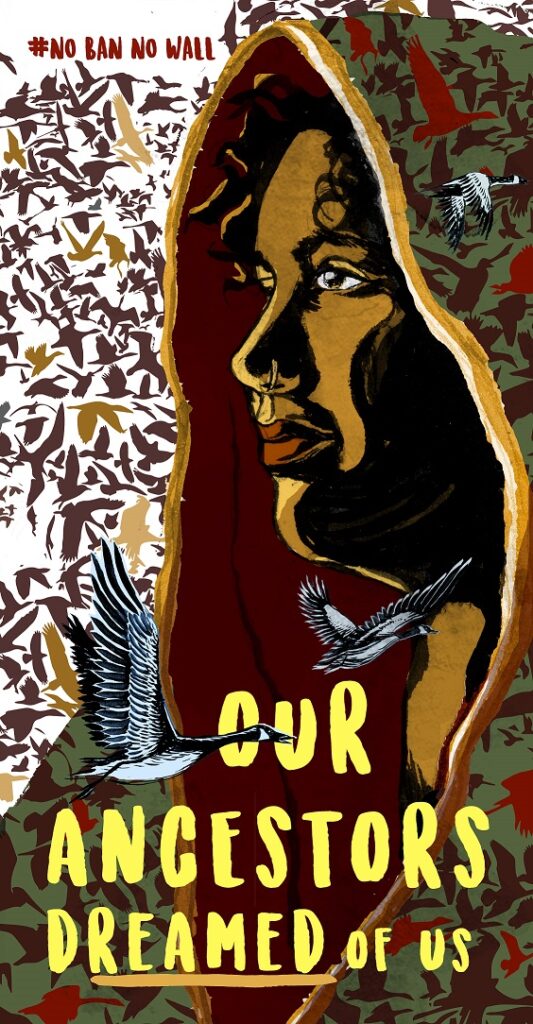
This post uses a gain-framed messaging approach, describing the ways in which my community could be enhanced as a result of climate change (Connor et al., 2016). It is also influenced by Kimmerer’s work, using ‘the grammar of animacy’ when describing the bluebells (2014, p. 21) and responds to her call for more gratitude (2014). The theme of migration and the dismantling of artificial borders and property ownership (the graphic, the movement of people across political boundaries, the dams impeding free movement of animals along the river, public access to the river, respect for indigenous land title and governance) are influenced by indigenous ways of being that have always resisted these constructs. Ben Okri, as cited by Sium & Ritskes (2013, p. 5), points out that stories have the power to make people and nations sick; positive stories therefore can also have the power to heal individuals and societies. I am inspired and empowered to dream that telling the right stories can be a transformative process that slowly reconstructs our collective reality.
(Tiny Ecology Post 3)
References
Alam, J. & Snow, J. X. (2017). Our Ancestors Dreamed of Us [graphic]. Justseeds Artists’ Cooperative. https://justseeds.org/graphic/our-ancestors-dreamed-of-us/
Connor, P.; Harris, E.; Guy, S.; Fernando, J.; Shank, D.; Kurz, T.; Bain, P. & Kashima, Y. (2016). Interpersonal communication about climate change: How messages change when communicated through simulated online social networks. Climatic Change 136(3-4), 463–476. doi: 10.1007/s10584-016-1643-z
Kimmerer, R. W. (2014). “Returning the Gift.” Center for Humans and Nature. https://www.humansandnature.org/returning-the-gift-article-177.php
Sium, A. & Ritskes, E. (2013). Speaking truth to power: Indigenous storytelling as an act of living resistance. Decolonization: Indigeneity, Education & Society, 2(1), 1-10. https://jps.library.utoronto.ca/index.php/des/article/view/19626

I go back to my house for a second sweater before heading down to my sit spot – the weather is colder than I was expecting. When I arrive, fall seems to have been stripped from the trees in a hurry. Two weeks ago the leaves were just starting to turn, but we got a few bright reds, lots of yellows and browns and now many of the leaves have already fallen. It’s okay – I cozy up inside my sweater and settle in to enjoy the wintering activities of the little waterside world around me.
My neighbour’s heavy equipment rules the soundscape today – he’s preparing for winter with home improvement projects before the snow comes (is he using sustainable materials and/or retrofitting for better energy efficiency, I wonder?). Once again, the critters are absent from my sit spot. I wonder if it’s because they aren’t used to me yet, or maybe they’re just too busy preparing for the cold season ahead to be foraging the river’s edge today. One (I believe invasive, just like me) ladybug sits motionless on a wet rock – I think his or her short life might have already departed.
As I cozy up in my sweater and gaze across to the village on the opposite shore, I think warmly of the coming hygge season ahead. I am so grateful for my vibrant, lively, spunky little rural community of activists, artists, farmers and eccentrics. Across the river, I see the local pub where I know my cousins-in-law and their friends will be converging many a night in the coming months. I hope to join them for a few beers and to have some inspiring conversations in the pub’s warm dark glow. We’ll also surely go cross-country skiing: last time we went together, I recall, I had some inspiring conversations with a high-school teacher friend from the community about climate change advocacy and sustainability – both of us being mutually inspired by each other’s important work and dreams. Maybe I’ll also get a chance to sit with a friend who I don’t see often enough in the busyness of the warmer months; we’ll cozy up on her warm living room couch, drinking tea and working on our crafty projects that slowly progress over the winter months. I think about all the climate change and social justice projects that I’ve been contributing to with my local advocacy group too – the beginnings of a food sovereignty, community resilience-building and permaculture-based community garden that I’m co-launching with another volunteer at a local park, the Town Hall on Green New Deal resolutions that our group is hosting just before winter, and the many other advocacy initiatives we’re involved in. Winter will be a time to take stock, regenerate, re-vision and rally forces behind those many initiatives. I hope the extra time indoors and contemplative nature of the cold season will find us more prepared and stronger come springtime. While some of these projects will be lending crucial support to larger provincial, national and international initiatives, I hope that our local projects will lead to our membership expanding and to a strengthening of our community’s social fabric that will help us to weather the storms ahead. This winter is forecasted to be a very snowy one too – I’m confident that my neighbours and I will rally together no matter the obstacle and dig ourselves out of any situation. Each season has its advantages, each challenge has its silver lining; we will all have the opportunity to grow and move through adversity together.
Academic citations and connections: While Connor et al.’s research findings pointed towards gain-framed messages on the themes of competence, communality and development being less propagated in the long-term on social media than loss-framed messages on the topics of nature and health (2016, p. 469), I chose to frame my post using a gain-framed format on the topics of communality and competence. I found Connor et al.’s discussion compelling, when they explained that although less conventional messages initially have a stronger impact on the reader, they are less likely to be passed on beyond the first share because of societal normative pressures and also because it can be challenging to find the words to express less conventional messaging (2016, p. 471-472). As well, in their closing statement they suggested that climate change communicators could play an important role by normalizing those less conventional messages, bringing them into the mainstream and ultimately making them more shareable (Connor, 2016, p. 473). For those reasons, I am inspired as a climate change communicator to share those messages more often, in an effort to diversify the pool of positive and effective messaging being shared in social media. In this writing, I also attempted to follow the five storytelling traits proposed by Downs (2014) and Green et al. (2018) as cited by Bayer and Hettinger: my purpose was to respond to the prompt and instructions provided for this assignment by sharing a personal experience with detailed descriptions inspired by my five senses (2019, p. 5). I hope that my experiences of winter life in this part of the world, the positives of that season for me and some of the other personal experiences that I shared are relatable to some of my readers (Bayer & Hettinger, 2019, p. 5). My concluding question, after reading Bayer and Hettinger’s work is: how might I engage my community in a conversation on some of the topics I shared in my post (2019)?
(Tiny Ecology post 2)
References
Bayer, S., & Hettinger, A. (2019). Storytelling: A natural tool to weave the threads of science and community together. Bulletin of the ecological society of America, 100(2), 1-6. https://doi.org/10.1002/bes2.1542
Connor, P.; Harris, E.; Guy, S.; Fernando, J.; Shank, D.; Kurz, T.; Bain, P.; Kashima, Y. (2016). Interpersonal communication about climate change: How messages change when communicated through simulated online social networks. Climatic Change 136(3-4), 463–476. doi: 10.1007/s10584-016-1643-z

On my third visit to my sit spot, the river is finally calming down, settling into a peaceful stillness that balances her ever-flowing energy.
The shoreline is re-emerging, I smell algae drying out on the driftwood, enjoy the pattern of vibrant fall leaves nestled and protected in a natural cavity, bathed in sunlight, hear the waves gently lapping and feel the whispering breeze on my cheeks.
My first two visits, I felt a pressure to ‘see’ the creatures of this space – I know the community of creatures up around my house well, but I wanted to meet this community, find out who they are and find out more about them. This time, realizing that I wasn’t truly relaxing into this space or this process, I let go of that goal and expectation to ‘see something’ and instead surrendered to what the land has to share with me, what is calling me in this place. I closed my eyes and listened to the wind, the lapping waves, felt the breeze on my cheeks, heard the rapids in the distance and submitted to the land’s wisdom.
I feel at one with the sparkling warm sun. The wind, river, sun, breeze and the land – the plants, rocks and driftwood – feel like elders with a quiet wisdom. The animals and insects feel like friends, sharing this space with me.
Above all, it’s the wind that brings me back to my center – the sound and the feel of it unravels me and reconnects me with myself and the land.
In the spiritual tradition I was raised with, I was never taught who I was connecting to or with (as an international multi-faith organization, it was open to each practitioner’s interpretation). But for me, it always felt like a connection to all things, to everything on the planet and in the cosmos. A combined energy or collective wisdom, greater than, interconnected with all, eternal.
Growing up in a society and culture that, to quote Bartlett, Marshall and Marshall, has spent “decades of diligent efforts … scrub(bing) spirituality and religion out of ways of knowing” (2012, p. 332), coming into this program and course with its strong grounding in indigenous ways of knowing that are inextricably intertwined with spirituality, and being asked to share from my own background and place of knowing, has been an interesting challenge. I’ve trained myself over decades to avoid this subject and to talk about my experiences without referencing spirituality. But with this sit spot and a call to engage with place and nature, as well as to speak with my authentic voice, it’s impossible not to share about my spiritual connection and experiences. Iseke shares the Elders’ perspective that there is “resistance to spiritual practices and distancing from these practices” and that our “out-of-balance lives are due to our lack of relationships to environment, community, and spiritual practices” (p. 572). While I understand their words were likely intended for indigenous peoples as they also called attention to the devastating influences of religion on indigenous communities, these words ring very true to my own life as well. I agree with the Elders that our lack of community, spirituality and relationship with the environment is a very deep cause of sorrow, loneliness, disconnect and sickness on all levels – emotional, physical, mental – in my settler society. Spiritual connection, which for me is a connection to nature and the world around me, is an endless source of inspiration, wisdom and fulfillment for me. It fills me up and makes me feel thankful at every moment. As Kimmerer says, “naming and appreciation of the gifts that surround us creates a sense of satisfaction, a feeling of ‘enoughness’” (2014, p. 20) and Young describes the benefits this connection-building experience with the world around us as bringing us more: “love, aliveness, presence, vision(), empathy, focus, vitality and happiness” (2020).
Kimmerer crucially asks of us “What is our gift?” (2014, p. 23) How can we enjoy the wonderful benefits of the Earth while also giving her back gifts of our own, living in the abundance of reciprocity? So what is my gift? To this space that I am beyond lucky to call home, that I am in reverence of, one of the gifts that I am compelled to pass on is the wisdom of Kimmerer and Young, the words of the Elders who shared in Iseke’s research and the many other gifts of learning that I’ve received in this program so far. Connor et al describe messaging focused on environmental degradation and negative health effects for humans as being the more conventionally accepted messages at the moment, while other messages, including positively-framed ones, are less normalized and therefore less ‘shareable’ on social media (2016). As concluded by Connor et al., there is a need for climate leaders and communicators to normalize these less conventional messages so that they can be adopted by the mainstream (p. 473). The questions that remain for me are how to make a change in this space – at a time when spirituality is often the focus of horrific news, skepticism and rejection, I am challenged by the idea of how to share my own authentic experiences as well as elevating Kimmerer’s calls to gratitude, to paying attention and to the spirituality in all things. These messages are so important to share and to tell, to invite others into these practices that are so healing and transformative. To quote Kimmerer once again: “While we race around asking how we might change technology or tax structures, the change that might save us goes unspoken: what we need to change is ourselves” (2014, p. 22).
(Tiny Ecology post 1)
References
Bartlett, C., Marshall, M., & Marshall, A. (2012). Two-Eyed Seeing and other lessons learned within a co-learning journey of bringing together indigenous and mainstream knowledges and ways of knowing. Journal of Environmental Studies and Science 2, 331-340. DOI:10.1007/s13412-012-0086-8
Iseke, J. (2013). Indigenous storytelling as research. International review of qualitative research 6(4), 559-577. DOI:10.1525/irqr.2013.6.4.559
Kimmerer, R. W. (2014). “Returning the Gift.” Center for Humans and Nature. https://www.humansandnature.org/returning-the-gift-article-177.php
Young, J. (2020). Repairing emotional isolation by reawakening deep nature connection. TEDxTalks. https://www.youtube.com/watch?v=QMWSvUp0CYk&t=476s
Assignment 2
The purpose of this article is to analyze a published communications piece, assessing its effectiveness against my chosen set of evidence-based techniques for effective climate change communications. The subject for my analysis is a free, publicly available news article from the Science section of CBC’s website entitled ‘How many climate disasters will today’s children face? Scientists release estimate’ (Reuters, 2021). This news article shares highlights from a recent report comparing the number of climate change-related extreme weather events for children born last year as compared to children born in 1960.
As Canada’s national public broadcaster with a digital reach of 18.2 million visitors in 2019-2020, the CBC aims to “be varied and comprehensive, providing a balance of information, enlightenment and entertainment for men, women and children of all ages, interests and tastes” (CBC/Radio-Canada, 1994). As a Crown corporation, the CBC attempts to be trustworthy and unbiased (Fenlon, 2021) and to offer a wide spectrum of opinions and perspectives representative of Canada’s multilingual, multicultural as well as politically and geographically diverse population (CBC/Radio-Canada, 2020; CBC/Radio-Canada, 1994). Although I found no information about audience focus for their online News/Science section specifically, as the data from a US-based survey suggests, newspapers including online versions have an adult readership of varying ages (Conaghan, 2017). As well, although CBC broadcasts youth programming, they have specific products and services dedicated to younger audiences (CBC/Radio-Canada, 2020). For these reasons, I would infer that this particular article was aimed at a large, dispersed Canadian adult audience of all ages with varied political leanings, worldviews and opinions. Due to the specific focus on children, I would argue that this article might also be geared particularly towards parents, adults young enough to identify with the decades being researched and other adults concerned with children’s welfare (e.g. teachers).
| 1. Use a Trusted Source | ||
| Using a trusted source is a recommended technique to overcome information overload (Hodson, 2019, p.3). Hodson asserts that trusted influencers, defined by “the influence of the person or organization delivering the message” are an important aspect of successful climate change communication (2019, p.4). He explains that these sources can help audiences to overcome information overload by (helping) people to filter the wealth of information they are exposed to on a daily basis” (2019, p.4). In their tips for general audiences as related to message framing, Dupar, McNamara & Pacha recommend using authoritative, trusted sources for message content (2019, p. 17). | ||
| 2. Provide options for audiences to participate and lend support | ||
| Providing options for audiences to participate and lend support is a technique used to address the critical climate communication challenge of “transitioning (audiences) from awareness and concern to action” (Moser, 2016, p. 345). Moser explains that while providing information to increase awareness and explain the climate science is still needed, this approach must always be accompanied by efforts aimed at “enabling and empowering action”, by providing options for participating and lending support that audiences can choose from (2016, p. 351). | ||
| 3. Focus on the positives and share hopeful solutions | ||
| Focusing on the positives and sharing hopeful solutions is an evidence-based technique that can help to counter the key climate change communications challenges of overwhelm and hopelessness (Moser, 2016, p. 345) as well as empower audiences and inspire them to take action. Hodson (2019) recommends empowering audiences by “avoiding fear-based appeals (and) focusing on the positives” as well as fostering concern and hope” (p. 5). In their communication framing tips for general audiences, Dupar, McNamara & Pacha suggest: “Show the power of positive solutions. People don’t want just bad news, they want inspiration!” (2019, p. 17). | ||
| 4. Use storytelling and narrative formats | ||
| Storytelling is a fundamental and powerful tool for indigenous communities; among its many applications it is used to inform, motivate, as well as inspire empathy and solutions (COP23fj, 2018). For example, the Talanoa Dialogue is a storytelling approach centered around three powerful and transformative questions: “Where are we now? Where do we want to go? How do we get there?” (COP23fj, 2018). Hodson also cites narrative formats as an important technique for increasing audience engagement (2019, p.2). Moser’s research indicates that storytelling and narrative approaches are becoming increasingly prioritized in climate change communication (2016, p. 350). Among Dupar, McNamara and Pacha’s framing tips for general audiences, they propose finding “the ‘human interest’ stories… people’s own words about their own experiences – that tell how climate change has negative impacts and undermines development progress. By reporting the stories of affected people … you give your audience something they can relate to” (2019, p. 17). |
What follows is my analysis and assessment of the article in relation to the above-listed techniques.
Hodson identifies ‘information overload and message fatigue’ as important challenges in climate change communication (2019, p. 3) and I think that in this regard, the CBC is in an advantageous position to reach audiences effectively. Since audiences often turn to more traditional information sources when experiencing information overload (Hodson, 2019, p. 3), the CBC’s longstanding position as our national public broadcaster with rigorous standards for transparency, trustworthiness and neutrality (Fenlon, 2021) puts it in a unique position in terms of audience trust. Moser’s stance on traditional news sources is more nuanced, describing the shift from their clear position as ‘leading influencers’ towards audiences perceiving them as increasingly politicized and polarized echo chambers (2016, p. 350-351). That said, I think that the CBC’s aforementioned standards around neutrality help it to maintain relative credibility in today’s tenuous and divided media landscape.
Another strength of this article is that it was based on information from a report by Save the Children. Since NGOs are among the trusted sources that audiences rely on (Schäfer, 2012 as cited in Hodson, 2019, p. 6), I infer that by sharing information from an aid agency such as Save the Children, the article does well in fostering its audience’s trust.
2. Provide options for audiences to participate and lend support
As stated by Moser: “It is now widely recognized that actions and practical support must be a central part of all climate communication, not necessarily in a prescriptive fashion, but options should be discussed and audiences must see and feel empowered to choose viable options” (2016, p. 351). The article presented data from the Report and testimonies from children and youth who had experienced climate-related disasters, but failed to provide any concrete suggestions for ways audiences could act or lend support to the crisis being presented. I think it would have been more successful in its attempts to engage and inspire audiences had there been a balance of content to elicit not only concern but also hope and empowerment, with options for ways the audience could lend support.
The article ends with one indirect call to action, with some interviewees from the Report encouraging other youth to “pressure governments to change” and an interviewee sharing that she “really want(s) to see world leaders take action” (Reuters, 2021) – perhaps in connection to the article’s earlier reference of the upcoming COP26 talks. However, since the article is geared towards an adult audience, it would have been more effective if a linkage could have been made with concrete steps that parents and other adults could take to rally behind the youth’s demands. For example, the article could have ended with some links to forums and organizations collecting public input leading up to COP26.
3. Focus on the positives and share hopeful solutions
Another area where I argue that this article falls short is in its exclusive focus on fear-based messaging. The article focuses almost exclusively on alarming future projections and heart-wrenching testimonies from children who have experienced climate-related disasters and fear for their futures. I imagine that the intention behind this approach was to elicit the audience’s concern and, considering the urgency of the crisis and the levels of engagement needed from every level of society, one would hope that its aim was also to inspire action. Although it is necessary to share the facts and elicit concern among audiences, research has shown that overwhelm and hopelessness are critical challenges and so sharing positive messages and hopeful solutions can be a powerful technique to mitigate those emotions (Moser, 2016, p. 245). For these reasons, I consider this article to have failed in terms of audience engagement, by focusing exclusively on alarming facts and tragic testimonies without any counterbalancing of hopeful or solutions-oriented messaging. Parents, younger adults as well as any other readers with personal ties to children would understandably be deeply affected by the sobering and alarming facts shared in this article and had it followed that information up with some optimism and solutions, it could have been an inspiring opportunity for audiences to shift their perspective and/or take action.
4. Use storytelling and narrative formats
“Narrative develops from both data and emotions, which is significantly more effective in engaging a listener than data alone (Dahlstrom 2014, cited by Bayer & Hettinger, 2019). Additionally, sharing stories connects us to one another. When we convey both information and our personal experiences through storytelling, our listeners begin to connect what they hear to their own lives” (Downs 2014, cited by Bayer & Hettinger, 2019).
Storytelling could have been a very effective technique for the subject matter of this article, since children’s welfare is a topic that is easy for many adults to engage with and relate to. The article did include emotional testimonies and direct quotes from children who were victims of climate-related disasters, and I consider this to be moving in the right direction in terms of using storytelling as a means to engage audiences. That being said, the quotes were too short to really hear the children’s stories and I argue that the article would have been more engaging if it had shared a more complete picture of their experiences.
On the basis of defending human rights, encouraging Canadians to think globally and to amplify the voices and realities of those on the frontlines of the climate crisis, I appreciated that this article focused on stories from other parts of the world. That being said, research points to the power of local stories to help individuals understand and respond to climate change (Krauß & Bremer, 2020). A more effective approach might have been to share the testimonies of children who have experienced climate-related disasters overseas, but to then relate those stories to children in Canada by providing statistics on the likelihood of our children experiencing similar disasters in the future. I think this approach might have helped audiences to empathize with the testimonies and to visualize the children in their lives going through similar experiences.
In addition to a few images of children experiencing climate-related disasters overseas and an image of young climate activists, the article also includes a video report on the global student climate strikes, including some interviews with youth from the US (CBC, 2019). Apart from the short testimonies from Canadian youth at the beginning of the report, this video seemed completely unrelated to the content of the written article. It was dated from two years ago so had no connection to current events or the Report from Save the Children; instead, the video focused on public reactions to Greta Thunberg and the 2019 Global Climate Strikes as well as a discussion and commentary on teens’ mastery of social media communications. I found the focus condescending – I think it would have been more appropriate to spotlight the youth’s demands rather than congratulating them on their social media prowess. Perhaps more significantly, it was a missed opportunity to provide a video of something more relevant to the Save the Children Report, COP26 and/or the recent IPCC findings. This could have also been an opportunity to use a storytelling approach by sharing a more in-depth story from one of the article’s interviewees, and/or to tap into audiences’ shared values by interviewing parents in Canada and hearing how this information makes them feel about their children’s futures.
In conclusion, based on my analysis and in terms of the list of techniques I chose to assess it against, this article was largely unsuccessful in engaging its target audience in a meaningful and impactful way. As a trusted source in a time of information overload that caters to a wide audience with many concerned parents, young adults and others either personally or indirectly set to experience the projections that were shared in the report, I think the CBC missed an exceptional opportunity. The very relatable, important and emotional subject matter of this article could have connected climate change in a meaningful way with Canadians’ lives, engaged with their emotions and values, and inspired action. Had there been a better balance of alarming data and emotional testimonies with some hopeful or solutions-oriented messaging, had the testimonies been expanded into more complete stories and linkages made with local realities, and/or had the article provided concrete suggestions for ways audiences could take action, it could have both enlightened and inspired CBC’s readers in keeping with their mandate. More importantly, it could have done a better job of moving its audience in the direction we so desperately need to be headed in.
References
Bayer, S., & Hettinger, A. (2019). Storytelling: A natural tool to weave the threads of science and community together. The Bulletin of the Ecological Society of America, 100(2). DOI: 10.1002/bes2.1542@10.1002/(ISSN)2327-6096.communicating-science
CBC (2019) How teen activists are demanding adults’ attention. [embedded video] The Weekly with Wendy Mesley. CBC.
CBC/Radio Canada (1994). 1.1.1 CBC Mandate. CBC/Radio-Canada. https://cbc.radio-canada.ca/en/vision/governance/programming-policies/programming-mandate
CBC/Radio-Canada (2020). Our Performance – Media Lines – CBC Highlights. Annual Report 2019-2020. [website]. CBC/Radio-Canada. https://cbc.radio-canada.ca/en/impact-and-accountability/finances/annual-reports/ar-2019-2020/measuring-our-performance/performance-media-lines-cbc-highlights
Conaghan, J. (2017). Young, Old and In-Between: Newspaper Platform Readers Ages are Well-Distributed. News Media Alliance. https://www.newsmediaalliance.org/age-newspaper-readers-platforms/
COP23fj (2018). Inspiring Climate Ambition through the Art of Storytelling. [YouTube video] COP23fj. https://www.youtube.com/watch?v=OhYLgsa1KYg
Dupar, M., with McNamara, L. and Pacha, M. (2019). Communicating climate change: A practitioner’s guide. Cape Town: Climate and Development Knowledge Network. Climate and Development Knowledge Network. https://unfccc.int/sites/default/files/resource/Communicating%20climate%20change_Insights%20from%20CDKNs%20experience.pdf
Fenlon, B. (2021). Canadian trust in journalism is wavering. Here’s what CBC News is doing about it. Editor’s blog. CBC. https://www.cbc.ca/news/editorsblog/editor-blog-trust-1.5936535
Hodson, J. (2019). An ecological model of climate marketing: A conceptual framework for understanding climate science related attitude and behavior change. Cogent Social Sciences 5(1), 1-15. https://doi.org/10.1080/23311886.2019.1625101
Krauß, W. & Bremer, S. (2020). The role of place-based narratives of change in climate risk governance. Climate Risk Management 28, 100221. https://doi.org/10.1016/j.crm.2020.100221
Moser, S .C. (2016). Reflections on climate change communication research and practice in the second decade of the 21st century: What more is there to say? WIREs Climate Change May/June, 345-369. https://doi.org/10.1002/wcc.403
Reuters, T. (2021) How many climate disasters will today’s children face? Scientists release estimate. Science section. CBC News. https://www.cbc.ca/news/science/children-climate-change-1.6191898
Throughout my time in the MACAL Climate Science, Impacts and Services course, I’ve been building my climate knowledge and familiarizing myself with credible climate science information sources. Equipped with this information, I would like to share those resources with you and debunk a few common climate change myths:
Myth # 1: The earth has warmed before – it’s a natural cycle.
Short answer: Yes, there have been ups and downs. But this time it’s because of us.
Yes, the earth’s temperature has gone through many ups and downs in the past 540 million years or so: for one thing, our planet has moved back and forth several times through two states known as the hothouse (also called warmhouse or greenhouse) climate and the icehouse (or coolhouse) climate (Green, 2013, as cited in Emanuel, 2020, Chapter 4 video 3). During hothouse periods, the poles were either mostly or completely ice-free and have at times been hospitable for alligators and turtles. Icehouse periods, on the other hand, are characterized by ice at the poles: as you might correctly deduce then, we are currently in an icehouse period. Within an icehouse period, there are also fluctuations in temperature: periods when ice extends over large portions of the continents are known as glacials or glacial periods and we often refer to the last such period as the ice age (although there were in fact several) (Eldredge & Biek, 2010). When those sheets of ice retreat to the poles, the earth moves into an interglacial period, such as the one we are currently in.
So yes, the earth has warmed in the past, but civilization has developed and thrived within an interglacial period of the icehouse climate and more specifically within a particularly stable climatic period known as the Holocene (Emanuel, 2020, p 35). Our civilization is highly dependent on the Holocene’s stable climate to sustain agriculture and ensure adequate food supply for Earth’s population, to mention just one of a host of features that have made the climatic stability of the Holocene both exceptional and critical (Emanuel, 2020, Chapter 8). Because of human activity and CO2 emissions, we are now destabilizing that climate and on a warming path (Emanuel, 2020, p. 20). The Earth has many natural cycles that influence global warming and cooling, but human activities are unequivocally responsible for the current warming (Masson-Delmotte et al., 2021, section A.1). In fact, the earth’s natural cycle would currently have us on a cooling path, were it not for human influence (Emanuel, 2020, p. 20).
Myth # 2: It’s only a few degrees – what’s the big deal?
A 1°C increase in average global temperature is just that – an average. In order for the average global temperature to be one degree higher today compared to the mid 1800s, for example, there will be days and areas of the globe experiencing extreme temperatures that are much higher than a degree above normal, and those unusually high temperatures are often associated with extreme events (Murdock & Tyler, 2019). Certain parts of the globe are also warming faster than others – Canada’s average warming is twice as high as the global average, for example (Bush et al. 2019, p. 5). As well, the ocean takes longer to show signs of global warming than land does and since the average global temperature includes the parts of the globe covered by oceans, the global average underrepresents what we are experiencing on land (Murdock & Tyler, 2021).
Given the current level of warming, the difference of one degree or even half a degree of additional warming also has dramatic repercussions on our climate. To cite a few of the many impacts, as stated in the Intergovernmental Panel on Climate Change (IPCC)’s latest report, the frequency and severity of events such as heatwaves, flooding, droughts and natural disasters such as cyclones are all projected to increase with each incremental amount of warming, “as well as reductions in Arctic sea ice, snow cover and permafrost” (Masson-Delmotte et al., 2021, section B.2).
Myth # 3: Canada is a cold place – we’ll be fine regardless; it might even improve our climate!
While there are a few predicted advantages for Canada with a warming climate, such as a longer growing season and less extreme cold (Bush & al., 2019, p. 5), unfortunately the list of disadvantages far outweighs the positives. As stated in Canada’s Changing Climate Report, the following changes are projected:
In addition to these changes within our own country, however, the impacts of climate change across the rest of the world will have direct and perhaps even more significant impacts on us. For example, agriculture will be impacted in places outside of our borders that we rely on to grow our food. In the US, climate change is projected to cause agricultural losses that currently occur every 20 years to potentially happen every second year (Emanuel, 2020, Chapter 8 – Figure 19). As well, I agree with the magnitude and importance attributed in the following statement:
Political and social destabilization… is perhaps the greatest and least predictable risk incurred by rapid climate change… climate change could have significant geopolitical impacts around the world, contributing to poverty, environmental degradation, and the further weakening of fragile governments. Climate change will contribute to food and water scarcity, will increase the spread of disease, and may spur or exacerbate mass migration (Emanuel, 2020, p.39).
Whether you look at these global impacts from an ethical and social responsibility perspective or consider how it will personally impact you here at home, climate change-related destabilization in other parts of the world will affect us all. This is a global problem and in an interconnected globalized world, we should and must cooperate to find solutions for the benefit of everyone.
Want to learn more? I encourage you to check out the references from this post for more information on these topics.
References
Bush, E., Gillett, N., Bonsal, B., Cohen, S., Derksen, C., Flato, G., Greenan, B., Shepherd, M., & Zhang, X. (2019). Canada’s Changing Climate Report: Executive Summary – Headline Statements. Environment and Climate Change Canada. https://changingclimate.ca/CCCR2019
Eldredge, S. & Biek, B. (2010) Glad You Asked: Ice Ages – what are they and what causes them? Utah Geological Survey. Survey Notes: Vol. 2. Number 3. https://geology.utah.gov/map-pub/survey-notes/glad-you-asked/ice-ages-what-are-they-and-what-causes-them/
Emanuel, K. (2020). Climate Science, Risk & Solutions: Climate Science for Everyone [Online Interactive Module & PDF document]. Massachusetts Institute of Technology (MIT). https://climateprimer.mit.edu/climate-science/
Masson-Delmotte, V.; Zhai, P.; Pirani, A.; Connors, S.L.; Péan, C.; Berger, S.; Caud, N.; Chen, Y.; Goldfarb, L.; Gomis, M.I.; Huang, M.; Leitzell, K.; Lonnoy, E.; Matthews, J.B.R.; Maycock, T.K.; Waterfield, T.; Yelekçi, O.; Yu, R. & Zhou, B. (eds.) (2021). IPCC, 2021: Summary for Policymakers. In: Climate Change 2021: The Physical Science Basis. Contribution of Working Group I to the Sixth Assessment Report of the Intergovernmental Panel on Climate Change. Cambridge University Press. In Press. https://www.ipcc.ch/report/ar6/wg1/downloads/report/IPCC_AR6_WGI_SPM.pdf
Murdock, T. & Tyler, K. (2019). Module 1, Part 2 – Using Future Climate Projections [Recorded Presentation]. Pacific Climate Impacts Consortium. https://www.youtube.com/watch?v=0eXyhJ0HiyI
Skeptical Science. (n.d.). Global Warming & Climate Change Myths. https://skepticalscience.com/argument.php Note: Although the website referenced here is a useful resource, I am not endorsing it as a credible climate science source.
Participating in the Indigenous Ways of Knowing, Being and Leading Circle led by Indigenous Scholar in Residence, Mike Lickers on June 1st was an especially impactful experience for me in the program so far. As Dr. Lickers guided us through a powerful shared experience and called on us to listen deeply, to come to a quiet place and to ‘listen twice as much as talking’ (Lickers, 2021), the result was so much more than a simple transmission of information. I continued to reflect on this exceptional experience when reading Decolonizing transformations through ‘right relations’ (Gram-Hanssen, Schafenacker, & Bentz, 2021). In their article, Gram-Hanssen et al. suggest characteristics of ‘right-relations’ including to “allow oneself to be affected, even transformed, in the process of engaging with the world” (2021). The experience of Dr. Lickers’ Circle felt indeed deeply engaging and affecting. This was not so much surprising for me as it was important, because I agree with Gram-Hanssen et al. that a “… willingness to be affected and altered by the process of reciprocal collaborations is key to imagining de-colonial ways of being” (2021, para 1). In the circle, Dr. Lickers also brought up the Two-Row Wampum Belt treaty between the Haudenosaunee and the Dutch in the early 17th century. As with the first time I had heard about this treaty, Dr. Lickers described the two rows in the Belt that represent the Dutch and the Haudenosaunee, each group paddling their own canoe, sharing the river without imposing their laws or opinions on each other (2021). I deeply and humbly recognize the merits of focusing on this facet of the treaty. Given the relentless and systematic oppression of indigenous cultures by colonial societies and the tendency for settlers (whether consciously or not) to engage in behaviours that “overwhelm and absorb the other into a hierarchical relationship” (Coleman, 2019, p. 67 as cited in Goodchild et al., 2021, p.9), I fully support the need for indigenous peoples and other oppressed groups to protect their identities, culture and knowledge to ensure they are not further violated. That being said, in reading Relational Systems Thinking: That’s how change is going to come, from Our Mother Earth, I was very inspired to learn about the significance of the other three rows in the Belt: “The three white rows … symbolize the ne’skennen (peace), karihwí:iyo (good word or way), and ka’satsténshsera (unified, empowered minds)” (Coleman, 2019, p. 65 as cited in Goodchild et al., 2021, p.8). As described in the article: “The two-row wampum treaty explicitly outlined a dialogical Indigenous European framework for how healthy relationships between peoples from different ‘laws and beliefs’ can be established. Dialogue, says Otto, is not about two parties talking to each other. Dialogue literally means ‘meaning flowing through’” (Goodchild et al, 2021, p.9).
In reading Goodchild et al’s article, I understand the ka’satsténshsera row of the Belt to mean a space or a process by which the travelers in each canoe are affected and influenced by each other. If as a settler society we can do the necessary, extensive and ongoing work of decolonizing our thoughts, actions and systems and approach our relationship with indigenous people with humility, respect, and care, then this third row of unified and empowered minds seems to me to be the ultimate way of being and engaging with one another that we can aspire towards.
References
Goodchild, M. et al., (2021). Relational Systems Thinking: That’s how change is going to come, from Our Mother Earth. Journal of Awareness Based Systems Change 1(1), 75-103 https://jabsc.org/index.php/jabsc/article/view/577/696
Gram-Hanssen, I., Schafenacker, N., & Bentz, J. (2021). Decolonizing transformations through ‘right relations.’ Sustainability Science, (20210507). https://doi.org/10.1007/s11625-021-00960-9
Lickers, M. (2021). Indigenous Ways of Knowing, Being, and Leading Circle. Course activity for the MACAL, RRU, online. https://154.kaf.it.ubc.ca/media/IndigenousCircleMLickers/0_sk9wvwsw/249567