Place and Visual Representation

This post is in response to prompts asking how I would propose a visual format for describing my Tiny Ecology sit spot and what tools I would use. My site is located within my local community park and it’s been helping me to better understand resiliency and the importance of adapting to change. I had been visiting this site frequently for a number of weeks prior to writing this post.

If I were to propose a visual format for documenting this special place, then I would start with one of the first photographs I took at the start of the exercise.

I would share with you the way that I became more connected, not just to a sit spot, but also to the bees and the trees. If we are to reconnect the disconnected to our natural environment and communities, I think the photograph is a great place to start to build empathy as a step towards understanding the importance of climate action.

The Bees and the Trees

A bee hovering over a Magnolia tree flower.
Exploring place and visual representation through the context of
urban planning as a climate change action

What tools would I use and what kind of narrative would I create to tell you a story about some bees, some trees, and the sit spot I think of as my own? I would tell you the story as I would as though trying to reach an urban audience to help them learn more about the importance of urban planning as climate change action. I would orient you to the Vancouver City Parks website where a Google Map customization shows you where the Park Meadows are in the city (City of Vancouver, n.d.).

Google Map with a highlight overtop the location China Creek North which is depicted with a tree symbol. Heading is Park Meadows

By situating you in this meadow, that is the main character of the story, I would then introduce the next character, the bees. I think that the plight of the pollinators is best told through the bees. By now their importance is well known. The challenges facing the pollinators extends beyond the few pollinating visitors to my local park, it’s beyond political borders.  

The Plight of the Pollinators

Photo credit: 20140905-AMS-LSC-033 by USDAgov Public Domain 1.0

I would extend the story to the United States by sharing information from the US Department of Agriculture which has released many photos and information into the public domain for educational purposes. The whole library of images opens to you when you reach into the public domain and the Creative Commons (Merkle, 2019).

I would quickly return to the little park in Vancouver, Canada to help you learn a bit about the different kind of pollinators that are local to British Columbia. I would provide you with a link to the Common Pollinators of British Columbia: A Visual Identification Guide. I would invite you to test your knowledge by seeing if you could find the two different pollinators from my photos above to the ones in the guide. I would try to make it fun, maybe I would add a quiz with the answers written upside down at the bottom of the page.

This return to local framing is important, as it’s been shown to increase engagement in environmental issues (Cambell and Vainio-Mattila, 2003 cited by Altinay 2017). The targeted audience of this blog post is a local city reader. My hope is to increase engagement in the environmental issues of pollinators and shade trees, that are important environmental issues, for which locals could become more involved in, or at least become more informed about.

Video is also a very effective visual tool and by including an educational video, like this trailer for the Hives for Humanity documentary, I would invite you to contemplate their mission

“We connect people to nature, community and themselves AND WE DO IT THROUGH THE BEES.”

Hives for Humanity, n.d.

This would open the story up to broader social issues and bring in the story of the disenfranchised in the city. I would continue in that vein to another urban planning focus, shade trees.

I would invite you to learn about their importance by trying out CBC’s interactive tool which would allow you to enter your postal code and see how your neighborhood ranks in terms of hotness (if you live in Canada) and the role of shade trees in that result.

A visual representation going from red to blue to indicate a range from cool to hotter temperature with lateral arrows going from less to more vegetation.
CBC Hot Neighbourhood Database

I think that the combination of visuals and interactivity is very powerful when it can bring an issue to your local neighborhood. Having set the context for the importance of the shade trees I would continue to share what the result was for my neighborhood and illustrate the sit spot with a map of trees.

Vancouver Street Trees App – Screenshot with tree description pop-up

I would continue on to share with you that that Vancouver has been developing some excellent educational apps, like this one, Vancouver Street Trees app, which I would use to tell you all about my favorite tree in the park, the Raywood Ash, that since 1992 it has lived in growing splendor at the end of the first corner on your way to my sit spot. The minimalist view in the app works well to find a tree on the map, compare the leaves through a photograph, and confirm its identity in a pop-up photo. I think it’s personality shines brighter if you see it in all its glory so I revert to the photograph.

Photograph of a Raymond Ash tree from a spot on a pathway in a city park.

Raymond Ash: Photo credit: Julie Simonsen, 2022

I would use this photo to bring you back to connect with community. I would tell you how this tree stands majestically in a neighborhood of green space lovers and that you can see evidence of this in all the yards up and down the streets around this park. I would tell you how the Community Garden situated here was started by an ecological artist whose art and artful projects have made, and continue to make, a difference. I would invite you to learn more about it’s caretakers, the EartHand Gleaners Society, by inviting you to watch their video Buzzscaping: Building a Pollinator House in Strathcona (EartHand Gleaners Society and Environmental Youth Alliance, 2013).

I would sum up the story by pointing out the importance of Community and ways that people connect through green spaces, art, and hands on natural education and how it’s these connections that can inspire empathy for the natural world. Then I would wrap up by inviting you to share in climate action in your own community.

References and Inspiration:

Border Free Bees and the Environmental Youth Alliance. (July 2017). Common Pollinators of British Columbia: A Visual Identification Guide.

CBC. (2022, July 13). Here’s who lives in your city’s worst heat islands. Retrieved July 25, 2022 from https://ici.radio-canada.ca/info/2022/07/ilots-chaleur-villes-inegalites-injustice-changements-climatiques/en.

City of Vancouver. (n.d.). Pollinator Meadows. Retrieved July 25, 2022, from  https://vancouver.ca/parks-recreation-culture/pollinator-meadows.aspx.

EartHand Gleaners Society and Environmental Youth Alliance (2013, November 2). Buzzscaping: Building a Pollinator House in Strathcona. [Video]. Vimeo. https://vimeo.com/78438493.

Hives for Humanity. (n.d.). Home Page. Retrieved July 25, 2022, from https://www.hivesforhumanity.com/.

ltinay, Z. (2017). Visual communication of climate change: Local framing and place attachmentCoastal Management 45(4), 293-309.

Merkle, B.G. (2019). Writing science: Best practices for the images that accompany your writingEcological Society of America 100(2), 1-7.

United States Department of Agriculture. (2014). Openverse. Retrieved July 25, 2022, from https://wordpress.org/openverse/image/c17a9458-a5b7-4ab9-9ddc-b0349f62f50c/.
The Center of Resilience

This short climate fiction story was written in response to prompts about envisioning my local sit spot twenty years from now and to demonstrate the craft of story. It grew quickly out of a few lines using a story spine from Curiographic.

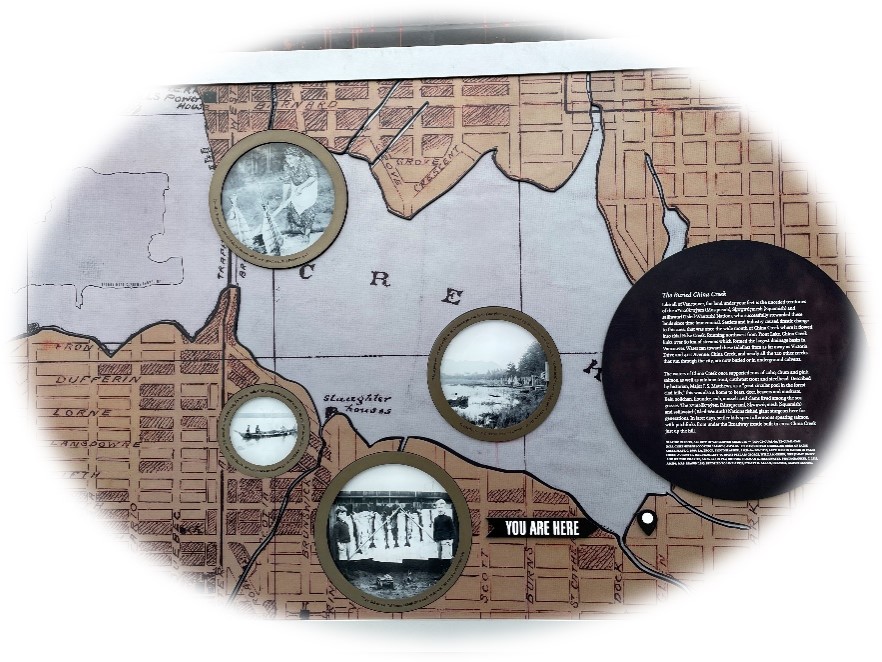
 There’s only one standout winner in the dozens of proposals that came through for the redesign of China Creek North Park. I’m an old timer, a long-time community member, and someone with a self inflated sense of power over the outcome of this process. I’m the president of the local community group and our objective is to see to it that whoever wins the bid for the redesign respects and maintains the history of our place. In ‘The Center of Resilience’ I felt an immediate visceral connection not only to my past park experiences but to much further back to when it had been a gathering place for the Indigenous community. It made me realize that it has always been, and will always be, a center of resilience. Although it sure hasn’t felt that way for some time now, this proposal with the concept of merging community park, health refuge, and Indigenous education centre into one, could change all that.

The historical picture in the proposal transported me back in time to the summer of ’22 when I started my climate change studies. I used to spend so much time just sitting and ruminating during my Tiny Ecology exercises. I remember being asked about this exercise by colleagues at work and how they rolled their eyes and asked how sitting around would help to solve the planetary crisis. This made me feel a bit insecure and I wasn’t quite sure how to respond. But it was during one of those sitting sessions that I finally figured out the fundamental point. It was if one of Huxley’s birds suddenly called out to me: Attention!

“That’s what you always forget, isn’t it? I mean, you forget to pay attention to what’s happening. And that’s the same as not being here and now.”

Island, Aldous Huxley, Ch. 2, 1962

At the time I had no idea just how bad it would get and how fast things would change. We had been looking without seeing for too long already. The course, Communication for Climate Action, helped me to connect with community, nature, and history in ways that I hadn’t anticipated. It had only been a couple of years since the park was redeveloped with pollinator meadows, a nature themed play area for children without destroying the beautiful shade trees along the perimeter.

Families brought their children, young adults brought their dogs, teams came to play their games and there was a walking path with a fitness circuit. They had put in a water fountain and washroom facility at the southeast corner. The City of Vancouver archival photo on the side of the building, the same one used in the proposal, was how I first learned about the indigenous connection.

The Means of Production community garden was located on the Northwest corner at the top of the hill where weavings of willow bordered a well maintained walking path through the various trees and plants that were lovingly cared for by the EartHand Gleaners Society. Intermittently someone living in their van or a tent would show up and camp out for a night or two and strike up a conversation with the locals meandering through on their daily walks.

Then things began to change, and we couldn’t stop the dying. Summer days kept getting hotter and winter days wetter. The pandemics, they kept coming in waves, more and more people were too vulnerable to face the elements of the real world. What was once a vibrant community gathering place became barren. Students young and old stayed home and exercised and played in virtual reality educational regimes.

Not the First Nations communities though. They had resilience, they thrived and grew from the wealth of Indigenous knowledge that they continued to cultivate. This kept them strong and the success of the early reconciliation programs brought them into the realm of consulting to community planners. One of the contributors to the proposal was one of these small consulting groups who claimed affiliation with the Musqueam, Squamish, and Tsleil-Waututh peoples and, they had experienced some recent successes of their work with the MST Development Corporation.

The proposal was unique in that apparently it was dreamt up by a few local employees from the businesses located on the north side of the park. I guess they started to get together in the evenings to hatch a plan. Because they also live in the neighborhood, and everyone’s been affected by what’s been happening. They used their inside knowledge of their companies to draft a proposal, connected with the local Indigenous groups, and held several participatory design sessions. A few of them had enough power in their company positions that they were able to call a meeting of the minds with the Indigenous groups and the Corporate CEOs, and the proposal turned out to solve some of their problems too.

Let’s face it. This proposal is radical with a capital R. The environmental, security, and educational systems are to be controlled by a state-of-the-art Artificial Intelligence (AI) that will be trained by an Indigenous Intelligence Collective. That’s a lot of trust to put into one autonomous AI. Maybe I’m cynical but I’ve seen what Meta, and the Internet, and a steady diet of Capitalism, has done to the typical AI autonomous units. They are mostly mean.

Just look at this picture of the concept for the exoskeleton though! Some crazy design that builds on the parametric design of the Morpheus Hotel by the Zaha Hadid Architects, morphed with the concept of the willow weaving that used to be in the park, but with the strength of bamboo.

That’s not all. There are plans for a synthetic apiary where honeybees will be able to live year-round. Apparently, there’s been a lot of progress since the Neri Oxman synthetic Bee Cube project. There will be education sessions on beekeeping and honey sold at a re-imagining of the neighborhood ‘Farmer’s Market’. So, if we can’t move past our mistrust in autonomous AI then what are we to do with the loss of community? What are we to do with the loss of safe places to go outside the home? How will we afford the cooling and warming centres that we so desperately need now? The proposal describes how, when needed, the park becomes a warming\cooling centre, with first aid available and high speed electric underground transit that connects directly to St. Paul’s Hospital.

The workers behind this proposal really did their homework. That’s why the CEOs are so excited. It’s a state-of-the-art showcase for their technologies and at the same time it allows them to demonstrate their respect for the Indigenous Communities.

It’s hard to believe all these companies exist along the north and east sides of the park but its true. The proposal team included Engineers from the Tesla delivery center, Human Resource Managers from Lululemon, directors from Electronic Arts, Professors and students from both the Vancouver Community College and the Emily Carr University of Art + Design and even some Doctors and Nurses from the new St. Paul’s Hospital down the way. It’s an impressive proposal arising from employee network members who did the first draft on their own time on evenings and weekends.

They held fundraisers so they could hire the indigenous community planning consultants who then agreed to partner on the proposal if their conditions were met. They wanted full control over training the AI and would own the data collected through the operation of the center. Particularly the data collected as the AI interacted with community members as this would form part of the AI’s continuous learning. They also requested that an education program designed around salmon spawning reintroduction programs be included. Maybe we do have an opportunity to break the kids out of their bonds with Meta’s AI.

This proposal brings with it a promise that in our future the community will have the refuge they need, they will have programs to help them become more empathic, and right relations will be restored, in their dealings with one another, and the natural elements around them. A level of empathy and understanding can be awoken and restored from a time before now. They have my vote.

Influences & References

Bridle, J. (2022). Wired – Backchannel. Can Democracy Include a World Beyond Humans? A truly planetary politics would extend decision making to animals, ecosystems, and potentially AI. Wired Backchannel.

Cunningham Bigler, K. 2017. Jumpstart your story with the story spine. Curiographic.

Hayhoe, K. (2018). The most important thing you can do to fight climate change: Talk about it [Video]. TED.

Huxley, Aldous (1962). Island. Aldous Huxley Island. Chapter 2. https://gutenberg.ca/ebooks/huxleya-island/huxleya-island-00-h.html

Kimmerer, R. W. (2014). “Returning the Gift.” Center for Humans and Nature.   (Short web piece)

Segel, M. (2019). To fix the climate movement, tell better stories: The missing climate change narrativeNautilus.

Storytelling. (2009). First Nations Pedagogy.
Withers, D. (2022). Story design: Where storytelling meets design thinking. Narrative Intelligence.

Vancouver Art Gallery. 2022. Imitation Game Exhibition. 14-Zaha-Hadid-Architects-Morpheus-Hotel.

Vancouver Art Gallery. 2022. Imitation Game Exhibition. Neri Oxman and The Mediated Matter Group. Bee-Cubes.