Earlier this year I wrote about transformation in practice, and the opportunities and challenges of bringing together practitioners from across Disaster Risk Management (DRM) and Climate Change Adaptation (CCA) to enable transformative change. As both a practitioner and learner in this space, I see an opportunity for collaboration to help achieve sustainable adaptations that could improve our ability to address climate change impacts equitably.
As part of my studies in Leading Change in the Context of Climate Change, I’m considering whether Complexity Leadership Theory would be a good fit to address this challenge, specifically for practitioners working within the renewable energy sector. The industry is undergoing a significant transition as a direct result of international pressures to reduce Green House Gas (GHG) emissions while also having to adapt to the current and future impacts of climate hazards.
BC’s renewable energy sector plays an important role in mitigating GHG emissions while also needing to adapt to climate change impacts. BC Hydro is a relevant example, being the primary supplier of hydro electricity, and as the owner of critical infrastructure, having accountability to the Province for climate change adaptation.
Recent Provincial announcements illustrate how the energy transition is unfolding within BC’s renewable energy sector (British Columbia, CBC). BC is forecasting a 15% increase in demand for renewable energy by 2030 and as a result BC Hydro is planning to put a call out for renewable energy providers in early 2024 (British Columbia, 2023). In parallel, the Provincial government is providing $140 Million for Indigenous-led power projects. As part of this Clean Energy initiative BC Hydro has created a special task force focused on enabling new power project opportunities (British Columbia, 2023). This is a big change for an electric utility that requires stability to ensure a reliable source of electricity to customers. It also makes complexity leadership theory worth considering because it addresses the challenges that come with crossing leadership styles of Operations and Entrepreneurial systems by bridging with Enabling leadership (Uhl-Bien & Arena, 2017).
The role of renewable energy practitioners with responsibilities for DRM and CCA functions are key. A recent report from the IPCC highlights the need to navigate through adaptation and mitigation options, balancing climate actions, to meet sustainability goals (Schipper et al., 2022, P.2666). Further, the 2018 British Columbia Auditor General report on Climate Change, highlighted that managing climate change includes both adaptation, to reduce harm, and mitigation, to reduce emissions, and that the Province was not adequately managing the risks posed by climate change (AGBC, 2018).
Given that the challenge exists within the renewable energy space requires considering that established power producers are by necessity, operational, ordered systems. Electric power systems are considered critical infrastructure, meaning that it is essential for the functioning of society and the economy (OAGBC, 2019). Service disruptions, including those caused by climate hazards, can have catastrophic effects to the communities that energy utilities serve. While an individual home might see a disruption as an inconvenience, a large grid failure could cascade through communities and cause widespread outages with higher potential for catastrophic damage. For this reason, the industry is highly regulated by the North American Electric Reliability Corporation (NERC) standards.
Driven by the need for increased renewable energy sources to combat reliance on fossil fuels, BC is introducing an entrepreneurial model which introduces uncertainty. This change brings an organizational challenge of working across operational and entrepreneurial spaces, where research has shown a need to act as complex adaptive system (Uhl-Bien & Arena, 2017). This makes the Complexity Leadership model a good fit because it works with the tension that occurs between ordered and entrepreneurial systems (Uhl-Bien & Arena, 2017).
According to Uhl-Bien & Arena, order is the enemy of adaptability and can stifle the organizational dynamics needed to effectively respond to complexity (2017). Further, “organizations that enable an adaptive response do not turn to a top-down approach. Instead, they engage networks and emergence” (Uhl-Bien & Arena, 2017, P.10).
Organizations that enable an adaptive response do not turn to a top-down approach. Instead, they engage networks and emergence”
Uhl-Bien & Arena, 2017, P.10
The benefit of the Complexity Leadership Model is that it brings together Operational, Entrepreneurial, and Enabling leadership styles. While operational leaders are well established within the sector, the new business model that is being introduced will bring entrepreneurial leaders with it. This is demonstrated by the creation of the BC Hydro Task Force with the strategic priorities of
- Improving the speed of permitting and delivery of required infrastructure
- Modernizing regulatory framework to better align with government priorities while protecting rate payers
- Identifying, enabling and accelerating economic opportunities for clean energy.
What may be missing is the enabling leadership and adaptive spaces that are needed to link people and ideas from across these spaces to support emergence and to help changes stick. “Emergence is the creation of a new order that happens when agents (e.g., people, technology, information, resources) in a networked system combine together in an environment poised for change to generate the emergence of something that did not exist previously” (Uhl-Bien & Arena, 2017, P. 10).
A potential incubator for an adaptive space exists within organizations that have functional managers from across areas of the business who have DRM or CCA responsibilities included as one part of their operational leadership role.
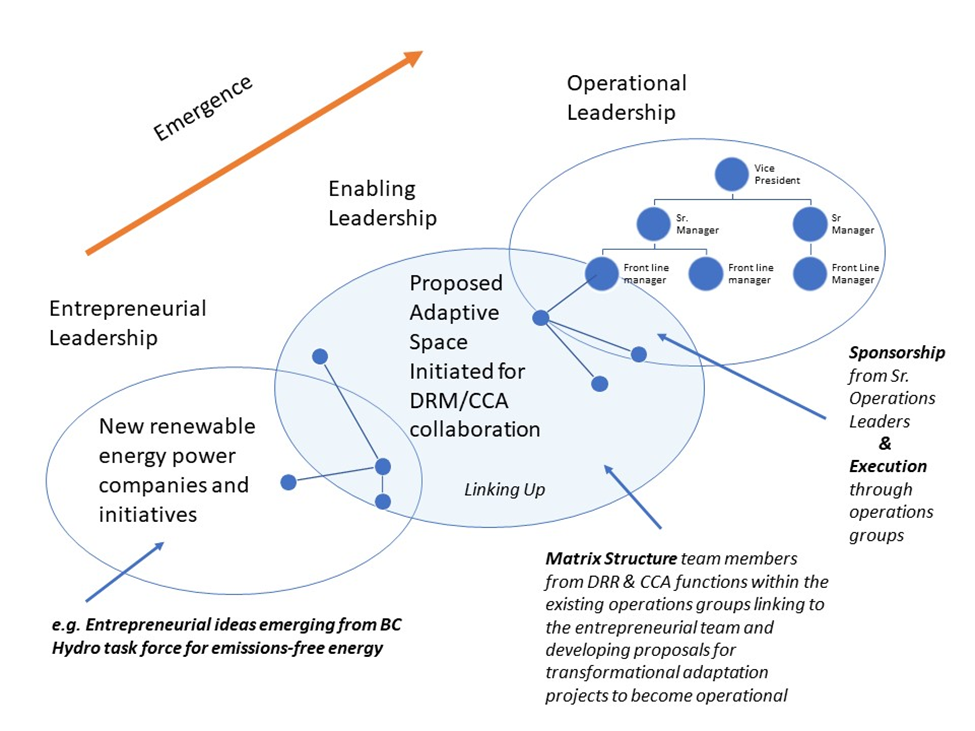
Figure 1 demonstrates how the complexity leadership model could be applied by creating an adaptive space within existing renewable energy organizations, starting with team members with responsibilities for DRM and CCA functions. This is where the enabling change leader comes in who can start in the fertile ground of shared purpose that exists between DRM and CCA and open an adaptive space for transformation ideas to take hold which could be operationalized through strengthening connections across leaders in the Entrepreneurial and Operational spaces. CCA is relatively new when compared to DRM and integration of capabilities across the practices are typically not well developed, though they share many commonalities (NIRAS, 2021). This brings additional challenges for the enabling leader.
By working across communities and establishing a goal of sustainable development, the enabling leader can engage senior operational leaders to request sponsorship of proposals emerging from the adaptive space. These ideas would have already been socialized through managers with whom they lead, and presumably trust, facilitating the progression of transformative ideas into sustainable, equitable climate solutions.
To illustrate potential outcomes from this model, one can look to examples of the clean energy initiatives of transitioning reliance on diesel fuel to micro grids, such as the one for the remote Indigenous community of Xeni Gwet’in (British Columbia, 2020). The initiative supports both a reduction in GHG emissions as well as the resilience of the community by providing 24/7 power and local reliability for the community to withstand climate change induced outages. With the introduction of additional power supplied through renewable sources such as wind, solar, and even ocean energy options, there will be new opportunities to explore transformative adaptations. This model builds on the concept of complex adaptive systems that can be found in nature, such as in bee colonies, where highly productive pollinators operate on simple rules and networked interactions (Uhl-Bien & Arena, 2017). Learning from nature, using the Complex Leadership Model for structure, perhaps it’s time for the creation of a Hive for Climate Action, opening space for cross pollinating ideas, and creating linkages to help emerging transformative adaptations stick.
References
British Columbia. 2020, Jun. 18. Province supporting Xeni Gwet’in First Nation transition to clean energy. News Release. https://archive.news.gov.bc.ca/releases/news_releases_2017-2021/2020EMPR0019-001084.htm
British Columbia. (ND). Land Use – ocean energy. https://www2.gov.bc.ca/gov/content/industry/crown-land-water/crown-land/crown-land-uses/clean-energy/ocean-energy#:~:text=British%20Columbia%20has%20significant%20ocean,Projects%20that%20exceed%2050%20megawatts
British Columbia. (2023, Jun. 15). BC Hydro Task Force. [web page]. https://www2.gov.bc.ca/gov/content/governments/organizational-structure/ministries-organizations/crown-corporations/bc-hydro-and-power-authority/bchydrotaskforce#about
British Columbia (2023, Jun. 15). Clean Power to electrify B.C.’s future. News Release. https://news.gov.bc.ca/releases/2023EMLI0036-000941
CBC News. 2023, Jun. 15. B.C. Hydro set to launch search for new, clean electricity sources. https://www.cbc.ca/news/canada/british-columbia/b-c-hydro-search-new-electricity-sources-1.6877920
IPCC. (2022, Dec.). Sixth Assessment Report. Working Group II – Impacts, Adaptation and Vulnerability: Fact Sheet – North America. https://www.ipcc.ch/report/ar6/wg2/downloads/outreach/IPCC_AR6_WGII_FactSheet_NorthAmerica.pdf
NIRAS. (2021, Mar.). Climate Change Adaptation and Disaster Risk Management Capability Statement. NIRAS. https://www.niras.com/media/nh1pggyp/cca-drm-capability-statement.pdf
Office of the Auditor General of British Columbia (OAGBC). (2019, Mar.). Detection and Response to Cybersecurity threats on BC Hydro’s Industrial Control Systems. https://www.bcauditor.com/sites/default/files/publications/reports/OABGC_Cybersecurity-ICS-BC-Hydro_RPT.pdf
Office of the Auditor General of British Columbia (OAGBC). (2018, Feb.). Managing Climate Change Risks: An Independent Audit. https://www.bcauditor.com/sites/default/files/publications/reports/Climate_Change_FINAL_0.pdf
Schipper, E.L.F., A. Revi, B.L. Preston, E.R. Carr, S.H. Eriksen, L.R. Fernandez-Carril, B.C. Glavovic, N.J.M. Hilmi, D. Ley, R. Mukerji, M.S. Muylaert de Araujo, R. Perez, S.K. Rose, and P.K. Singh, 2022: Climate Resilient Development Pathways. In: Climate Change 2022: Impacts, Adaptation and Vulnerability. Contribution of Working Group II to the Sixth Assessment Report of the Intergovernmental Panel on Climate Change [H.-O. Pörtner, D.C. Roberts, M. Tignor, E.S. Poloczanska, K. Mintenbeck, A. Alegría, M. Craig, S. Langsdorf, S. Löschke, V. Möller, A. Okem, B. Rama (eds.)]. Cambridge University Press, Cambridge, UK and New York, NY, USA, pp. 2655–2807, doi:10.1017/9781009325844.027. https://www.ipcc.ch/report/ar6/wg2/downloads/report/IPCC_AR6_WGII_Chapter18.pdf
Uhl-Bien, M. & Arena, M. (2017). Complexity Leadership: Enabling people and organizations for adaptability. Organizational Dynamics. 46, pp. 9-20. http://dx.doi.org/10.1016/j.orgdyn.2016.12.001.
Uhl-Bien, M. & Arena, M. (2016). Complexity Leadership Theory: Shifting from Human Capital to Social Capital. SHRM Executive Network. https://www.shrm.org/executive/resources/people-strategy-journal/spring2016/pages/complexity-leadership.aspx