Adam Lerner, co-founder of Solvable, helps organizations “live between worlds” in a civilization in transition, by learning how to diagnose, interrupt, and innovate (2023, RRU). Focusing on the initial challenge of diagnostics, I think a good place to start for adaptive leaders, educated in Western academia, is to spend time directly within communities most vulnerable to climate change, hearing their stories and learning from their perspectives.
In many areas of the world Indigenous peoples are the most vulnerable to climate change and have also shown incredible resilience learned through their Indigenous Knowledge Systems (IKS). To start the work of crossing the boundaries of Western science and IKS, we need to open space for healthier relations by surrendering our arrogance (Oliveira, 2022). Modernity has a hierarchy of worth that ‘deeply conditions how we relate to ourselves and to each other’ (Oliveira, 2022). According to Oliveira, to surrender we must first identify what the traits are and where they come from. Referencing the underprivileged status of IKS in academia, she cautions that surrender comes with loss for some and gains for others (Oliveira, 2022).
While I believe that this surrendering is necessary work for an adaptive leader, it brings me to a place of emotional discomfort as my experience has preferred technology over humanities. Hathoway (2019) in an assessment of the American Green New Deal (GND), argues that “Viewing Climate Change through a lens of environmental science and technology precludes any alternative perspectives that would affect our diagnosis of the problem and ensuing responses.” She argues that we need an intersectional lens to build relations across communities and to work towards social justice (Hathoway, 2019).
This is difficult for those of us working in organizations that are operating with increasingly constrained resources that leave little, if any space, for anything but prescriptive outcomes (RRU, 2023). This has been my experience, which aligns to the challenges described by Adam Lerner of Solvable. Lerner discusses the need for developing practices that prepare one to “sit in the zone of disequilibrium productively” (RRU, 2023, 6:04).
In my own attempt to both surrender my western arrogance, and condition myself to exist in this zone of disequilibrium, I made space to engage in dialogue with an international cohort, as part of a climate change field study in West Africa. The course started in my comfort area, with familiar academic research reports about the importance of biocultural heritage. In the field, I was quickly pulled out of my comfort zone while meeting with Indigenous community members and listening to stories of resilience in a place that has been dealing with climate change as a fact of life for thousands of years (Brown & Crawford, 2008). I listened to stories about ecosystem memories and what this has meant for biodiversity and migration and the resulting resilience of the people.
Midway through the program, while standing inside an Islamic stone building of an ancient design, I felt physical relief from the muggy heat and yet I was emotionally unsettled. The teachings were set against the backdrop of a religious landscape where over 95% of people practice a formal religion, primarily Christian in the South and Islamic in the North (HRW, 2018).
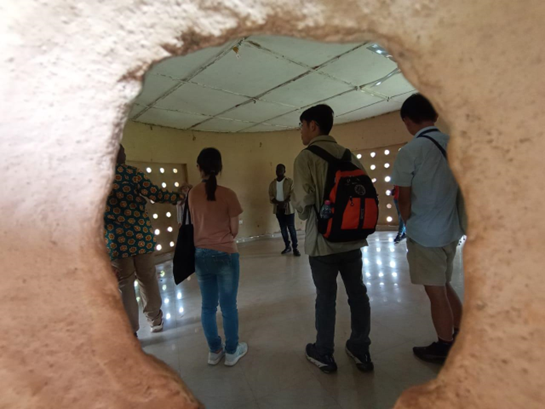
Having spent my career in the pursuit of technological solutions to a variety of problems, I have resisted looking back, feeling it was the anti-thesis to progress. I still find aspects unsettling, particularly with respect to women’s rights.
When culture is embedded in our stories, and we want to learn from Indigenous ways of knowing, what does it mean when that knowledge prefers some bodies over others, or worse, sanctions harm to those that do not comply to the norms of their dominant culture? This complicated moment of conflict between my physical and emotional response, made me reflect on Hathaway’s point about overlapping intersectionality, and how we need to consider people who are marginalized by the intersection of power structures. It may be impossible for those at the intersection to ask for justice and as a result, society may fail to grasp their issues (Hathoway, 2019).
Back in the safe comfort of my first world home I reflect on my experience. The words of the Feminist Cyborg Scholar, Donna Haraway, come to mind, “it matters which stories tell stories” (Haraway, 2017, 7:43). As a Lesbian, I struggle. I come from a place of privilege where I’m free and protected at home and yet was temporarily vulnerable in the physical space I found myself during this period of study. Even getting there took some self-talk to overcome my fear of willingly putting myself into a space where I would become one of the vulnerable. While Ghana’s laws against same sex relations are not the worst (jail vs. death sentence), they are not trivial (HRW, 2018). There is a distinct gap in the official government position on human rights and what was found in the Human Rights Watch research report (HRW, 2018). I want to surrender my first world arrogance and learn from the incredible resilience of the global south, but I fear their religious ways, and I question how to get to a just outcome for all. In the hard work ahead as a Climate Action Leader, there is so much parallel work needed to protect those trying to survive in the intersections of vulnerability.
The 2018 HRW recommendations to Ghana include a need to “… focus on addressing the intersecting forms of discrimination that affect lesbian and bisexual women—and ensure that the necessary legislative and policy measures are taken to ensure their safety, dignity, and equality” (2018, HRW). The question remains, who will surrender their arrogance? How will this be possible as the impacts of climate change continue to increase the stress on these communities?
Returning to Oliveira, and the need to surrender arrogance, she conjectures that it will take generations for systems to be recalibrated and to be working together on a level playing field (Oliveira, 2022). I worry for those who don’t have time to wait. While we need to mourn our losses (Haraway 2017) and to learn from the past (Oliveira, 2022) we can’t romanticize histories told by those in positions of privilege. It is in this work on the diagnosis that we can build confidence that we will be interrupting the right things before beginning the work of innovation. Climate Action Leaders need to do the emotional work that prepares them to ask the hard questions about norms and structures of power, and in the words of Haraway, work towards an equitable and just vision so that “what comes after will not be like what comes before” (Haraway, 2017, 7:43).
Reference:
Brown, O. & Crawford, A., (2008). Assessing the security implications of climate change for West Africa: Country case studies of Ghana and Burkina Faso. International Institute for Sustainable Development (IISD).
Haraway, D. (2017). Staying with the Trouble. [Audio book]. Chapter 4: Making Kin: Anthropocene, Capitalocene, Plantationocene, Chthulucene. Tantor Audio.
Hathaway, J.R. (2020). Climate Change, the Intersectional Imperative, and the Opportunity of the Green New Deal, Environmental Communication, 14:1, 13-22, DOI: 10.1080/17524032.2019.1629977.
Human Rights Watch (HRW). (2018). “No Choice but to Deny Who I Am” : Violence and Discrimination against LGBT people in Ghana. ISBN: 978-1-6231-35621 http://www.hrw.org
Jackson, S. & Humphrey C., (2022, JUL 28). (Yale Sustainability. Yale Experts Explain Intersectionality and Climate Change.
Machado de Oliveira, V. Release Date 2022-01-04. Hospicing Modernity. Facing Humanity’s Wrongs and the Implications for Social Activism. Audiobook. Audible. North Atlantic Books. Narrated by Dougald Hine. Copyright 2021.
Royal Roads University (RRU). (Producer). (2023). Interview with Adam Lerner [Video]. Interviewer: Robin Cox. Royal Roads University Moodle. https://media.royalroads.ca/owl/media/macal/videos/CA
Thank you, Julie, for this incredible post. First, I commend your courage to travel to a place that is hostile to your gender and sexuality. Experiencing hostility to who you are fundamentally is frightening. I felt fearful just reading your post and wondered how hard it must be for those who are not straight, presumably religious men, to manage their lives under these conditions.
Secondly, I have focused my efforts locally, therefore to physically transport yourself to a completely different realm to condition yourself to the “zone of disequilibrium,” is a perspective on learning that I have not considered. Yet from my “think local” perspective, I wonder if it is possible to explore if technology could help lesbian and bisexual women in Ghana meet the 2018 Human Rights Watch recommendations.
Thanks for raising this question, Deanna. I’ve been contemplating the role technology plays, or technology intermediaries could play, in the work between NGOs and Developing Countries. First, delivering education virtually provides safety to those providing education and training related to these risky topics. Second, for Ghanians whose gender and/or sexual orientation does not conform, it could offer a way for them a way to connect to others. The challenge would be safe access and privacy of information. Once digitized and ‘out there’ how secure could or would it be kept? There is an NGO http://www.rainbowrailroad.org – so one way technology is helping to provide access – reaching out to allies who can help those in need.