After a few weeks of studying reports from the Intergovernmental Panel on Climate Change (IPCC) , I’m taking on the challenge of writing about Climate Change, in plain language, which is harder than one might think. I’m reflecting about the challenges of climate change adaptation and mitigation related to permafrost thaw and whether we’re making progress towards equitable climate resilience.
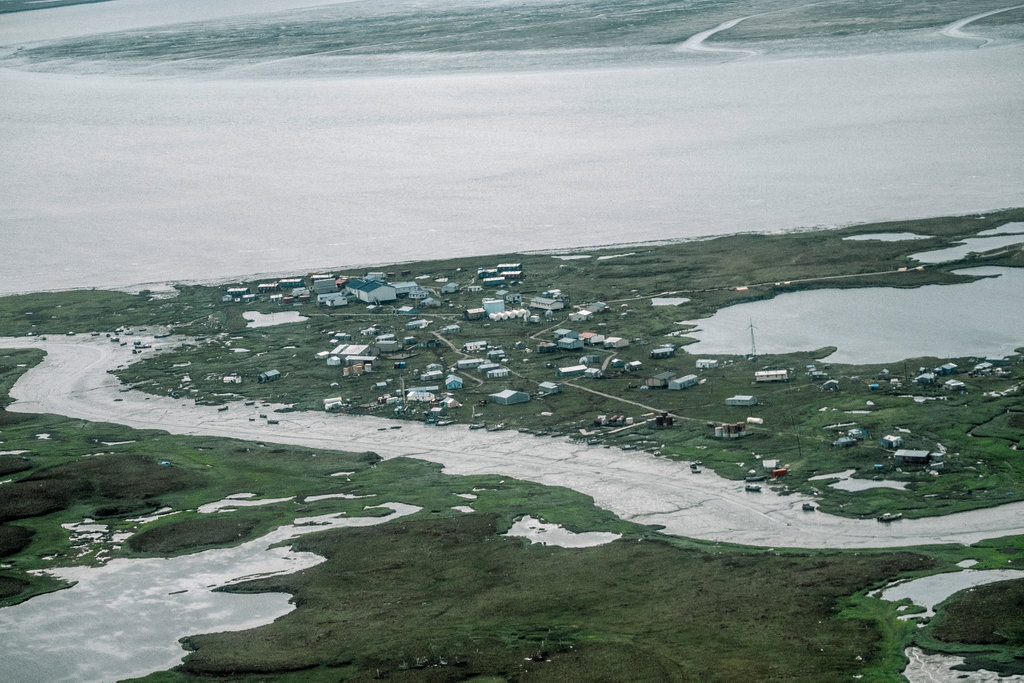
Image: Climate Visual Countdown, Vlad Sokhin / Panos Pictures
Meeting Canada’s pledge of Net-Zero Emissions by 2050 requires that everyone is engaged, all levels of Government (Federal, Provincial, Municipal), small communities, businesses, and Indigenous Peoples (ECCC, 2022). While Canada’s Net-Zero Emissions plan works to reduce GHG emissions from the economy, we also need to be concerned about emissions that are not a direct result of economic activity. Canada is warming on average at double the global rate (Bush et al., 2022, P.7) in addition to human influence, there is an amplification of warming in northern regions (Bush et al., 2021, P.6).
Canada’s geographic location means that we need to pay close attention to changes in the cryosphere. The cryosphere includes land and ocean surfaces that are frozen, including permafrost (IPCC, 2022: Annex II: Glossary, P.2905). Permafrost is defined as ground that has remained below 0°C for at least two consecutive years (Sawyer et al., 2022, P. 82). Thawing permafrost is a Climatic Impact Driver (CID) which means that it can affect an element of society or ecosystem (Ranasinghe et al., 2021, P.1871).
Thawing permafrost releases methane, contributing to the accumulation of Greenhouse Gas (GHG) in the atmosphere, which then increases global warming, which is followed by further thaw, creating a positive feedback loop (IPCC, 2021, P.20 B. 4.3). Warming presents unprecedented challenges for Northern regions and requires a consideration of both mitigation and adaptation to become climate resilient (Constable, et al., 2022, P. 2354).
The IPCC report (AR6) uses the latest generation of climate models that project future climate based on emission scenarios which include Shared Socio Economic Pathways (SSPs), as shown in table 1 below. SSPs consider factors linked to climate change such as population growth and advances in climate mitigation technologies, making it easier to understand climate impacts from different actions (Gannon & Boonvanich, 2021).
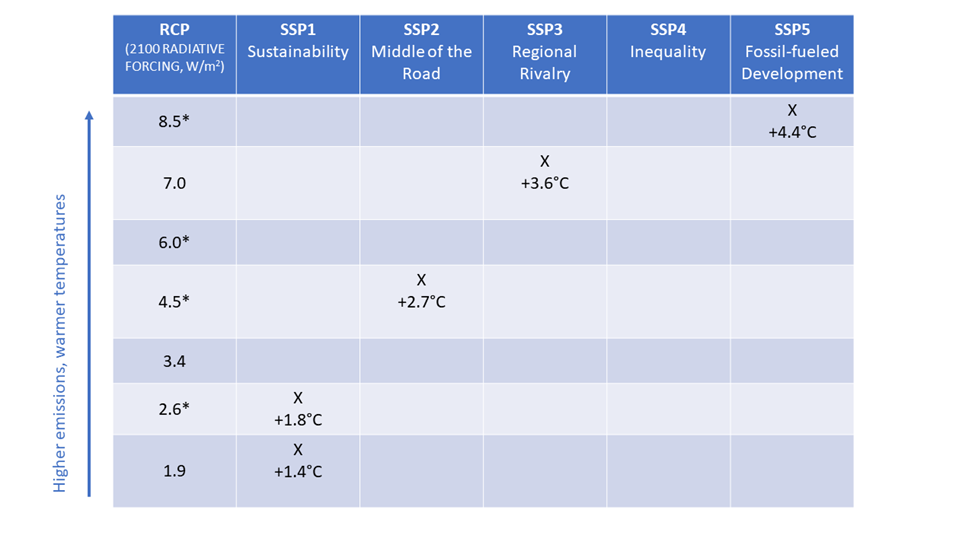
Mitigation and adaptation policy decisions are based on SSP projections, that are interrelated with climate models, so it’s important that the models are as accurate as possible. Assuring the reliability of model projections is done by testing its ability to reproduce reality accurately (Yokohata et al., 2020, P.9). Yokohata et al. conducted a study that improved accuracy for permafrost projections by incorporating additional observational data and improved calculations of thermal conductivity for ice and water, thus contributing to improved reliability of future permafrost thaw projections (Yokohata et al., 2020, P.6).
The combination of damages resulting from permafrost thaw and sea level rise may also result in tipping points leading to inhospitable environments which have already caused some communities to engage in relocation planning (Constable et al., 2021, Ch.6, P. 2339).
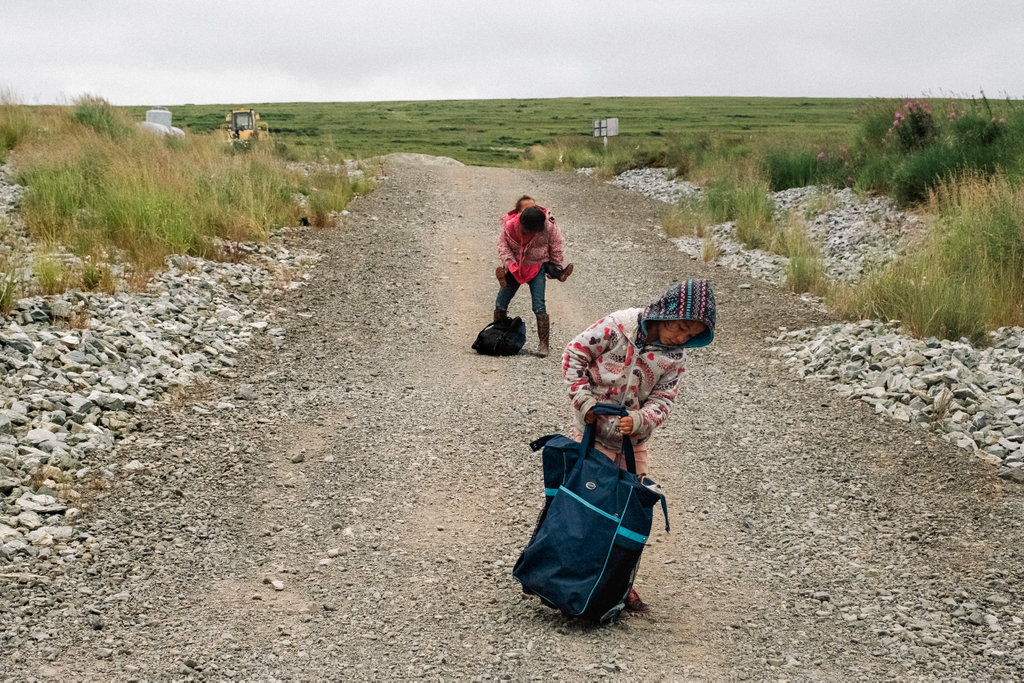
Image: Climate Visuals Countdown, Vlad Sokhin / Panos Pictures
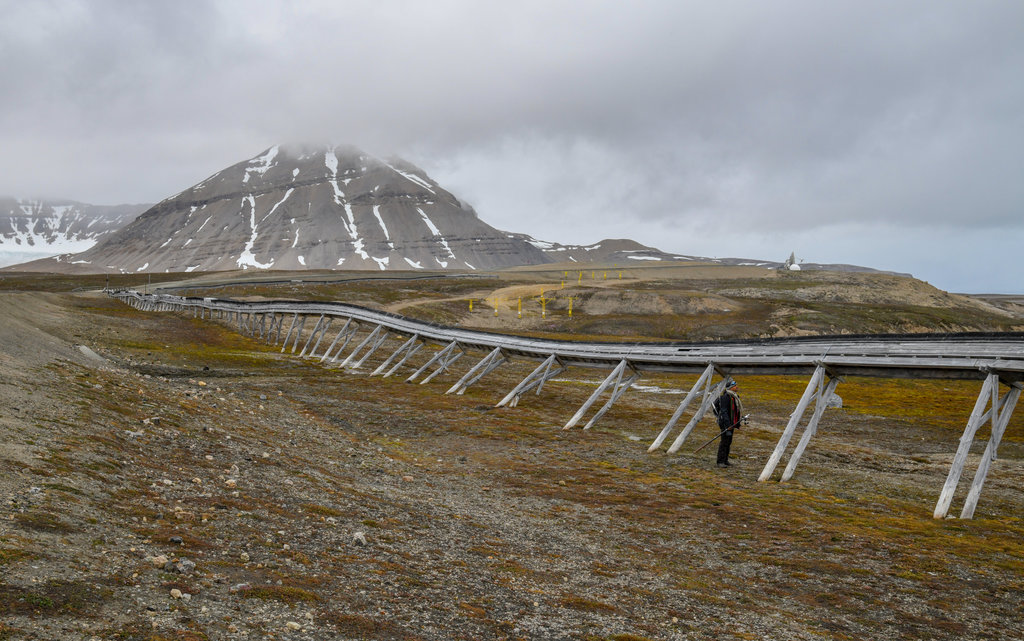
Adhering to SSP1, the sustainability pathway, projects that the temperature rise will be held below 2° C from post industrial levels, and is the best chance to prevent reaching a tipping point that could trigger an abrupt thaw of the Boreal Permafrost which, according to the best estimates reported by Armstrong et al. (2022, P.5), is between 1 to 2.3°C. Thawing permafrost has already caused extensive infrastructure damages and the Canadian Government has focused on infrastructure adaptations in the North where annual repair costs for roads, buildings and airport runways are exceeding $400 million (Sawyer et al., 2022, P. 32).
Adaptation responses range along a continuum of rapid and incremental to the more transformative. In the polar regions this can be as small as an alternative harvest or as big as changing a communities livelihood (Constable, et al., 2021, P.2344). Indigenous Peoples are joining together and identifying broader regional adaptation strategies that consider common themes in addition to infrastructure, like species, subsistence practices, environment, and culture (Inuvialuit, 2016). Through community data collection they are also identifying changes in species as well as the appearance of zoonotic diseases (Inuvialuit, 2016). Incorporating Indigenous Knowledge, like that found in the Inuvialuit Strategy, is important because it acknowledges the related interconnectedness of human activity and biodiversity loss to ensure biodiversity is protected during restoration and rehabilitation (Gorman et al, 2022).
The IPCC Working Group II argues for an approach to climate resilient development centered on the co-location of people and ecosystems, to protect and maintain ecosystem function across the planet (IPCC Summary for Policymakers, 2022, P.28). This climate resilient development requires partnerships and meaningful engagement with Indigenous Peoples to ensure risk reduction, equity, and justice are prioritized (IPCC Summary for Policymakers, 2022, P.28). Indigenous Knowledge has been incorporated into the latest assessment led by Indigenous authors who assessed impacts, adaptation and governance of climate change, which they consider an important step towards self-determination in the international assessment process (Constable et al., 2021, P.2325). The advancements by Indigenous Peoples to be included and leading the incorporation of Indigenous Knowledge, both locally and internationally, is a good indicator that we’re on the right path in making progress towards equitable climate resilience.
References
Armstrong McKay, D. I., Staal, A., Abrams, J. F., Winkelmann, R., Sakschewski, B., Loriani, S., Fetzer, I., Cornell, S. E., Rockström, J., Lenton, T. M. (2022). Exceeding 1.5C global warming could trigger multiple climate tipping points. Science 377(6611) https://doi.org/10.1126/science.abn7950
Bush, E., Bonsal, B., Derksen, C., Flato, G., Fyfe, J., Gillett, N., Greenan, B.J.W., James, T.S., Kirchmeier-Young, M., Murdyk, L., Zhang, X. (2022): Canada’s Changing Climate Report in Light of the Latest Global Science Assessment. Government of Canada. Ottawa. ON. 37p. https://changingclimate.ca/site/assets/uploads/sites/2/2022/03/CCCR-2022-Supplement-Final.pdf
Constable, A.J., S. Harper, J. Dawson, K. Holsman, T. Mustonen, D. Piepenburg, and B. Rost, 2022: Cross-Chapter Paper 6: Polar Regions. In: Climate Change 2022: Impacts, Adaptation and Vulnerability. Contribution of Working Group II to the Sixth Assessment Report of the Intergovernmental Panel on Climate Change [H.-O. Pörtner, D.C. Roberts, M. Tignor, E.S. Poloczanska, K. Mintenbeck, A. Alegría, M. Craig, S. Langsdorf, S. Löschke, V. Möller, A. Okem, B. Rama (eds.)]. Cambridge University Press, Cambridge, UK and New York, NY, USA, pp. 2319–2368, doi:10.1017/9781009325844.023. https://www.ipcc.ch/report/ar6/wg2/downloads/report/IPCC_AR6_WGII_CCP6.pdf
Environment and Climate Change Canada. (No Date). The Map of Adaptation Actions. [Web Page]. Retrieved online Oct. 29, 2022 from https://changingclimate.ca/map#z=4&lat=58.42862399306741
Environment Climate Change Canada (ECCC). (2022, Aug. 26). Net Zero Emissions 2050. https://www.canada.ca/en/services/environment/weather/climatechange/climate-plan/net-zero-emissions-2050.html
Environment and Climate Change Canada. (DATE). Inuvialuit on the Frontline of Climate Change Development of a Regional Climate Change Adaptation Strategy. https://changingclimate.ca/case-study/inuvialuit-on-the-frontline-of-climate-change-development-of-a-regional-climate-change-adaptation-strategy/
Gannon, C. & Boonvanich, G. (2021, Sept. 1). IPCC’s use of latest generation models will help better assess real-world impacts of climate change. [Web Page]. Retrieved online Oct. 29, 2022 from https://esg.moodys.io/insights-analysis-reports/ipccs-use-of-latest-generation-models-will-help-better-assess-real-world-impact-of-climate-change
Gorman, C. E., Torsney, A., Gaughran, A., McKeon, C. M., Farrell, C. A., White, C., Donohue, I., Stout, J. C., & Buckley, Y. M. (2022). Reconciling climate action with the need for biodiversity protection, restoration and rehabilitation. Science of The Total Environment, 857, 159316. https://doi.org/10.1016/j.scitotenv.2022.159316
Inuvialuit. (2016). On the front line of climate change: Development of a Regional Climate Change Adaptation Strategy. https://www.irc.inuvialuit.com/system/files/Inuvialuit%20on%20the%20Frontline%20of%20Climate%20Change-Final-Feb2018%20%28SMALL%29.pdf
IPCC, 2022: Summary for Policymakers [H.-O. Pörtner, D.C. Roberts, E.S. Poloczanska, K. Mintenbeck, M. Tignor, A. Alegría, M. Craig, S. Langsdorf, S. Löschke, V. Möller, A. Okem (eds.)]. In: Climate Change 2022: Impacts, Adaptation and Vulnerability. Contribution of Working Group II to the Sixth Assessment Report of the Intergovernmental Panel on Climate Change [H.-O. Pörtner, D.C. Roberts, M. Tignor, E.S. Poloczanska, K. Mintenbeck, A. Alegría, M. Craig, S. Langsdorf, S. Löschke, V. Möller, A. Okem, B. Rama (eds.)]. Cambridge University Press, Cambridge, UK and New York, NY, USA, pp. 3–33, doi:10.1017/9781009325844.001. https://www.ipcc.ch/report/ar6/wg2/downloads/report/IPCC_AR6_WGII_SummaryForPolicymakers.pdf
IPCC (2021). Summary for Policymakers. In: Climate Change 2021: The Physical Science Basis. Contribution of Working Group I to the Sixth Assessment Report of the Intergovernmental Panel on Climate Change [Masson-Delmotte, V., P. Zhai, A. Pirani, S.L. Connors, C. Péan, S. Berger, N. Caud, Y. Chen, L. Goldfarb, M.I. Gomis, M. Huang, K. Leitzell, E. Lonnoy, J.B.R. Matthews, T.K. Maycock, T. Waterfield, O. Yelekçi, R. Yu, and B. Zhou (eds.)]. Cambridge University Press, Cambridge, United Kingdom and New York, NY, USA, pp. 3−32, doi:10.1017/9781009157896.001. https://www.ipcc.ch/report/ar6/wg1/downloads/report/IPCC_AR6_WGI_SPM.pdf
IPCC, 2022: Annex II: Glossary [Möller, V., R. van Diemen, J.B.R. Matthews, C. Méndez, S. Semenov, J.S. Fuglestvedt, A. Reisinger (eds.)]. In: Climate Change 2022: Impacts, Adaptation and Vulnerability. Contribution of Working Group II to the Sixth Assessment Report of the Intergovernmental Panel on Climate Change [H.-O. Pörtner, D.C. Roberts, M. Tignor, E.S. Poloczanska, K. Mintenbeck, A. Alegría, M. Craig, S. Langsdorf, S. Löschke, V. Möller, A. Okem, B. Rama (eds.)]. Cambridge University Press, Cambridge, UK and New York, NY, USA, pp. 2897–2930, doi:10.1017/9781009325844.029. https://www.ipcc.ch/report/ar6/wg2/downloads/report/IPCC_AR6_WGII_Annex-II.pdf
Ranasinghe, R., A.C. Ruane, R. Vautard, N. Arnell, E. Coppola, F.A. Cruz, S. Dessai, A.S. Islam, M. Rahimi, D. Ruiz Carrascal, J. Sillmann, M.B. Sylla, C. Tebaldi, W. Wang, and R. Zaaboul, 2021: Climate Change Information for Regional Impact and for Risk Assessment. In Climate Change 2021: The Physical Science Basis. Contribution of Working Group I to the Sixth Assessment Report of the Intergovernmental Panel on Climate Change [Masson-Delmotte, V., P. Zhai, A. Pirani, S.L. Connors, C. Péan, S. Berger, N. Caud, Y. Chen, L. Goldfarb, M.I. Gomis, M. Huang, K. Leitzell, E. Lonnoy, J.B.R. Matthews, T.K. Maycock, T. Waterfield, O. Yelekçi, R. Yu, and B. Zhou (eds.)]. Cambridge University Press, Cambridge, United Kingdom and New York, NY, USA, pp. 1767–1926, doi:10.1017/9781009157896.014. https://www.ipcc.ch/report/ar6/wg1/downloads/report/IPCC_AR6_WGI_Chapter12.pdf
Schaefer, K., Lantuit, H., Romanovsky, V. E., Schuur, E. A. G., Witt, R. (2014). The impact of the permafrost carbon feedback on global climate. Environmental Research Letters, 9(8). doi:10.1088/1748-9326/9/8/085003
Sawyer, Dave, Ness, Ryan, Lee, Caroline, and Miller, Sarah. (2022). Damage Control: Reducing the costs of climate impacts in Canada. Canadian Climate Institute. https://climateinstitute.ca/wp-content/uploads/2022/09/Damage-Control_-EN_0927.pdf
Yokohata, T., Saito, K., Takata, K., Nitta, T., Satoh, Y., Hajima, T., Sueyoshi, T., & Iwahana, G. (2020). Model improvement and future projection of permafrost processes in a global land surface model. Progress in Earth and Planetary Science, 7(1), 69. https://doi.org/10.1186/s40645-020-00380-w