Integrating ideas across industry and cultural practices

I’m designing a project to implement a Climate Futures Design Team to both support sustainability reporting and to develop ideas for potential transformative climate solutions as an evolution from incrementally responding and  adapting to climate change.

multicultural hands on a tree representing cross cultural team work

This is the final project for the course, Leading Change in the Context of Climate Change.

The goal of the project is to develop idea propositions for equitable, transformative change which requires the team leader to consider approaches that help the team to act responsibly to all other beings, in other words, to do the work to ‘right relations’ (Gram-Hanssen, 2021). The biggest challenge that I see emerging out of this is with integrating ideas across industry and cultural boundaries.

For lessons learned in cross cultural practices I looked to research conducted, in part, by Albert Marshall, a Mi’kmaw elder, who introduced the concept of Two-Eyed seeing in 2004. Since its introduction, there has been a strengthening consensus across Western and Indigenous researchers that successful integration of Western Science and Traditional Knowledge is fundamental to getting to equitable, transformative solutions (Hathaway, 2020, Bartlett & Marshall & Marshall, 2012).

Two-Eyed Seeing is the gift of multiple perspective treasured by many aboriginal peoples and explains that it refers to learning to see from one eye with the strengths of Indigenous knowledges and ways of knowing, and from the other eye with the strengths of Western knowledges and ways of knowing, and to using both these eyes together, for the benefit of all

Bartlett 2012, citing citing Bartlett 2006, 2011, 2012, Bartlett et al. 2012; Hatcher et al. 2009, Iwama et al. 2009; Hatcher and Barlett 2010; Marshall et al. 2010, IISH website,  P.335

To achieve this objective the leader will need to include Indigenous representation to co-design potential future solutions in a way that helps weave ideas across western and Indigenous worldviews. This is a challenging objective for a couple reasons. First, this project has a strong information systems foundation and Indigenous people are under-represented in STEM education so getting Indigenous team members could be challenging (IndigeSTEAM. ND). Second, the demands on Indigenous community member’s time are many and are increasing. A couple of examples are the time demands related to changes on the regulatory front in B.C., such as the implementation of UNDRIP and the Modernization of the Emergency Management Act.

Given the time constraints, one option that might work would be to create, or to connect with, an Indigenous advisory council. This idea of bringing together a knowledgeable group of stakeholders across Western and Indigenous communities was presented by Bartlett et al. as a lesson learned from decades of research into integrating western science and Indigenous knowledge (Bartlett et al., 2012). Their lesson is based on academic research, which could be tested in an Industry environment to determine viability.

Finding or establishing such a council would take time and could be done in parallel with establishing the organization’s internal team. Keeping Indigenous principles in mind, Bartlett et al. extend the principle of two eyed seeing to multiple eyed seeing, explaining the belief that no one person has more than a small piece of knowledge and that we need to tap into the collective consciousness (2012). This concept aligns to what in Western research is referred to as Transdisciplinarity (Corman & Cox, 2020). Bartlett et al. describe how their research maps to transdisciplinary research, describing the key characteristics of relating to social issues, integrating across disciplines, and participatory research (Bartlett et al., 2012).

My project is also embedded in the renewable energy industry as a response to the challenges emerging from the broader societal energy transition. Research into iterative risk management within the electricity sector has identified the value of integrating transdisciplinary knowledge into the process to meet the demands of climate change impacts, both for the Utility and the population it serves (Gerlack et al., 2018).  Research in this area has been unable to find examples of cross sectoral collaboration (Gerlack et al., 2018), which means that this challenge will continue as transdisciplinary approaches are tried and tested. While this research was centered in risk management practices, the researchers have made a case to shift away from what they refer to as a fragmented approach, to consider greater collaboration beyond the utility sector (Gerlack et al., 2018). This shift would not only open the opportunity for new perspectives but would allow for a shift from risk at the center to one of uncertainty at the center. This would support designing for the uncertainty inherent to Climate Change projections and open space for collaborations around scenario-based analysis, leading to the benefits that come with developing strategic foresight.

However, there are benefits with starting with a small and agile team which can be done by starting in the center of climate risk management and at the intersection of the common interests of Disaster Risk Management and Climate Change Adaptation practices. This would provide the leader with an opportunity to start from practical, established business functions, centered in managing risks, before creating a bridge to broader objectives, once trust in the leader, the team, and the outcomes that they achieve, is further established.

References

Bartlett, C., Marshall, M., & Marshall, A. (2012). Two-Eyed Seeing and other lessons learned within a co-learning journey of bringing together indigenous and mainstream knowledges and ways of knowing. Journal of Environmental Studies and Sciences, 2(4), 331–340. https://doi.org/10.1007/s13412-012-0086-8

Corman, I. & Cox, R. (2020). Transdisciplinarity: A Primer. Royal Roads University. https://commons.royalroads.ca/macal/wp-content/uploads/sites/88/2021/04/MACAL_Transdisciplinary_Thinking03-31-21-3.pdf

Environment and Climate Change Canada (ECCC). (2022, Oct. 18). Indigenous science. https://www.canada.ca/en/environment-climate-change/services/science-technology/indigenous-science.html

Gerlak, A. K., Weston, J., McMahan, B., Murray, R. L., & Mills-Novoa, M. (2018). Climate risk management and the electricity sector. Climate Risk Management19, 12–22. https://doi.org/10.1016/j.crm.2017.12.003

Gram-Hanssen, I., Schafenacker, N., & Bentz, J. (2021). Decolonizing transformations through ‘right relations.’ Sustainability Science, 17(2), 673-685. Retrieved 10 May. 2022, from https://doi.org/10.1007/s11625-021-00960-9   

IndigeSTEAM. (ND). Indigenous perspectives in STEM & STEAM opening doors for all. https://www.indigesteam.ca/

Institute for Integrative Science and Health. (ND). Two-Eyed Seeing. http://www.integrativescience.ca/Principles/TwoEyedSeeing/

Irwin, T. (2021). Transition Design: Design for systems-level change. American Institute of Graphic Arts (AIGA) National Conference. Terry Irwin [Presenter]. https://www.youtube.com/watch?app=desktop&v=KEzrqICi7hI

OECD. (ND). Strategic Foresight. Web Page. https://www.oecd.org/strategic-foresight
Leading within complexity

Earlier this year I wrote about transformation in practice, and the opportunities and challenges of bringing together practitioners from across Disaster Risk Management (DRM) and Climate Change Adaptation (CCA) to enable transformative change. As both a practitioner and learner in this space, I see an opportunity for collaboration to help achieve sustainable adaptations that could improve our ability to address climate change impacts equitably.

As part of my studies in Leading Change in the Context of Climate Change, I’m considering whether Complexity Leadership Theory would be a good fit to address this challenge, specifically for practitioners working within the renewable energy sector. The industry is undergoing a significant transition as a direct result of international pressures to reduce Green House Gas (GHG) emissions while also having to adapt to the current and future impacts of climate hazards.

BC’s renewable energy sector plays an important role in mitigating GHG emissions while also needing to adapt to climate change impacts. BC Hydro is a relevant example, being the primary supplier of hydro electricity, and as the owner of critical infrastructure, having accountability to the Province for climate change adaptation. 

Recent Provincial announcements illustrate how the energy transition is unfolding within BC’s renewable energy sector (British Columbia, CBC). BC is forecasting a 15% increase in demand for renewable energy by 2030 and as a result BC Hydro is planning to put a call out for renewable energy providers in early 2024 (British Columbia, 2023). In parallel, the Provincial government is providing $140 Million for Indigenous-led power projects. As part of this Clean Energy initiative BC Hydro has created a special task force focused on enabling new power project opportunities (British Columbia, 2023). This is a big change for an electric utility that requires stability to ensure a reliable source of electricity to customers. It also makes complexity leadership theory worth considering because it addresses the challenges that come with crossing leadership styles of Operations and Entrepreneurial systems by bridging with Enabling leadership (Uhl-Bien & Arena, 2017).

The role of renewable energy practitioners with responsibilities for DRM and CCA functions are key. A recent report from the IPCC highlights the need to navigate through adaptation and mitigation options, balancing climate actions, to meet sustainability goals (Schipper et al., 2022, P.2666). Further, the 2018 British Columbia Auditor General report on Climate Change, highlighted that managing climate change includes both adaptation, to reduce harm, and mitigation, to reduce emissions, and that the Province was not adequately managing the risks posed by climate change (AGBC, 2018).

Given that the challenge exists within the renewable energy space requires considering that established power producers are by necessity, operational, ordered systems. Electric power systems are considered critical infrastructure, meaning that it is essential for the functioning of society and the economy (OAGBC, 2019). Service disruptions, including those caused by climate hazards, can have catastrophic effects to the communities that energy utilities serve. While an individual home might see a disruption as an inconvenience, a large grid failure could cascade through communities and cause widespread outages with higher potential for catastrophic damage. For this reason, the industry is highly regulated by the North American Electric Reliability Corporation (NERC) standards. 

Driven by the need for increased renewable energy sources to combat reliance on fossil fuels, BC is introducing an entrepreneurial model which introduces uncertainty. This change brings an organizational challenge of working across operational and entrepreneurial spaces, where research has shown a need to act as complex adaptive system (Uhl-Bien & Arena, 2017). This makes the Complexity Leadership model a good fit because it works with the tension that occurs between ordered and entrepreneurial systems (Uhl-Bien & Arena, 2017). 

According to Uhl-Bien & Arena, order is the enemy of adaptability and can stifle the organizational dynamics needed to effectively respond to complexity (2017). Further, “organizations that enable an adaptive response do not turn to a top-down approach. Instead, they engage networks and emergence” (Uhl-Bien & Arena, 2017, P.10).

Organizations that enable an adaptive response do not turn to a top-down approach. Instead, they engage networks and emergence”

Uhl-Bien & Arena, 2017, P.10

The benefit of the Complexity Leadership Model is that it brings together Operational, Entrepreneurial, and Enabling leadership styles. While operational leaders are well established within the sector, the new business model that is being introduced will bring entrepreneurial leaders with it. This is demonstrated by the creation of the BC Hydro Task Force with the strategic priorities of

  • Improving the speed of permitting and delivery of required infrastructure
  • Modernizing regulatory framework to better align with government priorities while protecting rate payers
  • Identifying, enabling and accelerating economic opportunities for clean energy.

(British Columbia, 2023)

What may be missing is the enabling leadership and adaptive spaces that are needed to link people and ideas from across these spaces to support emergence and to help changes stick. “Emergence is the creation of a new order that happens when agents (e.g., people, technology, information, resources) in a networked system combine together in an environment poised for change to generate the emergence of something that did not exist previously” (Uhl-Bien & Arena, 2017, P. 10).

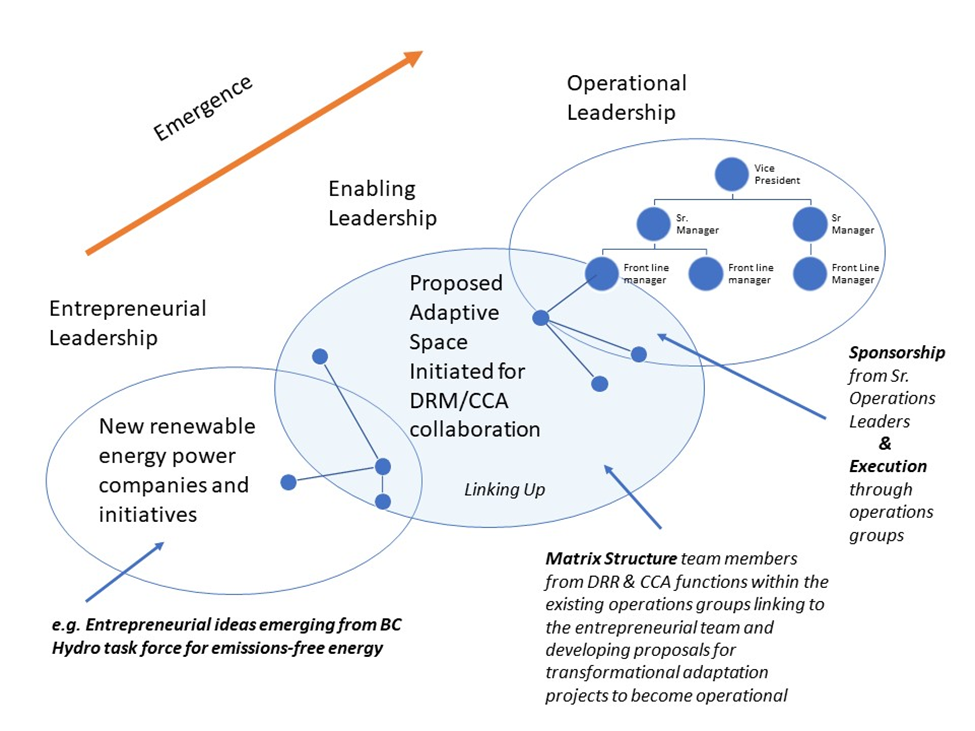
A potential incubator for an adaptive space exists within organizations that have functional managers from across areas of the business who have DRM or CCA responsibilities included as one part of their operational leadership role.

Figure 1: Application of Complexity Leadership Model – Adapted from Uhl-Bien & Arena (2017)

Figure 1 demonstrates how the complexity leadership model could be applied by creating an adaptive space within existing renewable energy organizations, starting with team members with responsibilities for DRM and CCA functions. This is where the enabling change leader comes in who can start in the fertile ground of shared purpose that exists between DRM and CCA and open an adaptive space for transformation ideas to take hold which could be operationalized through strengthening connections across leaders in the Entrepreneurial and Operational spaces. CCA is relatively new when compared to DRM and integration of capabilities across the practices are typically not well developed, though they share many commonalities (NIRAS, 2021). This brings additional challenges for the enabling leader.

By working across communities and establishing a goal of sustainable development, the enabling leader can engage senior operational leaders to request sponsorship of proposals emerging from the adaptive space. These ideas would have already been socialized through managers with whom they lead, and presumably trust, facilitating the progression of transformative ideas into sustainable, equitable climate solutions.  

To illustrate potential outcomes from this model, one can look to examples of the clean energy initiatives of transitioning reliance on diesel fuel to micro grids, such as the one for the remote Indigenous community of Xeni Gwet’in (British Columbia, 2020). The initiative supports both a reduction in GHG emissions as well as the resilience of the community by providing 24/7 power and local reliability for the community to withstand climate change induced outages. With the introduction of additional power supplied through renewable sources such as wind, solar, and even ocean energy options, there will be new opportunities to explore transformative adaptations. This model builds on the concept of complex adaptive systems that can be found in nature, such as in bee colonies, where highly productive pollinators operate on simple rules and networked interactions (Uhl-Bien & Arena, 2017). Learning from nature, using the Complex Leadership Model for structure, perhaps it’s time for the creation of a Hive for Climate Action, opening space for cross pollinating ideas, and creating linkages to help emerging transformative adaptations stick.

References

British Columbia. 2020, Jun. 18. Province supporting Xeni Gwet’in First Nation transition to clean energy. News Release. https://archive.news.gov.bc.ca/releases/news_releases_2017-2021/2020EMPR0019-001084.htm

British Columbia. (ND). Land Use – ocean energy. https://www2.gov.bc.ca/gov/content/industry/crown-land-water/crown-land/crown-land-uses/clean-energy/ocean-energy#:~:text=British%20Columbia%20has%20significant%20ocean,Projects%20that%20exceed%2050%20megawatts

British Columbia. (2023, Jun. 15). BC Hydro Task Force. [web page]. https://www2.gov.bc.ca/gov/content/governments/organizational-structure/ministries-organizations/crown-corporations/bc-hydro-and-power-authority/bchydrotaskforce#about

British Columbia (2023, Jun. 15). Clean Power to electrify B.C.’s future. News Release. https://news.gov.bc.ca/releases/2023EMLI0036-000941

CBC News. 2023, Jun. 15. B.C. Hydro set to launch search for new, clean electricity sources. https://www.cbc.ca/news/canada/british-columbia/b-c-hydro-search-new-electricity-sources-1.6877920

IPCC. (2022, Dec.). Sixth Assessment Report. Working Group II – Impacts, Adaptation and Vulnerability: Fact Sheet – North America. https://www.ipcc.ch/report/ar6/wg2/downloads/outreach/IPCC_AR6_WGII_FactSheet_NorthAmerica.pdf

NIRAS. (2021, Mar.). Climate Change Adaptation and Disaster Risk Management Capability Statement. NIRAS. https://www.niras.com/media/nh1pggyp/cca-drm-capability-statement.pdf

Office of the Auditor General of British Columbia (OAGBC). (2019, Mar.). Detection and Response to Cybersecurity threats on BC Hydro’s Industrial Control Systems. https://www.bcauditor.com/sites/default/files/publications/reports/OABGC_Cybersecurity-ICS-BC-Hydro_RPT.pdf

Office of the Auditor General of British Columbia (OAGBC). (2018, Feb.). Managing Climate Change Risks: An Independent Audit.  https://www.bcauditor.com/sites/default/files/publications/reports/Climate_Change_FINAL_0.pdf

Schipper, E.L.F., A. Revi, B.L. Preston, E.R. Carr, S.H. Eriksen, L.R. Fernandez-Carril, B.C. Glavovic, N.J.M. Hilmi, D. Ley, R. Mukerji, M.S. Muylaert de Araujo, R. Perez, S.K. Rose, and P.K. Singh, 2022: Climate Resilient Development Pathways. In: Climate Change 2022: Impacts, Adaptation and Vulnerability. Contribution of Working Group II to the Sixth Assessment Report of the Intergovernmental Panel on Climate Change [H.-O. Pörtner, D.C. Roberts, M. Tignor, E.S. Poloczanska, K. Mintenbeck, A. Alegría, M. Craig, S. Langsdorf, S. Löschke, V. Möller, A. Okem, B. Rama (eds.)]. Cambridge University Press, Cambridge, UK and New York, NY, USA, pp. 2655–2807, doi:10.1017/9781009325844.027. https://www.ipcc.ch/report/ar6/wg2/downloads/report/IPCC_AR6_WGII_Chapter18.pdf

Uhl-Bien, M. & Arena, M. (2017). Complexity Leadership: Enabling people and organizations for adaptability. Organizational Dynamics. 46, pp. 9-20. http://dx.doi.org/10.1016/j.orgdyn.2016.12.001.

Uhl-Bien, M. & Arena, M. (2016). Complexity Leadership Theory: Shifting from Human Capital to Social Capital. SHRM Executive Network. https://www.shrm.org/executive/resources/people-strategy-journal/spring2016/pages/complexity-leadership.aspx

Equitable Climate Resilience

After a few weeks of studying reports from the Intergovernmental Panel on Climate Change (IPCC) , I’m taking on the challenge of writing about Climate Change, in plain language, which is harder than one might think. I’m reflecting about the challenges of climate change adaptation and mitigation related to permafrost thaw and whether we’re making progress towards equitable climate resilience.

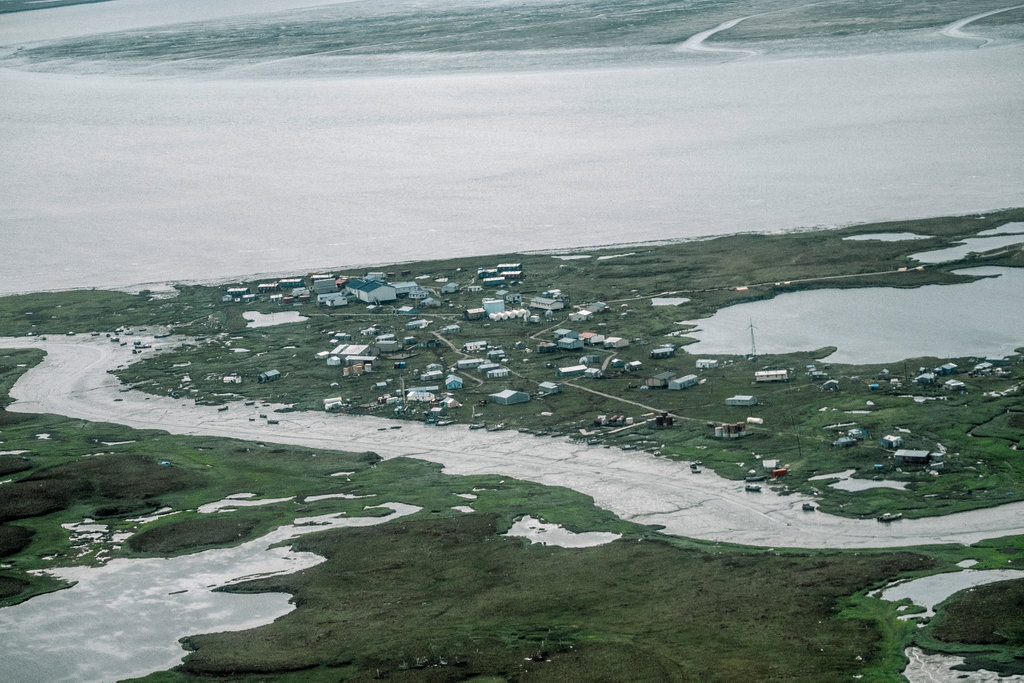
An aerial view of Newtok village [Alaska]. Surrounded by water, the village is under imminent threat from climate change. Permafrost thaw, regular floods and coastal erosion make it dangerous for people of Newtok to remain there. It is estimated that in the next ten years nearly a 1/3 of the village’s area will become uninhabitable due to erosion.
Image: Climate Visual Countdown, Vlad Sokhin / Panos Pictures

Meeting Canada’s pledge of Net-Zero Emissions by 2050 requires that everyone is engaged, all levels of Government (Federal, Provincial, Municipal), small communities, businesses, and Indigenous Peoples (ECCC, 2022). While Canada’s Net-Zero Emissions plan works to reduce GHG emissions from the economy, we also need to be concerned about emissions that are not a direct result of economic activity. Canada is warming on average at double the global rate (Bush et al., 2022, P.7) in addition to human influence, there is an amplification of warming in northern regions (Bush et al., 2021, P.6).

Canada’s geographic location means that we need to pay close attention to changes in the cryosphere. The cryosphere includes land and ocean surfaces that are frozen, including permafrost (IPCC, 2022: Annex II: Glossary, P.2905). Permafrost is defined as ground that has remained below 0°C for at least two consecutive years (Sawyer et al., 2022, P. 82). Thawing permafrost is a Climatic Impact Driver (CID) which means that it can affect an element of society or ecosystem (Ranasinghe et al., 2021, P.1871).

Thawing permafrost releases methane, contributing to the accumulation of Greenhouse Gas (GHG) in the atmosphere, which then increases global warming, which is followed by further thaw, creating a positive feedback loop (IPCC, 2021, P.20 B. 4.3). Warming presents unprecedented challenges for Northern regions and requires a consideration of both mitigation and adaptation to become climate resilient (Constable, et al., 2022, P. 2354).

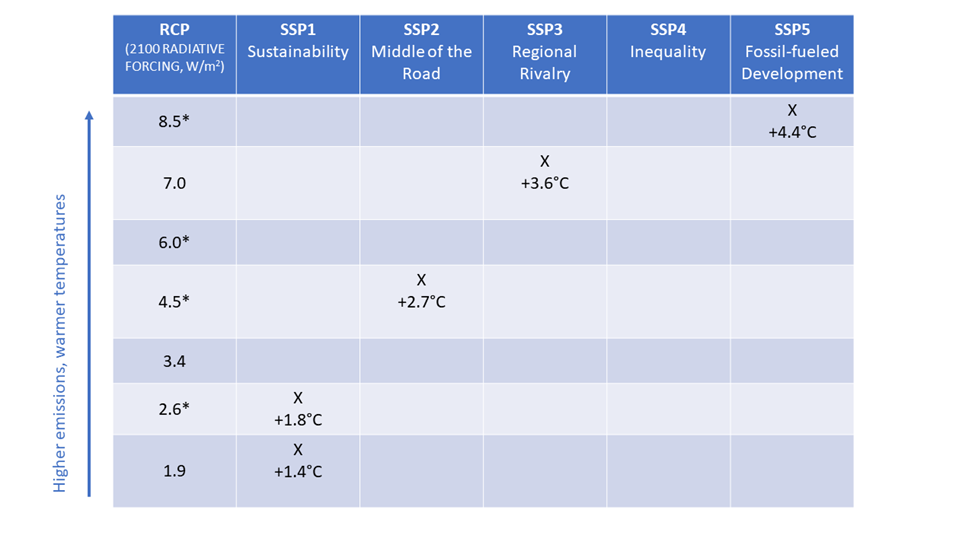
The IPCC report (AR6) uses the latest generation of climate models that project future climate based on emission scenarios which include Shared Socio Economic Pathways (SSPs), as shown in table 1 below. SSPs consider factors linked to climate change such as population growth and advances in climate mitigation technologies, making it easier to understand climate impacts from different actions (Gannon & Boonvanich, 2021). 

Table 1 Adapted from Table 1 SSP-RCP combinations used in CMIP6, with “best estimate” 2081-21-00 end-of-century temperature anomaly

Mitigation and adaptation policy decisions are based on SSP projections, that are interrelated with climate models, so it’s important that the models are as accurate as possible. Assuring the reliability of model projections is done by testing its ability to reproduce reality accurately (Yokohata et al., 2020, P.9). Yokohata et al. conducted a study that improved accuracy for permafrost projections by incorporating additional observational data and improved calculations of thermal conductivity for ice and water, thus contributing to improved reliability of future permafrost thaw projections (Yokohata et al., 2020, P.6).

The combination of damages resulting from permafrost thaw and sea level rise may also result in tipping points leading to inhospitable environments which have already caused some communities to engage in relocation planning (Constable et al., 2021, Ch.6, P. 2339).

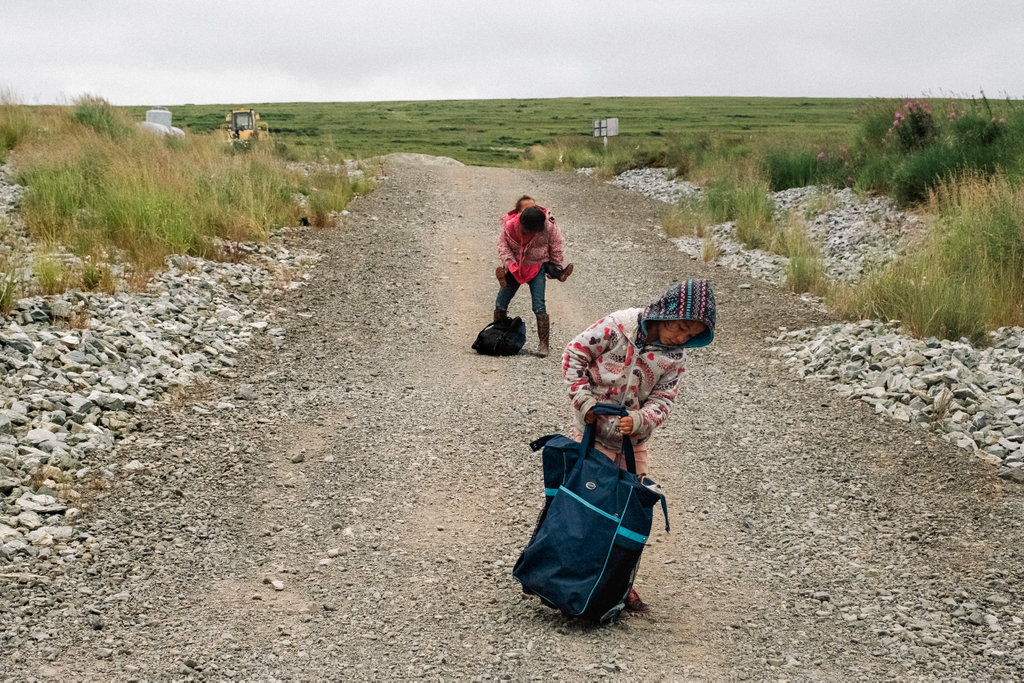
Children relocating with their grandparents because their house in Newtok will soon be not suitable for living due to coastal erosion that severely impacts the village. 
Image: Climate Visuals Countdown, Vlad Sokhin / Panos Pictures

Adhering to SSP1, the sustainability pathway, projects that the temperature rise will be held below 2° C from post industrial levels, and is the best chance to prevent reaching a tipping point that could trigger an abrupt thaw of the Boreal Permafrost which, according to the best estimates reported by Armstrong et al. (2022, P.5), is between 1 to 2.3°C. Thawing permafrost has already caused extensive infrastructure damages and the Canadian Government has focused on infrastructure adaptations in the North where annual repair costs for roads, buildings and airport runways are exceeding $400 million (Sawyer et al., 2022, P. 32).

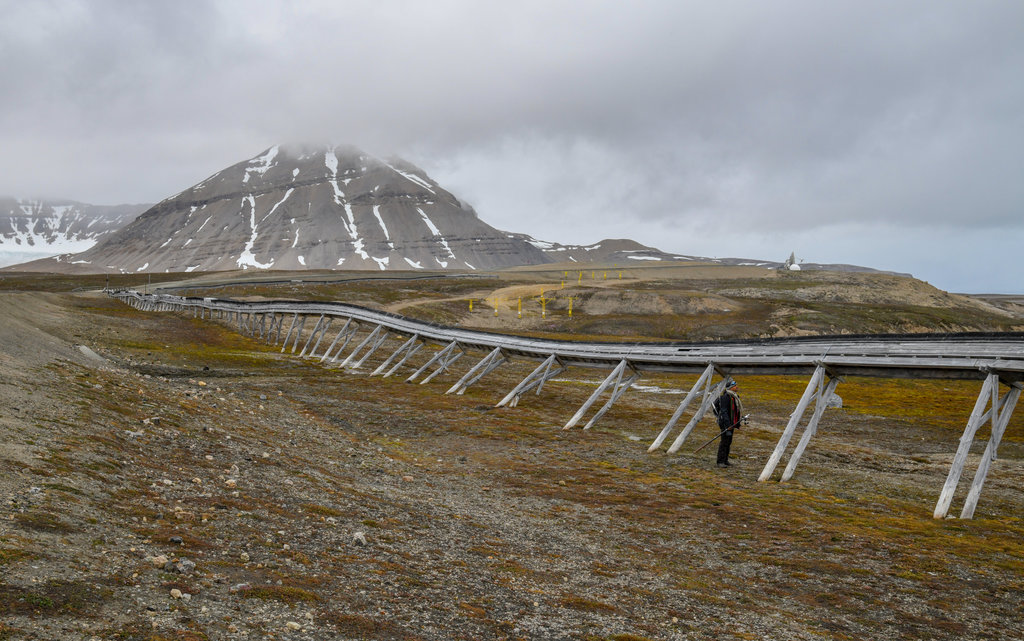
Water pipeline at Ny-Ålesund that had to be abandoned, as the ground on which it was installed thawed, disrupting the supply. Image: Rakesh Rao / Climate Visuals Countdown

Adaptation responses range along a continuum of rapid and incremental to the more transformative. In the polar regions this can be as small as an alternative harvest or as big as changing a communities livelihood (Constable, et al., 2021, P.2344). Indigenous Peoples are joining together and identifying broader regional adaptation strategies that consider common themes in addition to infrastructure, like species, subsistence practices, environment, and culture (Inuvialuit, 2016). Through community data collection they are also identifying changes in species as well as the appearance of zoonotic diseases (Inuvialuit, 2016). Incorporating Indigenous Knowledge, like that found in the Inuvialuit Strategy, is important because it acknowledges the related interconnectedness of human activity and biodiversity loss to ensure biodiversity is protected during restoration and rehabilitation (Gorman et al, 2022).

The IPCC Working Group II argues for an approach to climate resilient development centered on the co-location of people and ecosystems, to protect and maintain ecosystem function across the planet (IPCC Summary for Policymakers, 2022, P.28). This climate resilient development requires partnerships and meaningful engagement with Indigenous Peoples to ensure risk reduction, equity, and justice are prioritized  (IPCC Summary for Policymakers, 2022, P.28). Indigenous Knowledge has been incorporated into the latest assessment led by Indigenous authors who assessed impacts, adaptation and governance of climate change, which they consider an important step towards self-determination in the international assessment process (Constable et al., 2021, P.2325). The advancements by Indigenous Peoples to be included and leading the incorporation of Indigenous Knowledge, both locally and internationally, is a good indicator that we’re on the right path in making progress towards equitable climate resilience.

References

Armstrong McKay, D. I., Staal, A., Abrams, J. F., Winkelmann, R., Sakschewski, B., Loriani, S., Fetzer, I., Cornell, S. E., Rockström, J., Lenton, T. M. (2022). Exceeding 1.5C global warming could trigger multiple climate tipping points. Science 377(6611) https://doi.org/10.1126/science.abn7950

Bush, E., Bonsal, B., Derksen, C., Flato, G., Fyfe, J., Gillett, N., Greenan, B.J.W., James, T.S., Kirchmeier-Young, M., Murdyk, L., Zhang, X. (2022): Canada’s Changing Climate Report in Light of the Latest Global Science Assessment. Government of Canada. Ottawa. ON. 37p. https://changingclimate.ca/site/assets/uploads/sites/2/2022/03/CCCR-2022-Supplement-Final.pdf

Constable, A.J., S. Harper, J. Dawson, K. Holsman, T. Mustonen, D. Piepenburg, and B. Rost, 2022: Cross-Chapter Paper 6: Polar Regions. In: Climate Change 2022: Impacts, Adaptation and Vulnerability. Contribution of Working Group II to the Sixth Assessment Report of the Intergovernmental Panel on Climate Change [H.-O. Pörtner, D.C. Roberts, M. Tignor, E.S. Poloczanska, K. Mintenbeck, A. Alegría, M. Craig, S. Langsdorf, S. Löschke, V. Möller, A. Okem, B. Rama (eds.)]. Cambridge University Press, Cambridge, UK and New York, NY, USA, pp. 2319–2368, doi:10.1017/9781009325844.023. https://www.ipcc.ch/report/ar6/wg2/downloads/report/IPCC_AR6_WGII_CCP6.pdf

Environment and Climate Change Canada. (No Date). The Map of Adaptation Actions. [Web Page]. Retrieved online Oct. 29, 2022 from https://changingclimate.ca/map#z=4&lat=58.42862399306741

Environment Climate Change Canada (ECCC). (2022, Aug. 26). Net Zero Emissions 2050. https://www.canada.ca/en/services/environment/weather/climatechange/climate-plan/net-zero-emissions-2050.html

Environment and Climate Change Canada. (DATE). Inuvialuit on the Frontline of Climate Change Development of a Regional Climate Change Adaptation Strategy. https://changingclimate.ca/case-study/inuvialuit-on-the-frontline-of-climate-change-development-of-a-regional-climate-change-adaptation-strategy/

Gannon, C. & Boonvanich, G. (2021, Sept. 1). IPCC’s use of latest generation models will help better assess real-world impacts of climate change. [Web Page]. Retrieved online Oct. 29, 2022 from https://esg.moodys.io/insights-analysis-reports/ipccs-use-of-latest-generation-models-will-help-better-assess-real-world-impact-of-climate-change

Gorman, C. E., Torsney, A., Gaughran, A., McKeon, C. M., Farrell, C. A., White, C., Donohue, I., Stout, J. C., & Buckley, Y. M. (2022). Reconciling climate action with the need for biodiversity protection, restoration and rehabilitation. Science of The Total Environment, 857, 159316. https://doi.org/10.1016/j.scitotenv.2022.159316

Inuvialuit. (2016). On the front line of climate change: Development of a Regional Climate Change Adaptation Strategy. https://www.irc.inuvialuit.com/system/files/Inuvialuit%20on%20the%20Frontline%20of%20Climate%20Change-Final-Feb2018%20%28SMALL%29.pdf

IPCC, 2022: Summary for Policymakers [H.-O. Pörtner, D.C. Roberts, E.S. Poloczanska, K. Mintenbeck, M. Tignor, A. Alegría, M. Craig, S. Langsdorf, S. Löschke, V. Möller, A. Okem (eds.)]. In: Climate Change 2022: Impacts, Adaptation and Vulnerability. Contribution of Working Group II to the Sixth Assessment Report of the Intergovernmental Panel on Climate Change [H.-O. Pörtner, D.C. Roberts, M. Tignor, E.S. Poloczanska, K. Mintenbeck, A. Alegría, M. Craig, S. Langsdorf, S. Löschke, V. Möller, A. Okem, B. Rama (eds.)]. Cambridge University Press, Cambridge, UK and New York, NY, USA, pp. 3–33, doi:10.1017/9781009325844.001. https://www.ipcc.ch/report/ar6/wg2/downloads/report/IPCC_AR6_WGII_SummaryForPolicymakers.pdf

IPCC (2021). Summary for Policymakers. In: Climate Change 2021: The Physical Science Basis. Contribution of Working Group I to the Sixth Assessment Report of the Intergovernmental Panel on Climate Change [Masson-Delmotte, V., P. Zhai, A. Pirani, S.L. Connors, C. Péan, S. Berger, N. Caud, Y. Chen, L. Goldfarb, M.I. Gomis, M. Huang, K. Leitzell, E. Lonnoy, J.B.R. Matthews, T.K. Maycock, T. Waterfield, O. Yelekçi, R. Yu, and B. Zhou (eds.)]. Cambridge University Press, Cambridge, United Kingdom and New York, NY, USA, pp. 3−32, doi:10.1017/9781009157896.001. https://www.ipcc.ch/report/ar6/wg1/downloads/report/IPCC_AR6_WGI_SPM.pdf

IPCC, 2022: Annex II: Glossary [Möller, V., R. van Diemen, J.B.R. Matthews, C. Méndez, S. Semenov, J.S. Fuglestvedt, A. Reisinger (eds.)]. In: Climate Change 2022: Impacts, Adaptation and Vulnerability. Contribution of Working Group II to the Sixth Assessment Report of the Intergovernmental Panel on Climate Change [H.-O. Pörtner, D.C. Roberts, M. Tignor, E.S. Poloczanska, K. Mintenbeck, A. Alegría, M. Craig, S. Langsdorf, S. Löschke, V. Möller, A. Okem, B. Rama (eds.)]. Cambridge University Press, Cambridge, UK and New York, NY, USA, pp. 2897–2930, doi:10.1017/9781009325844.029. https://www.ipcc.ch/report/ar6/wg2/downloads/report/IPCC_AR6_WGII_Annex-II.pdf

Ranasinghe, R., A.C. Ruane, R. Vautard, N. Arnell, E. Coppola, F.A. Cruz, S. Dessai, A.S. Islam, M. Rahimi, D. Ruiz Carrascal, J. Sillmann, M.B. Sylla, C. Tebaldi, W. Wang, and R. Zaaboul, 2021: Climate Change Information for Regional Impact and for Risk Assessment. In Climate Change 2021: The Physical Science Basis. Contribution of Working Group I to the Sixth Assessment Report of the Intergovernmental Panel on Climate Change [Masson-Delmotte, V., P. Zhai, A. Pirani, S.L. Connors, C. Péan, S. Berger, N. Caud, Y. Chen, L. Goldfarb, M.I. Gomis, M. Huang, K. Leitzell, E. Lonnoy, J.B.R. Matthews, T.K. Maycock, T. Waterfield, O. Yelekçi, R. Yu, and B. Zhou (eds.)]. Cambridge University Press, Cambridge, United Kingdom and New York, NY, USA, pp. 1767–1926, doi:10.1017/9781009157896.014. https://www.ipcc.ch/report/ar6/wg1/downloads/report/IPCC_AR6_WGI_Chapter12.pdf

Schaefer, K., Lantuit, H., Romanovsky, V. E., Schuur, E. A. G., Witt, R. (2014). The impact of the permafrost carbon feedback on global climate. Environmental Research Letters, 9(8). doi:10.1088/1748-9326/9/8/085003

Sawyer, Dave, Ness, Ryan, Lee, Caroline, and Miller, Sarah. (2022). Damage Control: Reducing the costs of climate impacts in Canada. Canadian Climate Institute. https://climateinstitute.ca/wp-content/uploads/2022/09/Damage-Control_-EN_0927.pdf

Yokohata, T., Saito, K., Takata, K., Nitta, T., Satoh, Y., Hajima, T., Sueyoshi, T., & Iwahana, G. (2020). Model improvement and future projection of permafrost processes in a global land surface model. Progress in Earth and Planetary Science7(1), 69. https://doi.org/10.1186/s40645-020-00380-w