The combined efforts of our cohort of climate action change leaders have inspired me with their variety of change leadership plans designed to help our communities build resilience to climate change. I learned something from every one of my cohort’s presentations and in their totality, they’ve revived my sense of cautious optimism.
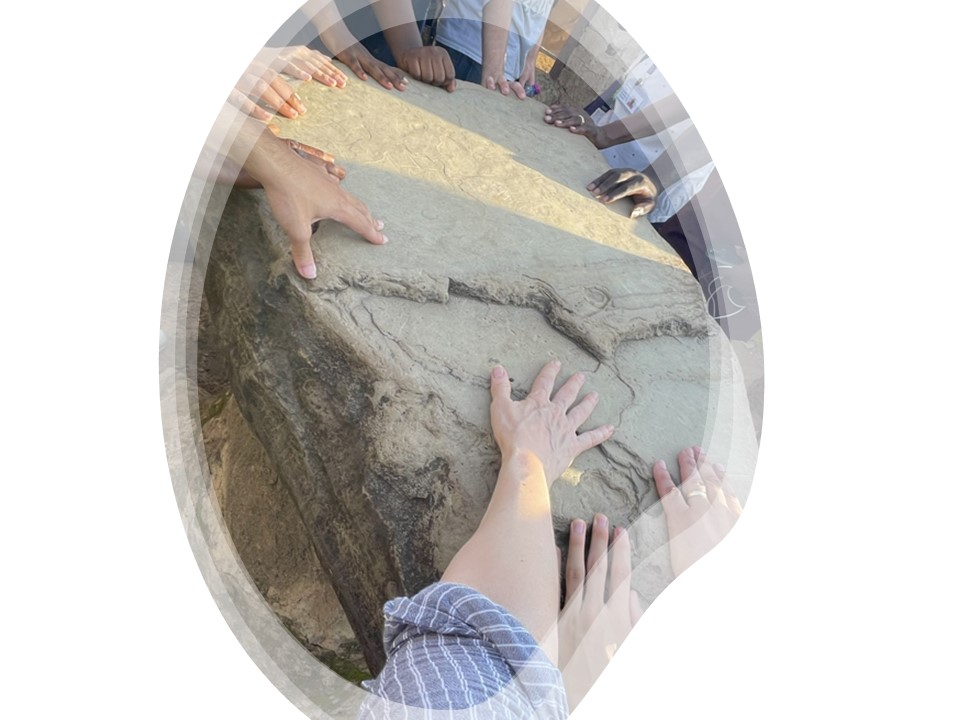
Making a group wish for our future climate on the Larabanga Mystic Stone
I started CALS 505 – Leading Change in the Context of Climate Change from a place of emotion, mostly passion for change, and I learned to use a logical structure to get to an actionable project. I learned that the power of being able to tell your story of change succinctly will go a long way to making it a reality. Practicing in front of a trusted peer group instilled a sense of confidence in my ability to tell the story while also identifying areas that I still need to work on.
My climate action change leadership story is centred on building resilience. Resilience is a strategic goal of the company I work for and it’s also a term I used in my letter of intent when I applied for the Climate Action Leadership Program. The need to balance resilience as a metaphor against resilience as a measurement is one of my biggest learnings from developing my Climate Action Project Plan. Reflecting on my presentation I believe I was able to impart the facts but the metaphor of how the project contributes to organizational resilience continues to be an area for me to work on.
My conclusion after presenting my project, and watching others present theirs, is that finding the sweet spot between telling my story while making sure the audience has the key facts, is tough. There is no one right way. While there are communications formulas and tips, ultimately personal style, and where you are in your change leadership journey, will influence the presentation. Not every telling of the story needs to feel like a success. The simple act of telling the story and getting feedback helps dial it in. Watching others with a critical eye, and discussing with peers, are invaluable learning exercises, painful as presenting may feel to some of us.
We need narrative to help others visualize our plans in a way that make them relatable. Yet, working in the nebulous world of metaphors is not easy. I think I learned a bit more about using my authentic voice in my work and yet I still feel a disconnect between my professional voice and my natural one. Hopefully, through practice, I’ll find my way to selecting the appropriate voice in the moment I need it. Getting comfortable with my voice can be practiced and will require not just developing a vision statement but learning how to ‘own’ it.
Using a linear thinking tool like the Kellogg Foundation’s logic model (2004) will help me to keep the components of my theory of change organized. It will also help me to refine it as I progress through future iterations. I also need to keep design thinking front of mind to continue to improve the vitality of my vision and to make sure it meets the needs of those who will be impacted by my project. Finally, I’ll continue to use systems thinking as I learn more from the study of the complexity of the climate impacted future ahead of us. I’ll continue to span the horizon for leverage points that can help me make the project a reality and achieve the impact I’ve been working so hard towards.
I entered the MACAL program while continuing to work so that I could open a new door without closing the one behind me. I’m planning on the same approach for my next steps. I’ve had many conversations about Climate Action over the last 16 months and this will continue. I’ve been able to progress the project that I had in mind before starting the MACAL program. This course helped me to develop a strong change leadership plan that I will continue to refine and tailor in a way that I feel confident bringing forward as a proposal. My hope is to get the initiative at least established and tested within my current organization and then to continue to champion climate action initiatives.
Greenberg, S. S., & Karak, M. (2020). Using Design Thinking to Tackle Climate Change When ‘What You Know No Longer Works.’ Stanford Social Innovation Review. https://doi.org/10.48558/PQ3Z-M311
I’m designing a project to implement a Climate Futures Design Team to both support sustainability reporting and to develop ideas for potential transformative climate solutions as an evolution from incrementally responding and adapting to climate change.
The goal of the project is to develop idea propositions for equitable, transformative change which requires the team leader to consider approaches that help the team to act responsibly to all other beings, in other words, to do the work to ‘right relations’ (Gram-Hanssen, 2021). The biggest challenge that I see emerging out of this is with integrating ideas across industry and cultural boundaries.
For lessons learned in cross cultural practices I looked to research conducted, in part, by Albert Marshall, a Mi’kmaw elder, who introduced the concept of Two-Eyed seeing in 2004. Since its introduction, there has been a strengthening consensus across Western and Indigenous researchers that successful integration of Western Science and Traditional Knowledge is fundamental to getting to equitable, transformative solutions (Hathaway, 2020, Bartlett & Marshall & Marshall, 2012).
Two-Eyed Seeing is the gift of multiple perspective treasured by many aboriginal peoples and explains that it refers to learning to see from one eye with the strengths of Indigenous knowledges and ways of knowing, and from the other eye with the strengths of Western knowledges and ways of knowing, and to using both these eyes together, for the benefit of all
Bartlett 2012, citing citing Bartlett 2006, 2011, 2012, Bartlett et al. 2012; Hatcher et al. 2009, Iwama et al. 2009; Hatcher and Barlett 2010; Marshall et al. 2010, IISH website, P.335
To achieve this objective the leader will need to include Indigenous representation to co-design potential future solutions in a way that helps weave ideas across western and Indigenous worldviews. This is a challenging objective for a couple reasons. First, this project has a strong information systems foundation and Indigenous people are under-represented in STEM education so getting Indigenous team members could be challenging (IndigeSTEAM. ND). Second, the demands on Indigenous community member’s time are many and are increasing. A couple of examples are the time demands related to changes on the regulatory front in B.C., such as the implementation of UNDRIP and the Modernization of the Emergency Management Act.
Given the time constraints, one option that might work would be to create, or to connect with, an Indigenous advisory council. This idea of bringing together a knowledgeable group of stakeholders across Western and Indigenous communities was presented by Bartlett et al. as a lesson learned from decades of research into integrating western science and Indigenous knowledge (Bartlett et al., 2012). Their lesson is based on academic research, which could be tested in an Industry environment to determine viability.
Finding or establishing such a council would take time and could be done in parallel with establishing the organization’s internal team. Keeping Indigenous principles in mind, Bartlett et al. extend the principle of two eyed seeing to multiple eyed seeing, explaining the belief that no one person has more than a small piece of knowledge and that we need to tap into the collective consciousness (2012). This concept aligns to what in Western research is referred to as Transdisciplinarity (Corman & Cox, 2020). Bartlett et al. describe how their research maps to transdisciplinary research, describing the key characteristics of relating to social issues, integrating across disciplines, and participatory research (Bartlett et al., 2012).
My project is also embedded in the renewable energy industry as a response to the challenges emerging from the broader societal energy transition. Research into iterative risk management within the electricity sector has identified the value of integrating transdisciplinary knowledge into the process to meet the demands of climate change impacts, both for the Utility and the population it serves (Gerlack et al., 2018). Research in this area has been unable to find examples of cross sectoral collaboration (Gerlack et al., 2018), which means that this challenge will continue as transdisciplinary approaches are tried and tested. While this research was centered in risk management practices, the researchers have made a case to shift away from what they refer to as a fragmented approach, to consider greater collaboration beyond the utility sector (Gerlack et al., 2018). This shift would not only open the opportunity for new perspectives but would allow for a shift from risk at the center to one of uncertainty at the center. This would support designing for the uncertainty inherent to Climate Change projections and open space for collaborations around scenario-based analysis, leading to the benefits that come with developing strategic foresight.
However, there are benefits with starting with a small and agile team which can be done by starting in the center of climate risk management and at the intersection of the common interests of Disaster Risk Management and Climate Change Adaptation practices. This would provide the leader with an opportunity to start from practical, established business functions, centered in managing risks, before creating a bridge to broader objectives, once trust in the leader, the team, and the outcomes that they achieve, is further established.
References
Bartlett, C., Marshall, M., & Marshall, A. (2012). Two-Eyed Seeing and other lessons learned within a co-learning journey of bringing together indigenous and mainstream knowledges and ways of knowing. Journal of Environmental Studies and Sciences, 2(4), 331–340. https://doi.org/10.1007/s13412-012-0086-8
Gerlak, A. K., Weston, J., McMahan, B., Murray, R. L., & Mills-Novoa, M. (2018). Climate risk management and the electricity sector. Climate Risk Management, 19, 12–22. https://doi.org/10.1016/j.crm.2017.12.003
Gram-Hanssen, I., Schafenacker, N., & Bentz, J. (2021). Decolonizing transformations through ‘right relations.’ Sustainability Science, 17(2), 673-685. Retrieved 10 May. 2022, from https://doi.org/10.1007/s11625-021-00960-9
IndigeSTEAM. (ND). Indigenous perspectives in STEM & STEAM opening doors for all. https://www.indigesteam.ca/
Irwin, T. (2021). Transition Design: Design for systems-level change. American Institute of Graphic Arts (AIGA) National Conference. Terry Irwin [Presenter]. https://www.youtube.com/watch?app=desktop&v=KEzrqICi7hI
OECD. (ND). Strategic Foresight. Web Page. https://www.oecd.org/strategic-foresight
Earlier this year I wrote about transformation in practice, and the opportunities and challenges of bringing together practitioners from across Disaster Risk Management (DRM) and Climate Change Adaptation (CCA) to enable transformative change. As both a practitioner and learner in this space, I see an opportunity for collaboration to help achieve sustainable adaptations that could improve our ability to address climate change impacts equitably.
As part of my studies in Leading Change in the Context of Climate Change, I’m considering whether Complexity Leadership Theory would be a good fit to address this challenge, specifically for practitioners working within the renewable energy sector. The industry is undergoing a significant transition as a direct result of international pressures to reduce Green House Gas (GHG) emissions while also having to adapt to the current and future impacts of climate hazards.
BC’s renewable energy sector plays an important role in mitigating GHG emissions while also needing to adapt to climate change impacts. BC Hydro is a relevant example, being the primary supplier of hydro electricity, and as the owner of critical infrastructure, having accountability to the Province for climate change adaptation.
Recent Provincial announcements illustrate how the energy transition is unfolding within BC’s renewable energy sector (British Columbia, CBC). BC is forecasting a 15% increase in demand for renewable energy by 2030 and as a result BC Hydro is planning to put a call out for renewable energy providers in early 2024 (British Columbia, 2023). In parallel, the Provincial government is providing $140 Million for Indigenous-led power projects. As part of this Clean Energy initiative BC Hydro has created a special task force focused on enabling new power project opportunities (British Columbia, 2023). This is a big change for an electric utility that requires stability to ensure a reliable source of electricity to customers. It also makes complexity leadership theory worth considering because it addresses the challenges that come with crossing leadership styles of Operations and Entrepreneurial systems by bridging with Enabling leadership (Uhl-Bien & Arena, 2017).
The role of renewable energy practitioners with responsibilities for DRM and CCA functions are key. A recent report from the IPCC highlights the need to navigate through adaptation and mitigation options, balancing climate actions, to meet sustainability goals (Schipper et al., 2022, P.2666). Further, the 2018 British Columbia Auditor General report on Climate Change, highlighted that managing climate change includes both adaptation, to reduce harm, and mitigation, to reduce emissions, and that the Province was not adequately managing the risks posed by climate change (AGBC, 2018).
Given that the challenge exists within the renewable energy space requires considering that established power producers are by necessity, operational, ordered systems. Electric power systems are considered critical infrastructure, meaning that it is essential for the functioning of society and the economy (OAGBC, 2019). Service disruptions, including those caused by climate hazards, can have catastrophic effects to the communities that energy utilities serve. While an individual home might see a disruption as an inconvenience, a large grid failure could cascade through communities and cause widespread outages with higher potential for catastrophic damage. For this reason, the industry is highly regulated by the North American Electric Reliability Corporation (NERC) standards.
Driven by the need for increased renewable energy sources to combat reliance on fossil fuels, BC is introducing an entrepreneurial model which introduces uncertainty. This change brings an organizational challenge of working across operational and entrepreneurial spaces, where research has shown a need to act as complex adaptive system (Uhl-Bien & Arena, 2017). This makes the Complexity Leadership model a good fit because it works with the tension that occurs between ordered and entrepreneurial systems (Uhl-Bien & Arena, 2017).
According to Uhl-Bien & Arena, order is the enemy of adaptability and can stifle the organizational dynamics needed to effectively respond to complexity (2017). Further, “organizations that enable an adaptive response do not turn to a top-down approach. Instead, they engage networks and emergence” (Uhl-Bien & Arena, 2017, P.10).
Organizations that enable an adaptive response do not turn to a top-down approach. Instead, they engage networks and emergence”
Uhl-Bien & Arena, 2017, P.10
The benefit of the Complexity Leadership Model is that it brings together Operational, Entrepreneurial, and Enabling leadership styles. While operational leaders are well established within the sector, the new business model that is being introduced will bring entrepreneurial leaders with it. This is demonstrated by the creation of the BC Hydro Task Force with the strategic priorities of
Improving the speed of permitting and delivery of required infrastructure
Modernizing regulatory framework to better align with government priorities while protecting rate payers
Identifying, enabling and accelerating economic opportunities for clean energy.
What may be missing is the enabling leadership and adaptive spaces that are needed to link people and ideas from across these spaces to support emergence and to help changes stick. “Emergence is the creation of a new order that happens when agents (e.g., people, technology, information, resources) in a networked system combine together in an environment poised for change to generate the emergence of something that did not exist previously” (Uhl-Bien & Arena, 2017, P. 10).
A potential incubator for an adaptive space exists within organizations that have functional managers from across areas of the business who have DRM or CCA responsibilities included as one part of their operational leadership role.
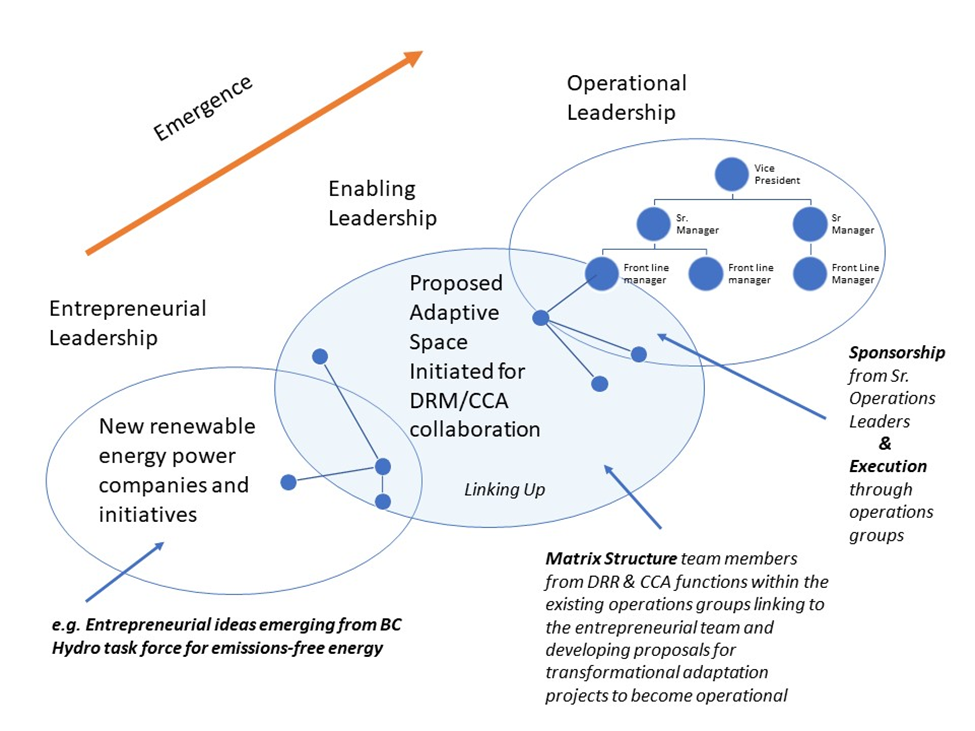
Figure 1: Application of Complexity Leadership Model – Adapted from Uhl-Bien & Arena (2017)
Figure 1 demonstrates how the complexity leadership model could be applied by creating an adaptive space within existing renewable energy organizations, starting with team members with responsibilities for DRM and CCA functions. This is where the enabling change leader comes in who can start in the fertile ground of shared purpose that exists between DRM and CCA and open an adaptive space for transformation ideas to take hold which could be operationalized through strengthening connections across leaders in the Entrepreneurial and Operational spaces. CCA is relatively new when compared to DRM and integration of capabilities across the practices are typically not well developed, though they share many commonalities (NIRAS, 2021). This brings additional challenges for the enabling leader.
By working across communities and establishing a goal of sustainable development, the enabling leader can engage senior operational leaders to request sponsorship of proposals emerging from the adaptive space. These ideas would have already been socialized through managers with whom they lead, and presumably trust, facilitating the progression of transformative ideas into sustainable, equitable climate solutions.
To illustrate potential outcomes from this model, one can look to examples of the clean energy initiatives of transitioning reliance on diesel fuel to micro grids, such as the one for the remote Indigenous community of Xeni Gwet’in (British Columbia, 2020). The initiative supports both a reduction in GHG emissions as well as the resilience of the community by providing 24/7 power and local reliability for the community to withstand climate change induced outages. With the introduction of additional power supplied through renewable sources such as wind, solar, and even ocean energy options, there will be new opportunities to explore transformative adaptations. This model builds on the concept of complex adaptive systems that can be found in nature, such as in bee colonies, where highly productive pollinators operate on simple rules and networked interactions (Uhl-Bien & Arena, 2017). Learning from nature, using the Complex Leadership Model for structure, perhaps it’s time for the creation of a Hive for Climate Action, opening space for cross pollinating ideas, and creating linkages to help emerging transformative adaptations stick.
Schipper, E.L.F., A. Revi, B.L. Preston, E.R. Carr, S.H. Eriksen, L.R. Fernandez-Carril, B.C. Glavovic, N.J.M. Hilmi, D. Ley, R. Mukerji, M.S. Muylaert de Araujo, R. Perez, S.K. Rose, and P.K. Singh, 2022: Climate Resilient Development Pathways. In: Climate Change 2022: Impacts, Adaptation and Vulnerability. Contribution of Working Group II to the Sixth Assessment Report of the Intergovernmental Panel on Climate Change [H.-O. Pörtner, D.C. Roberts, M. Tignor, E.S. Poloczanska, K. Mintenbeck, A. Alegría, M. Craig, S. Langsdorf, S. Löschke, V. Möller, A. Okem, B. Rama (eds.)]. Cambridge University Press, Cambridge, UK and New York, NY, USA, pp. 2655–2807, doi:10.1017/9781009325844.027. https://www.ipcc.ch/report/ar6/wg2/downloads/report/IPCC_AR6_WGII_Chapter18.pdf
Uhl-Bien, M. & Arena, M. (2017). Complexity Leadership: Enabling people and organizations for adaptability. Organizational Dynamics. 46, pp. 9-20. http://dx.doi.org/10.1016/j.orgdyn.2016.12.001.
Adam Lerner, co-founder of Solvable, helps organizations “live between worlds” in a civilization in transition, by learning how to diagnose, interrupt, and innovate (2023, RRU). Focusing on the initial challenge of diagnostics, I think a good place to start for adaptive leaders, educated in Western academia, is to spend time directly within communities most vulnerable to climate change, hearing their stories and learning from their perspectives.
In many areas of the world Indigenous peoples are the most vulnerable to climate change and have also shown incredible resilience learned through their Indigenous Knowledge Systems (IKS). To start the work of crossing the boundaries of Western science and IKS, we need to open space for healthier relations by surrendering our arrogance (Oliveira, 2022). Modernity has a hierarchy of worth that ‘deeply conditions how we relate to ourselves and to each other’ (Oliveira, 2022). According to Oliveira, to surrender we must first identify what the traits are and where they come from. Referencing the underprivileged status of IKS in academia, she cautions that surrender comes with loss for some and gains for others (Oliveira, 2022).
While I believe that this surrendering is necessary work for an adaptive leader, it brings me to a place of emotional discomfort as my experience has preferred technology over humanities. Hathoway (2019) in an assessment of the American Green New Deal (GND), argues that “Viewing Climate Change through a lens of environmental science and technology precludes any alternative perspectives that would affect our diagnosis of the problem and ensuing responses.” She argues that we need an intersectional lens to build relations across communities and to work towards social justice (Hathoway, 2019).
This is difficult for those of us working in organizations that are operating with increasingly constrained resources that leave little, if any space, for anything but prescriptive outcomes (RRU, 2023). This has been my experience, which aligns to the challenges described by Adam Lerner of Solvable. Lerner discusses the need for developing practices that prepare one to “sit in the zone of disequilibrium productively” (RRU, 2023, 6:04).
In my own attempt to both surrender my western arrogance, and condition myself to exist in this zone of disequilibrium, I made space to engage in dialogue with an international cohort, as part of a climate change field study in West Africa. The course started in my comfort area, with familiar academic research reports about the importance of biocultural heritage. In the field, I was quickly pulled out of my comfort zone while meeting with Indigenous community members and listening to stories of resilience in a place that has been dealing with climate change as a fact of life for thousands of years (Brown & Crawford, 2008). I listened to stories about ecosystem memories and what this has meant for biodiversity and migration and the resulting resilience of the people.
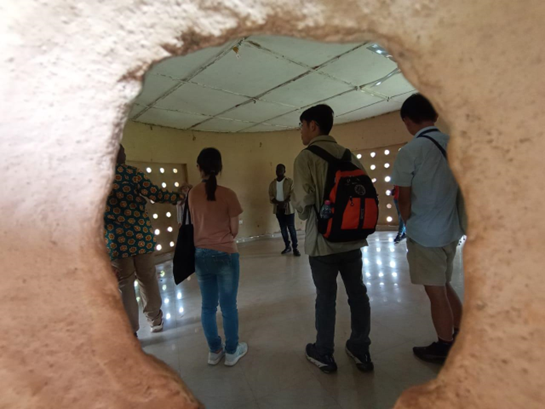
Midway through the program, while standing inside an Islamic stone building of an ancient design, I felt physical relief from the muggy heat and yet I was emotionally unsettled. The teachings were set against the backdrop of a religious landscape where over 95% of people practice a formal religion, primarily Christian in the South and Islamic in the North (HRW, 2018).
Having spent my career in the pursuit of technological solutions to a variety of problems, I have resisted looking back, feeling it was the anti-thesis to progress. I still find aspects unsettling, particularly with respect to women’s rights.
When culture is embedded in our stories, and we want to learn from Indigenous ways of knowing, what does it mean when that knowledge prefers some bodies over others, or worse, sanctions harm to those that do not comply to the norms of their dominant culture? This complicated moment of conflict between my physical and emotional response, made me reflect on Hathaway’s point about overlapping intersectionality, and how we need to consider people who are marginalized by the intersection of power structures. It may be impossible for those at the intersection to ask for justice and as a result, society may fail to grasp their issues (Hathoway, 2019).
Back in the safe comfort of my first world home I reflect on my experience. The words of the Feminist Cyborg Scholar, Donna Haraway, come to mind, “it matters which stories tell stories” (Haraway, 2017, 7:43). As a Lesbian, I struggle. I come from a place of privilege where I’m free and protected at home and yet was temporarily vulnerable in the physical space I found myself during this period of study. Even getting there took some self-talk to overcome my fear of willingly putting myself into a space where I would become one of the vulnerable. While Ghana’s laws against same sex relations are not the worst (jail vs. death sentence), they are not trivial (HRW, 2018). There is a distinct gap in the official government position on human rights and what was found in the Human Rights Watch research report (HRW, 2018). I want to surrender my first world arrogance and learn from the incredible resilience of the global south, but I fear their religious ways, and I question how to get to a just outcome for all. In the hard work ahead as a Climate Action Leader, there is so much parallel work needed to protect those trying to survive in the intersections of vulnerability.
The 2018 HRW recommendations to Ghana include a need to “… focus on addressing the intersecting forms of discrimination that affect lesbian and bisexual women—and ensure that the necessary legislative and policy measures are taken to ensure their safety, dignity, and equality” (2018, HRW). The question remains, who will surrender their arrogance? How will this be possible as the impacts of climate change continue to increase the stress on these communities?
Returning to Oliveira, and the need to surrender arrogance, she conjectures that it will take generations for systems to be recalibrated and to be working together on a level playing field (Oliveira, 2022). I worry for those who don’t have time to wait. While we need to mourn our losses (Haraway 2017) and to learn from the past (Oliveira, 2022) we can’t romanticize histories told by those in positions of privilege. It is in this work on the diagnosis that we can build confidence that we will be interrupting the right things before beginning the work of innovation. Climate Action Leaders need to do the emotional work that prepares them to ask the hard questions about norms and structures of power, and in the words of Haraway, work towards an equitable and just vision so that “what comes after will not be like what comes before” (Haraway, 2017, 7:43).
Reference:
Brown, O. & Crawford, A., (2008). Assessing the security implications of climate change for West Africa: Country case studies of Ghana and Burkina Faso. International Institute for Sustainable Development (IISD).
Haraway, D. (2017). Staying with the Trouble. [Audio book]. Chapter 4: Making Kin: Anthropocene, Capitalocene, Plantationocene, Chthulucene. Tantor Audio.
Hathaway, J.R. (2020). Climate Change, the Intersectional Imperative, and the Opportunity of the Green New Deal, Environmental Communication, 14:1, 13-22, DOI: 10.1080/17524032.2019.1629977.
Human Rights Watch (HRW). (2018). “No Choice but to Deny Who I Am” : Violence and Discrimination against LGBT people in Ghana. ISBN: 978-1-6231-35621 http://www.hrw.org
Jackson, S. & Humphrey C., (2022, JUL 28). (Yale Sustainability. Yale Experts Explain Intersectionality and Climate Change.
Machado de Oliveira, V. Release Date 2022-01-04. Hospicing Modernity. Facing Humanity’s Wrongs and the Implications for Social Activism. Audiobook. Audible. North Atlantic Books. Narrated by Dougald Hine. Copyright 2021.