At the start of the Climate Risk Management course I was re-immersed in researching Indigenous perspectives and reminded of the guiding principal of Two-Eyed Seeing developed by Mi’kmaq Elder, Albert Marshal, to bridge Indigenous and western ways of knowing (Bartlett et al., 2012). In previous courses I had learned of the value of storytelling as integral to Indigenous ways of knowing. In this course, I found myself embracing the power of story, while reaching beyond, to understand how the Two-Eyed Seeing principle would be applied when working across western science and Indigenous Knowledge Systems (IKS).
To get started in risk assessment work, I needed a deeper understanding of resilience. The ICLEI framework used across many Canadian Municipalities, was a good place to start as I considered community resilience from a disaster management perspective. The Public Infrastructure Engineering Vulnerability Committee (PIEVC) Green Protocol, provided additional value to consider critical infrastructure resilience from an Engineering-ecosystem perspective (2022). However, when I went deeper, considering the dynamic and interconnectedness of the social-ecological systems, I didn’t find a polished practitioner’s guideline. I did find an academic framework (Frazier et al., 2014) and a critique (Jozaei et al., 2022), both of which provided insights into the challenge of working with this complexity.
Considering social-ecological vulnerability requires going beyond adaptation to transformations that may be required. This is particularly true for coastal communities that are highly vulnerable to climate risks including sea level rise. These are places where vulnerabilities could require transformations such as switching from an established economic base or physically re-locating a community (Jozaei et al., 2022). This brought me back to contemplate the potential for stories to help participants visualize transformational change.
Telling good stories about climate change is not easy. The release of the IPCC AR6 synthesis report has renewed criticism of the failures of past climate science stories. For guidance, practitioners can look to guidelines from experts including Climate Outreach, De Meyer & Hubble-Rose, and Climate Access. A common thread across them is that a positive tone, and active story structure, play an important role in engaging audiences. Storytelling, framed around Shared Socio-economic Pathways (SSPs), can also help climate action practitioners employ futures thinking. Briefly, SSPs describe possible futures, based on policy decisions, and potential climate actions, that help visualize alternative futures, while also considering the tension between mitigation and adaptation challenges (Riahi et al., 2017).
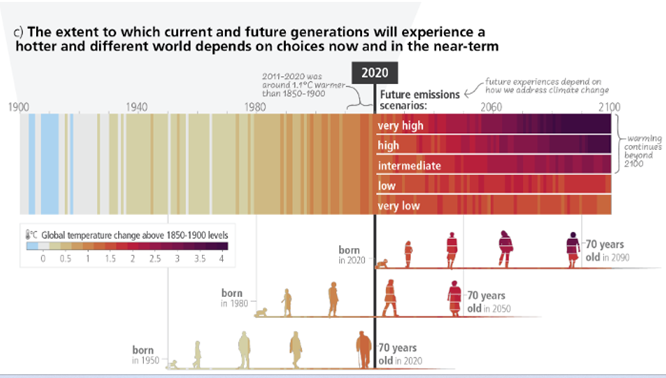
An example of how SSPs can be used to tell a future story is shown in this illustration from the latest IPCC synthesis report (Figure 1). This is an effective short story about how three demographic groups could experience a hotter and different future, as they age, ranging from the lowest likely temperature in SSP1 to the highest in SSP5 (IPCC, 2023).
Setting the future within the context of SSP1: Sustainability – Taking the Green Road, can prevent a hopeful story from turning into a fantastical utopia. There is an evolving term for this type of story, protopia. This term was originally used to describe incremental improvements over time, specifically tied to the acceleration of technology (Needelman, 2023, WordBuzz, 2011). More recently, it’s being adopted and redefined by futurists and sustainability experts as a framework for telling stories that incorporate designs for positive and equitable futures (Bielskyte, 2021, Narberhause, ND, Paiss, Z, ND, Luksha et al., 2017). This evolved protopian structure is well suited for inspiring climate action, as climate change impacts will not be felt equally across communities.
As a climate action practitioner, I need to know how to go beyond storytelling. I need to know how to work with subject matter experts to design pathways to this future. This work requires confronting the multi-parameter complexity of climate vulnerability risk analysis. I found a framework for this purpose in the Spatially Explicit Resilience Vulnerability (SERV) model (Frazier et al., 2014). SERV combines social and ecological data, in a spatially explicit manner, to support the analysis of resilience and vulnerability of social-ecological systems. However, I also found that assessments considering social-ecological resilience, although necessary, have been criticized due to their limitations stemming from the challenge of addressing the complex interrelated systems of humans and nature (Jozaei et al., 2022). At this point I found myself wondering how much complexity our human brains can effectively process.
I wondered if technology could help. Headlines touting the benefits of Artificial Intelligence (AI) are becoming common, but not as much is being said about Intelligence Augmentation (IA). While AI may seek to remove the need for the human in the task, IA seeks to enhance human ingenuity to improve decision making (IEEE,2023). IA has been used in medical analysis to identify treatment options, and similar areas that require processing immense amounts of data. In situations like these, human decision makers can become overwhelmed, fatigued, or distracted (IEEE,2023).
Given the volume, and often incompleteness of data, along with uncertainties inherent to climate change vulnerability analysis, it’s reasonable to assume there would be value in investigating the application of IA technologies. This raised the question of whether practitioners should rush to embrace such applications or proceed with caution, given the known bias inherent in western scientific methods.
Searching for an answer, I turned to the advances being made in Indigenous led research. Here I found an Indigenous protocol and artificial intelligence position paper. The protocol was used in an experiment by a team of Indigenous and Western project members to develop a mobile app to engage Indigenous youth in learning their native language (Lewis et al., 2020). The value of using experimentation, to explore transformative futures like this, was also identified by participants in the Jozaei et al. (2020) study critical of social vulnerability assessment methods. There are few spaces where experimentation across western science and IKS is taking place. One innovative program is setting out to change this, IndigeSTEAM. This is a program that provides support and mentors for Indigenous youth across the disciplines of Science, Technology, Engineering, Arts and Math (STEAM). The Federal government is also advancing in this direction with the new Federal Indigenous Science Division led by Myrle Ballard (ECCC, 2022). Ballard is starting with the principle of two-eyed seeing, and is researching the inclusion of Indigenous Peoples as environmental stewards, in an evolution to 3 voices and 3 eyed seeing (Ballard 2022). It’s advances like these that bring me constructive hope that new imaginings of transformative futures are on the horizon.
References
Bartlett, C., Marshall, M., & Marshall, A. (2012). Two-Eyed Seeing and other lessons learned within a co-learning journey of bringing together indigenous and mainstream knowledges and ways of knowing. Journal of Environmental Studies and Sciences, 2(4), 331–340. https://doi.org/10.1007/s13412-012-0086-8
Environment and Climate Change Canada (ECCC). (2022, Oct. 18). Indigenous science. https://www.canada.ca/en/environment-climate-change/services/science-technology/indigenous-science.html
Frazier, T., Thmpson, C.M., Dezzanie, R.J. (2014). A framework for the development of the SERV model: A Spatially Explicit Resilience-Vulnerability model. Applied Geography 51 (2014) 158-172.
IndigeSTEAM. (ND). Indigenous perspectives in STEM & STEAM opening doors for all. https://www.indigesteam.ca/
ICLEI Local Governments for Sustainability. (ND). Risk Assessment Process Framework. https://www.campbellriver.ca/docs/default-source/planning-building-development/risk-assessment-framework.pdf?sfvrsn=b6d36a08_0
IPCC. (2023). Synthesis Report of the IPCC Sixth Assessment Report (AR6). Summary for Policymakers. https://report.ipcc.ch/ar6syr/pdf/IPCC_AR6_SYR_SPM.pdf
Institute for Integrative Science and Health. (ND). Two-Eyed Seeing. http://www.integrativescience.ca/Principles/TwoEyedSeeing/
Lewis, Jason Edward, ed. 2020. Indigenous Protocol and Artificial Intelligence Position Paper. Honolulu, Hawaiʻi: The Initiative for Indigenous Futures and the Canadian Institute for Advanced Research (CIFAR). https://spectrum.library.concordia.ca/id/eprint/986506/
Luksha, P., Cubista, J., Laszlo, A., Popovich, M., Ninenko, I. (2018). Educational ecosystems for societal transformation (Global Education Futures report). GEFPress, Moscow and San Francisco. Retrieved October 30, 2018, from https://futuref.org/educationfutures
Needelman, J., (2023, Mar. 14). Forget Utopia. Ignore Dystopia. Embrace Protopia! New York Times. The Bright Side. https://www.nytimes.com/2023/03/14/special-series/protopia-movement.html
Public Infrastructure Engineering Vulnerability Committee (PIEVC). (2022, Nov). PIEVC Green Protocol: Integrating Ecosystem-based Adaptation into Infrastructure Climate Risk Assessments. https://www.adaptationcommunity.net/wp-content/uploads/2022/11/2022giz-en-pievc-green-low-res.pdf
Riahi, K., van Vuuren, D. P., Kriegler, E., Edmonds, J., O’Neill, B. C., Fujimori, S., Bauer, N., Calvin, K., Dellink, R., Fricko, O., Lutz, W., Popp, A., Cuaresma, J. C., Kc, S., Leimbach, M., Jiang, L., Kram, T., Rao, S., Emmerling, J., … Tavoni, M. (2017). The Shared Socioeconomic Pathways and their energy, land use, and greenhouse gas emissions implications: An overview. Global Environmental Change, 42, 153–168. https://doi.org/10.1016/j.gloenvcha.2016.05.009
Smitsman, A., Laszlo, A., & Luksha, P. (2020). Evolutionary learning ecosystems for thrivable futures: crafting and curating the conditions for future-fit education. World Futures: The Journal of General Evolution, 76(4), 214–239. https://doi.org/10.1080/02604027.2020.1740075
WordBuzz: Protopia. (2011, Sep). The Futurist, 45, 2. https://www.proquest.com/magazines/wordbuzz-protopia/docview/884627225/se-2