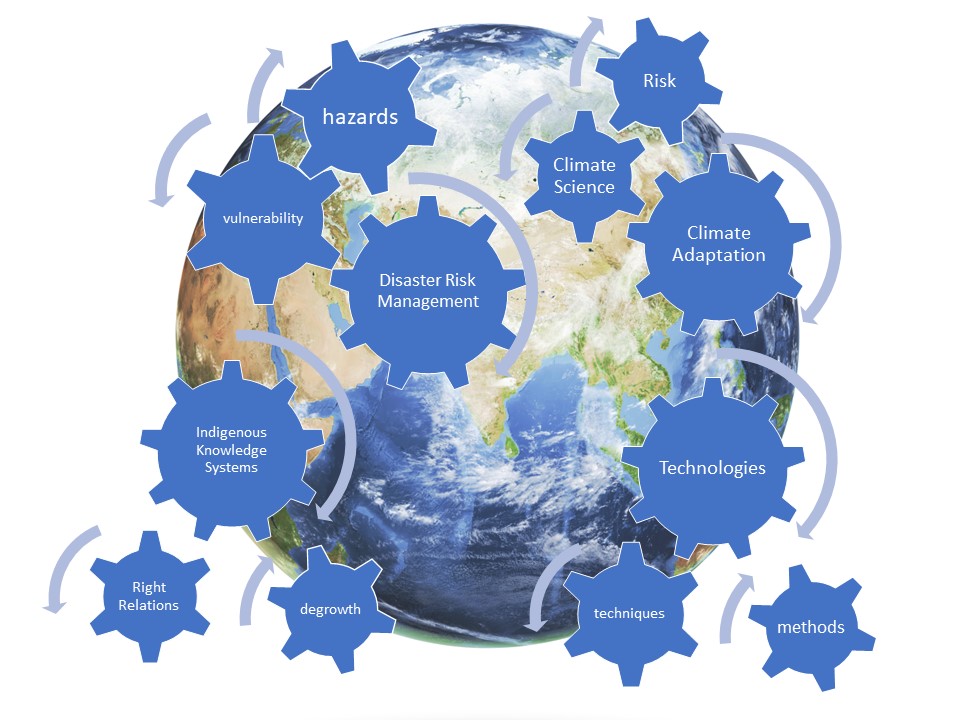
My take-away from the first year of the MACAL program is that it was designed to prepare climate action leaders with core competencies to research, analyze and design climate action projects. So far in the program I’ve worked with my professors and peers to co-construct learning products that demonstrate my competency across communications, climate science, and risk management. In the last course I’ve drawn from these skills to develop a business case for climate action. Does this mean that I’ve reached the pinnacle of learning how to be a climate action leader? Is it enough to have learned to identify, design, and make the case for climate solutions?
I wonder if we have what we need to work through the dialectical tension that comes with working across disciplines. I wonder how, when new transformative ideas result from transdisciplinary efforts, that they will be received by the practitioner’s individual disciplines.
What tools and skills are needed to help make change take hold and for transformative ideas to stick? It’s with these questions that I look forward to the next course, CALS 505 – Leading Change in the Context of Climate Change.
In anticipation, I watched Denise Withers’ TEDx Talk, How to Make Change Easier with Narrative Intelligence, where I discovered a hint that we may be returning to the theme of the power of story. This makes sense. Many successful leaders have learned how to tap into the power of story to inspire. A recent leadership example comes from Sanna Marin, the youngest person to ever be appointed as the Prime Minister of Finland.
While receiving an Honorary Doctor of Humane Letters, Marin delivered an inspiring commencement message to New York University’s Class of 2023. Starting out with the charge that “the face of power is not the same as the face of the people—and this has to change” (Marin, 2023).
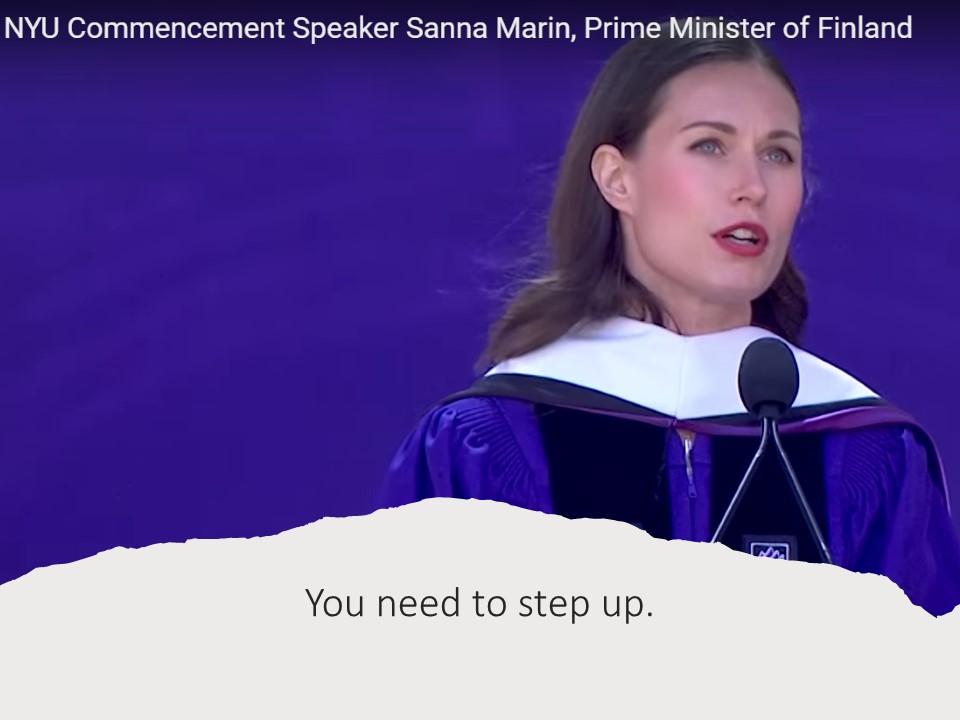
a NYU Commencement Speech (Marin, 2023)
Marin emphasized 3 key messages for the new grads, while challenging them to step up:
You have to want things to change
Wanting is not enough, you need to take over
Don’t be afraid
Marin painted a global backdrop of intersecting vulnerabilities and then enumerated several problems that are awaiting the application of the talents of emerging leaders, not least among them, climate change.
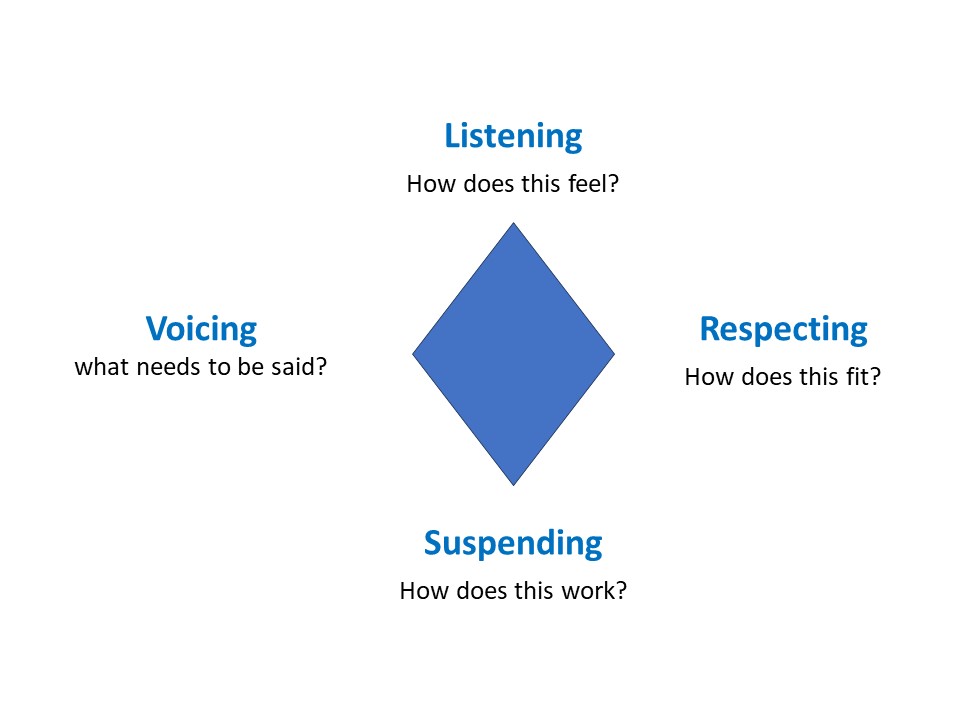
Climate change is widely considered to be a wicked problem. The use of the adjective ‘wicked’, to describe problems that are swirling in complexity, has been evolving since the 1970s (Rittel & Webber, 1973 cited by Cormon & Cox, 2020). So, while I’m inspired by Marin’s advice, I also wonder if inspiration is enough to lead solutions designed to address wicked problems. I wonder about the need for competencies such as the power of dialogue for working across opposing world views. We know that “[w]ith wicked problems there is a slipperiness, high levels of uncertainty, and high stakes” (Corman & Cox, 2020, P.4). Combine this with the urgency that comes from being constantly bombarded with climate doomsday headlines. Is it any wonder that, when it comes to the topic of climate change, “…we have largely lost the ability to simply talk and think” (Isaacs, 1999, P.78). In dialogue, and the art of thinking together, Isaacs is speaking of this loss more broadly as he describes the fundamentals of dialogic skills. He proposes four dialogic practices as required building blocks (Figure 1). Starting with truly listening without resistance to the words being spoken, showing respect through awareness of the other’s position, suspending judgement, and then using your voice, to speak your truth (Issacs, 1999).
Dialogue is a foundational practice needed by transdisciplinary leaders because as Corman & Cox (2020), citing Bohm (1990), remind us, “[d]ialogue makes the emergence of new understandings possible” (P.14). After considering dialogue, the next question that arises for me is: what happens when, after the practitioners, skilled in dialogue, triumphing over dialectical tension, with transformative ideas in hand, return to their own disciplines, and are met at the door by stubborn resistance to change?
To enact change, are technical skills combined with dialogic skills, enough to work through cultural resistance? Transdisciplinary leaders need to help make change happen. The competency not yet explored, change leadership, holds the promise of helping emerging climate action leaders to engage others in the necessary work towards change at all levels, from the individual, to communities, to the broader societal shifts that are needed.
Without competency in dialogue, as well as change leadership, new ideas may not get a chance to grow into the solutions that hold the promise for better futures. Contemplating the message in Withers’ TedX Talk, I return to dissect Marin’s speech. I realize part of Marin’s power to inspire the future leaders in her audience is in her mastery of narrative. I experienced this power viscerally while watching. I had my own ‘aha’ moment as she explained that if she had waited for permission to step into politics, she’d still be waiting. It was her personal story that connected me to my own stories, where too many times, I had waited for permission to act, and in doing so, lost the opportunity for the changes I desired. This idea of connecting through stories has stood the test of time. In her talk, Withers suggests that one of the reasons we are on the brink of collapse on so many fronts, not just climate change, is that we’re stuck in our own stories. She suggests that building a competency in “narrative intelligence gives us the power to create the future we want” (Withers, 2023, 10:30). So it is with constructive optimism that I’ll enter this final course, ready to put the cap on the Graduate Diploma, by learning the skill of change making.
References
Corman, I. & Cox, R. (2020). Transdisciplinarity: A Primer. Royal Roads University. https://commons.royalroads.ca/macal/wp-content/uploads/sites/88/2021/04/MACAL_Transdisciplinary_Thinking03-31-21-3.pdf
Isaacs, W. (1999). dialogue and the art of thinking together: a pioneering approach to communicating in business and in life. Doubleday.
Marin, S. (2023, May 17). New York University Commencement Speech. [Video]. YouTube. https://www.youtube.com/watch?v=eMms7FVLSiI&t=266s
Wallston, K.A. (1994, Apr.) Cautious Optimism vs. Cockeyed Optimism. Psychology and Health 9(3):201-203. DOI: 10.1080/08870449408407480. https://www.researchgate.net/publication/232606472_Cautious_Optimism_Vs_Cockeyed_Optimism
Withers, D. (2022, Apr. 20). How to Make Change Easier with Narrative Intelligence. [TEDx Talks]. YouTube. https://www.youtube.com/watch?v=5paqr2IN_zU