If I had to choose one word to describe the learnings from the first week of the Masters of Climate Action Leadership it would be hopeful. This is partly due to the standout session where I had the honour of participating in an Indigenous circle led by Michael Lickers. My team had asked what his perspective on what a decolonized world would look like. I thought it would help to have a hopeful vision as a guide for future practice. Michael quickly reminded us that, as described by Gram-Hanssen (2021), decolonization is itself a colonizer’s word and thus problematic. He then went on to expand on the concept of transformation being about coming up with something new rather than destruction, which is a concept that I’m learning through this program and, which in itself is a hopeful future vision.
As we engaged in further dialogue I was drawn deeper into the concept of ‘right relations’ and I realized that I have much work to do to embody the characteristics put forward by Gram-Hanssen: listening deeply, self-reflexivity, creating space and being in action. (2021)
“Right Relations, then can be seen as an obligation to live up to the responsibilities involved when taking part in a relationship – be it to other humans, other species, the land or climate.”
(Gram-Hanssen 2021, p.678)
Later, as I reflected on our talk and readings on the topic, I was gazing at ‘Eagle Spirits’, a John Rombough painting, on the wall in my home office, and it made me wonder about the artist’s story and how right relations may have impacted him and his community. This was my first purchase of an original work of art which, at the time, made me feel as though I had stepped through the threshold into adulthood. Rombough credits his birth mother’s Ukranian Heritage for also informing his style, a style which a local critic opines is an extension of the Indigenous Group of Seven. (Grunwald, 2022, para. 31) For me this is an interesting visual example of the possibilities of transformation.

Eagle Spirits, Lutsel K’e, NT by John Rombough 09/22/2000
In the circle we discussed the importance of being able to participate in the economy, such as it exists, and it made me wonder if this young artist was able to go on to thrive in his work. I Googled him and this small act of academic procrastination took me to a place of deeper understanding of the assigned readings. Not only did I feel good in knowing that Rombough is doing well, as told in his own words in an interview with CBC News (Grunwald, 2022), but it brought me to a place of deeper connection of the kind described by Gram-Hanssen. (2022) as I read about how his family was impacted by the the ‘sixties scoop’. (Grunwald, 2022, para. 10) I then explored a bit more about his community and found a good example of ‘right relations’ in action through the Indigenous Guardian Program and the Ni Hat’ni Dene Rangers in Lutsel K’e. The kind of reconciliation programs that feel in tune with the concept of right relations. However, the impact of this one reconciliation program seems to be relatively small for the community. The overall economic outlook isn’t as positive as shown in this excerpt from their Community Infographic produced by the Northwest Territories Government.
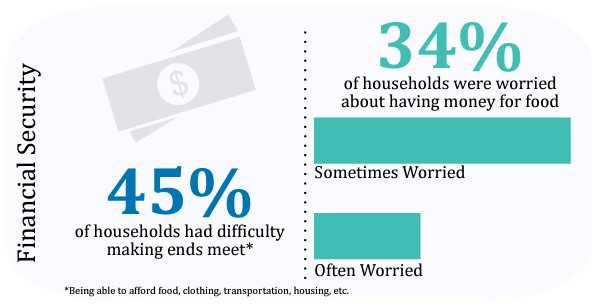
Equitable participation in the economy?
(Government of Northwest Territories, 2022)
I’m reminded of how we are all connected and how important engaging in the act of righting relations is if society is to over come the climate crisis and move from adaptation to a more hopeful transformation. For me, philosophically, this concept of transformation was my first surprising new learning of the program so far. I find it empowering to reframe how I was thinking of climate adaptation as only in the negative rather than as an opportunity for “generating equitable and sustainable transformations.” (Gram-Hanssen et al., 2022, p.773).
As I write and reflect on these ideas I’m taking my first aspirational steps towards a deeper understanding of what it means to create space for voices of the oppressed to be heard by “decolonizing our practice at every turn.” (Gram-Hanssen, p.681). I’m sharing my thoughts and hoping for feedback to foster dialogue with those outside of my typical circle to help me develop transdisciplinary thinking in my practice. My goal is to get to that place where we can envision solutions that help to address the complex and wicked problems that the climate crisis presents. (Corman & Cox, 2020)
References
Corman, I., & Cox, R. (2020). Transdisciplinarity: A Primer. Royal Roads University.https://commons.royalroads.ca/macal/wp-content/uploads/sites/88/2021/04/MACAL_Transdisciplinary_Thinking03-31-21-3.pdf
Government of Northwest Territories. (2022). Lutselk’e 2019 Community Survey. Downloaded 2022-05-14 from www.statsnwt.ca/community-data/CommunityInfographics/community%20-%20Lutselke.pdf
Gram-Hanssen, I., Schafenacker, N., & Bentz, J. (2021). Decolonizing transformations through ‘right relations.’ Sustainability Science, 17(2), 673–685. Retrieved 10 May. 2022, from https://doi.org/10.1007/s11625-021-00960-9
Grunwald, Emma (2022, March 13). Finding his Dene family brought colour into John Rombough’s art. CBC News. https://www.cbc.ca/news/canada/north/artist-john-rombough-dene-connection-1.6383392
Indigenous Leadership Initiative. New Video spotlights indigenous guardians leadership on the land. Retrieved 10 May 2022, from https://www.ilinationhood.ca/blog/new-video-spotlights-indigenous-guardians-leadership-on-the-land
Rombough, John. Eagle Spirits. 2000. Oil. Vancouver.
Smith, M.(2016). Indian Group of Seven . In The Routledge Encyclopedia of Modernism. : Taylor and Francis. Retrieved 15 May. 2022, from https://www.rem.routledge.com/articles/indian-group-of-seven. doi:10.4324/9781135000356-REM835-1