Who Should I Invite to Take Part in My Research?
In addition to determining sample size, you also need to determine what types of people are going to be in your sample. These two factors together help you answer the “Who” of your 5W questions to design your research.
Tips from the Professor: Qualitative sampling is also sometimes referred to as non-probability sampling. Non-probability sampling means you cannot use statistics to make claims about the probability of finding a certain result if you use these sampling approaches. But that’s ok – qualitative research isn’t about finding probabilities, it’s about gaining deeper knowledge about things that cannot be measured probabilistically.
Different Sampling Strategies:
- Quota sampling:
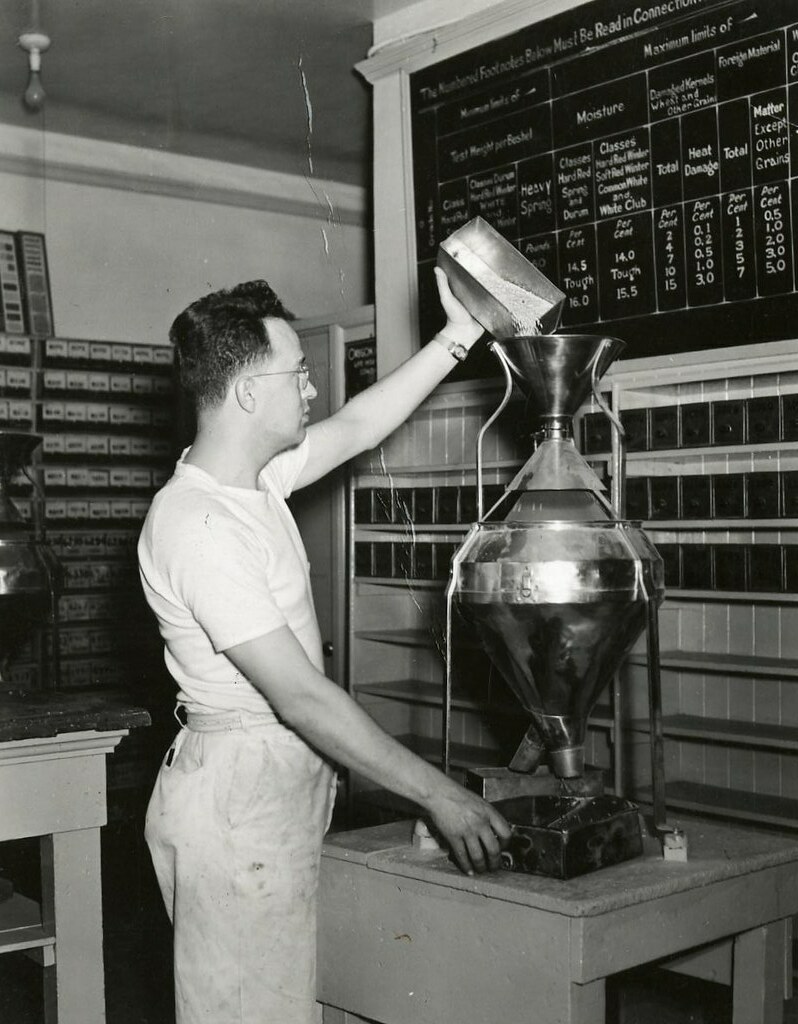
“Grain sampling” by Oregon Department of Agriculture is licensed under CC BY-NC-ND 2.0 You might be interested in finding out about a certain group of people (francophone students in Ontario, or indigenous women on Vancouver Island, for example. Quota sampling is where you choose your participants from the subgroups that you are most interested in.
- Purposive sampling: You may be studying a specific population. With purposive sampling, you choose your participants specifically to mimic the characteristics of the larger population you are interested in. So, you choose a certain percentage of women, men, caucasian and participants from different ethnic and cultural group so as to mimic the properties of the population of Ottawa, you have engaged in purposive
sampling.
- Convenience sampling: Is choosing your population based on – you guessed it – convenience! Two examples of convenience sampling include: 1. Seed and Snowball – where you start with people available to you and have them refer you to others, and 2. Sampling based on a population already known and accessible to the researcher.
- Convenience sampling is the least reliable of the three approaches, but sometimes is unavoidable (for example, asking visitors to a website if they’d like to complete a survey).
Want more advice? Check out this video on non-probability sampling techniques from MeanThat (11 mins):