Following on my previous post related to the privacy paradox, today I’m interested in discussing a curious social media related behavior that I’m calling the trust paradox.
Fake news
21st Century PR: When All Else Fails, Pretend You’re a Journalist
Despite all the wailing and gnashing of teeth about fake news, biased journalism, and journalists as “very bad people“, the very people complaining the loudest about the press seem to be those who are most adept at manipulating it. Take for example, the current President of the United States, who employs a combination of direct to consumer social media tactics, and also maintains strong relationships with non-professiona,l we-cannot-really-call-them (cough cough) news organizations like infowars, in order to perform the idea of news while supplanting the actual purpose entirely.
Continue reading “21st Century PR: When All Else Fails, Pretend You’re a Journalist”
Social Media and Information in a Post Cambridge Analytica World
I was fortunate enough to attend two great International academic conferences in the last two weeks. The first, The International Conference on Social Media and Society, took place at the Copenhagen Business School, and the second, the IEEE Professional Communications Conference, took place at the University of Toronto. The first conference was entirely about research having to do with social media, and included a panel about how social media research must change now that platforms are cutting access to their API’s in the wake of the Cambridge Analytica scandal. The second conference was, broadly speaking, about technical communication, but included a plenary about how the ways we communicate can either facilitate accuracy, truth and information access, or undermine all of these things. The IEEE Professional Communications Conference also included panels centred around using social media to teach and research communication. Now, after both of these conferences, I have a few reflections of my own on social media, data gathering, research and access to information in a post Cambridge Analytica world.

- Post truth issues such as “alternative facts”, polarization, and propaganda cannot simply be countered with more information. It is clear that people are not swayed by data. Providing additional arguments to back up your claims will likely be countered with additional false information from the other side. The information bounty of online spaces facilitates this. So if we can’t counter mistruths or propaganda with more information what can we do?
- HOW you tell your story is very important in this context. This means that if you really want people to have access to truthful information, you have an obligation to present that information in a way that is accessible, including using plain language and easy-to-understand images, and telling a compelling story whenever possible. Humans tend to respond to narratives better than they respond to straight repetition of facts, so science communicators and researchers need to think about how we can remain faithful to the facts while also telling a compelling story.
- Research therefore, and necessarily must focus on people – what do they want? What resonates with them? How do they access information? What do they believe to be true, and how does this influence how they engage with one another and with the information environment? Since access to API’s is becoming much more difficult in the wake of Cambridge Analytica, we will be challenged to come up with new methods for understanding what people do online, but this is also a wake up call for researchers, as we were becoming quite complacent scraping twitter for the low hanging fruit of our research, without having to ask critical questions about the limitations of API scraping.
Continue reading “Social Media and Information in a Post Cambridge Analytica World”
If Something Seems Right… Try To Find the Opposite
Digital communication and PR professionals recognize a few truisms about online communication:
- Strong emotions get shared more often on social media.
- People tend to share things they really strongly agree or disagree with.
- Google and Facebook tend to tailor or curate your feeds, giving you more of the stuff you already like, because that’s what we tend to view as more relevant.
- Messages that are easily digestible and meet criteria 1-3 will be more shareable than ones that are not.
In this information environment then, if you want to get your message out, you try to craft something that arouses a strong emotion and is specifically targeted at the audience you want to reach. If you don’t believe me, then think about how Trump’s campaign so masterfully employed Facebook targeting to reach their key demographics. While many still claim that Russian meddling helped to win the election, in reality it was strong, emotional and tailored content that won the day.
Continue reading “If Something Seems Right… Try To Find the Opposite”
Social Media Mindfulness Is Not Enough

It used to be only a few voices on the margin: Ian Bogost, Sherry Turkle, Geert Lovink, or Evgeny Morozov, for example, who urged people to think a little more about the time they were spending on social media. But soon the whisper grew and now the movement may be reaching the mainstream. With the rise to prevalence of former Google design ethicist Tristan Harris and his Center for Humane Technology, and with the Facebook Privacy/Cambridge Analytical scandal all over congress and the world news, people are starting to have conversations that were considered almost laughable before. Continue reading “Social Media Mindfulness Is Not Enough”
Civil Society: Gone to the Bots?
Civil society is defined by the London School of Economics as:
“Civil Society refers to the arena of uncoerced collective action around shared interests, purposes and values. In theory, its institutional forms are distinct from those of the state, family, and market, though in practice, the boundaries between state, civil society, family and market are often complex, blurred and negotiated. Civil society commonly embraces a diversity of spaces, actors and institutional forms, varying in their degree of formality, autonomy and power. Civil societies are often populated by organizations such as registered charities, development non-governmental organizations, community groups, women’s organizations, faith-based organizations, professional associations, trade unions, self-help groups, social movements, business associations, coalitions and advocacy groups”
I’d like to put the emphasis on “uncoerced collective action” in that definition, because I’d like to talk about how civil society might be challenged or at least threatened in an era where we organize using digital communication technologies.
Social Media, the Separation of Time and Space, and a Plea for a Critical Look at Technology
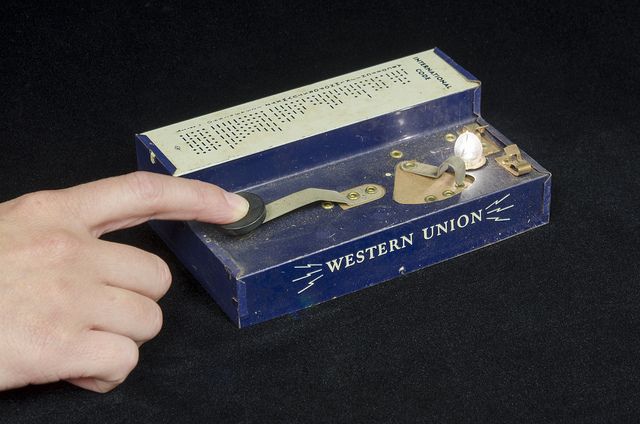
Considered by James Carey to be the first medium of electronic communication, the telegraph was a revolutionary development, since it was the first communication medium to separate time and space for the purposes of communication. Before the invention of the telegraph, message speed was bound to how fast a messenger could travel: by foot, horse, or railroad. After the invention of the telegraph, messages could travel faster than a messenger ever could. This development thus had ripple effects on markets, democratic participation and community.
Celebrity “trumps” truth: The key difference between the liberal press and Twitter
Today, The Verge published an article stating that Twitter has drawn a small line in the sand with respect to the tweeting habits of the 45 president of the United States. Adi Robertson reports that Twitter has suggested that while it is important not to censor or remove important public figures like the president from the platform, it will draw the line at “tweets that reveal a private address or phone number”. Of course, not all people agree with this stand. For example, Sam Harris clearly stated in a recent podcast that he thinks Trump should be banned from Twitter, since the damage he can do via a Tweet is just so great. Twitter’s response though, is one worth considering. When is it appropriate to silence a public figure on a platform like Twitter? And when is it actually in the public interest to support a person’s right to make even crazy or patently false claims on the site?

Twitter politics, polarization and a lack of trust in media: The case of #cdnmedia
One of the hallmarks of the last year of US politics has been a steady stream of messages from the president about “fake news” or the “lying media”. Arguably, this has been a mainstay of Trump’s political strategy since he announced his run for the presidency, and it remains a tactic that he employs, and his followers seem to take at face value. So it’s not surprising to learn that in the US, trust in traditional media is at an all time low. In fact, recent research from the American Press Institute and Associated Press shows that 41% of Americans report having hardly any confidence in the traditional press.

What was surprising for me though, as a Canadian researcher, was learning that this is more than just an American issue. In Canada, Statistics Canada reports that only 40% of Canadians report feeling confidence in the national media. With so much information available from so many different sources, it seems as though we just don’t know who or what we should trust anymore. This is true in 2017 and, unfortunately, my research also shows evidence of this trend as early as our Federal election in 2015. We collected thousands of tweets in the month leading up to the 2015 federal election, and we analyzed a sample of them using corpus analysis software along with human content analysis.
Why Does Fake News Spread on Social Media? Because Of Our Caveman Brains
In a world of 24/7 cable news, round the clock Amazon Deliveries, and infinite social media notifications, it’s been difficult to not notice how the ways we interact with each other and information is changing each passing day. Chief among these changes of course is the problem of fake news (#fakenews, I guess) or the spread of misinformation in an online environment. Some people blame Facebook and Twitter, who are currently in the news for the role their platforms played in Russian trolling of the 2016 US election. Their involvement notwithstanding, it seems to me that though the platforms had a role to play in the spread of fake news, it was more a passive role in which they took advantage of human frailty, rather than an active one in which their algorithms spread fake news because it’s more exciting content or something. Allow me to explain.
Continue reading “Why Does Fake News Spread on Social Media? Because Of Our Caveman Brains”