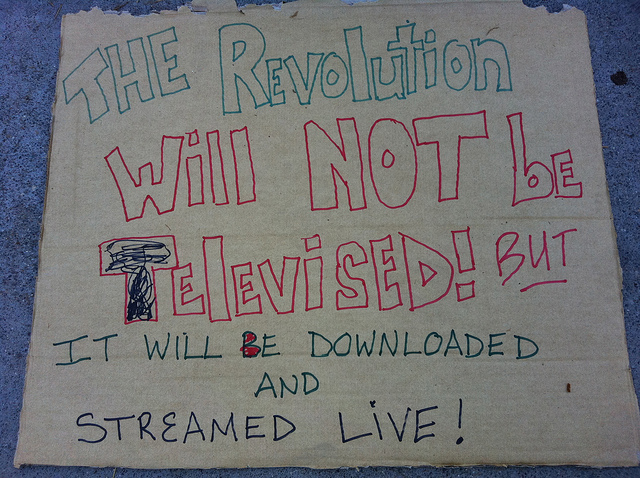
When the participatory web was new, activists and researchers alike were excited by the potential of this new medium to connect groups without the need for conventional gatekeepers. Because social media allows anyone to post information that anyone (everyone) else can theoretically access, it changed the broadcast model of communication from a one to many (or point to multi-point) to a many to many (or multi-point to multi-point) system. Initially, this change delivered on its promise, facilitating movements like #occupy, #idlenomore, and #blacklivesmatter. More recently, however, even though social media still connects people and facilitates some political organization, it has also revealed its darker side.
The 2016 US election revealed part of this dark side. Regardless of whether Russian propagandists are in part to blame for the spread of misinformation through online channels, the fact remains that the affordances of this medium contributed to misinformation and incomplete information whether or not it was deliberately spread. Media logic theory, developed by David Altheide and Robert Snow suggests that the form and content of popular media, and specifically broadcast news is driven by the need for broadcasters to create a compelling and dramatic story that will hold viewers’ attention, produce strong ratings and thus help attract advertisers. Building on this, Josee van Dijck noted that social media has its own media logic, that has both the same requirements as broadcast media, but also includes datafication, programmability, popularity and connectivity.
Connectivity means that we’re connected to each other, and to brand messages in new and compelling ways. It also means that people who were not previously connected can reach one another – making it easy for example for outside forces to influence the spread of information during an election. Popularity means that popular opinions rise to the top, becoming ever more popular. Rather than editorial decisions, the performance of a post and initial popularity of the poster will impact whether others see the post more broadly. This is why cute cat videos spread much more easily than information about the local economy. Datafication refers to the ways that social media can quantify things that have never been quantified before, such as likes, shares and relationships, and finally programmability refers to the ways that our lives, including our ability to send and receive information, are influenced by the often opaque actions of developers who tweak the platforms regularly, often without users knowledge or consent.
These characteristics of social media have been exacerbated by the public offering of social media platforms. It’s not cheap to run a large global online platform to begin with, and when the platforms then have the added pressure to make money for their shareholders, of course their priority must be to create an online environment amenable to advertising. This online environment is then not necessarily the best one for citizens to connect with each other on a level communication playing field. Popular posts and sponsored posts always take priority in our feeds.
When we looked at the types of posts that were trending on Twitter during the 2015 Canadian election, we saw celebrity users producing posts that spread much farther than other users. We saw messages that echoed the trends in the mainstream media. We saw an absence of topics that were of interest to smaller communities or diverse populations, and finally, we saw controversial or dramatic posts trending more than boring but politically important information. Our findings thus show that social media messaging both conforms to a broadcast media logic and social media logic. Other research also backs this up, showing that news actually makes up a small percent of social media posts, and when it is used, it tends to be used as a broadcast communication tool primarily employed by large existing news networks.
So does social media level the communication playing field, and is it still useful for independent actors looking to organize for the purposes of influencing political decision making? It’s difficult to say. I would suggest that when it does happen, it’s despite the media logic of these technologies rather than because of them. It’s better than a pre-internet communication ecosystem, but the halcyon days of social media are likely behind us.