In recognition of the Canadian winter and the polar vortex, today I’m going to use the concept of wind chill to discuss science communication.
Recently, a 2016 article by Vox has been popping up in my social media feeds. TItled Wind chill is a terrible, misleading metric, it discusses how, over the years, a wind chill index has been replaced by the concept of a temperature equivalent, and it argues that this temperature equivalent obscures as much about the weather conditions as it reveals. The article goes on to suggest that we do away with wind chill altogether, and instead adopt more accurate metrics of the temperature, such as the Universal Temperature Climate Index.
“Jak & Nic – Cold” by craigmdennis is licensed under CC by 2.0
“Sleepy hacker” by thomasbonte is licensed under CC by 2.0
These companies make money by ensuring we spend as much time on their platforms as possible so they use various tricks like creating an illusion of choice, hijacking our natural tendencies as social animals, and producing the compelling draw of variable rewards to capture and hold our attention. In his article, Harris makes suggestions for why each of these tactics is problematic for people, community, and society, and he also suggests different ways we could design and approach technology in our lives. I’d like to build on his ideas specifically with respect to weaponized misinformation and propaganda. Harris doesn’t really get into this in his article, but I’d like to suggest why I think the hacking of the human mind has left us far more vulnerable to this type of message manipulation.
Propaganda is not new, nor is the attempt of foreign powers to sow the seeds of division among the population of a country against which they are engaging in information ops. For example, in the 1950s and 1960s, Russia helped to support the burgeoning human rights movement as a way to sow deep division and distrust of power. It’s a complicated relationship, and one that likely had both intended and unintended outcomes.
When social media platforms hack our brains for attention, they have also super charged the propaganda, misinformation and black ops tactics that were already being deployed at a slower grassroots scale. Just as we are wired to seek variable rewards from social media notifications, we are wired to respond to emotionally charged (particularly negative) posts. The human mind, evolutionary speaking, is optimized to ignore the mundane but attend to threats to ourselves or our tribes. Thus when we see a viral video showing a confrontation between two groups, one of whom we identify with, we will be likely to pay attention to the video and then share it with our tribe without thinking critically about what is not shown on the video.
This type of uncritical engagement with media is not particularly new either. As anyone who has taken a media studies class can tell you, we tend to trust what we see with our own eyes, which is why video is so successful a medium for building and reinforcing cultural norms. But as social media platforms use popularity and auto play to hold our attention, they also facilitate the spread of video, increasing the global scale at which they can effectively influence people’s views.
So as Harris points out, we are all being hacked for our attention. And as the companies hack our brains, they pave the way for propagandists to do so as well. This adds additional weight to Harris’ call for a social media bill of rights, and I would add, suggests that we need to carefully think through the question of regulation for platforms and whether we need to develop an international and enforceable standard of practice.
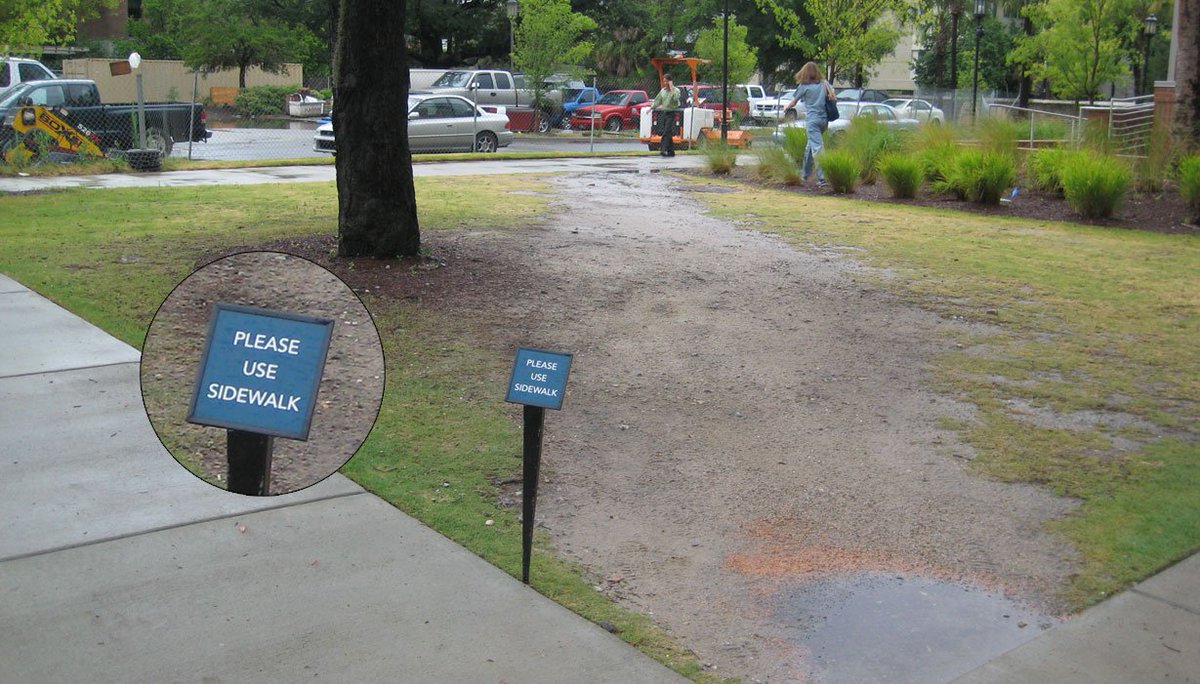
Design vs. experience: by Dale Calkins on Twitter: https://twitter.com/dalecalkins/status/774998979054415872
Information alone is not enough to change behavior. As the image above shows, if people have good reason to behave a certain way (in this case to cut the corner across a grassy lawn rather than taking a purpose built path on the sidewalk), they will keep behaving in that way, even if told otherwise (please use sidewalk).
With COP24 coming to a close at the end of this week, climate change has been relatively newsworthy which likely means that people are more likely to use their favorite search engine to search for information related to climate change. In a recent survey by the Association for Canadian Studies, Canadians reported that they believe the Internet makes them smarter, and they feel they do not have to remember facts or events because they can so easily search them online.
But is it wise to trust search engines as information sources? A growing number of critical information scholars, including Safiya Noble would say otherwise. In honor of COP24, I decided to test the two most popular search engines on the topic of climate change. I entered “climate change is” into both Google, Yahoo and Bing and took screen capture images of their suggested searches. The differences were very interesting.
Well most of us have, anyway. The infamous addendum to your Twitter bio. Come on, you know it – it goes something like this: “RT’s are not endorsements” or “RT’s do not equal endorsements” or something along those lines.
Heck, I have one myself, you can check it out on Twitter if you look up @SocMedDr. It serves as a little disclaimer. A little “I may not have done my homework, but I liked a tweet so I retweeted it, don’t hassle me later” disclaimer.
“Twittering your Business 06: retweet” by Hugger Industries is licensed under CC by-nc-sa 2.0
And today, I’m going to tell you why I think we’re all wrong to do this. Especially now in an age of online information operations and fake news.
Think about the last time you shared something on Facebook or Twitter. What was your primary motivation for doing so?
“Can You Etch It – Social media refrigerator magnets – Laser engraved” by Alan Reeves is licensed under CC BY 2.0
Perhaps it was because you learned about some news or current events that you felt others should know about. Perhaps it was because you saw a cute video or picture that you thought other people would like to see too. Perhaps it was because you saw a pithy quote or saying that you felt really described the way you were feeling in that moment, and you wanted to convey that feeling to other people in your network.
So, in the news last week, it turns out Facebook behaved like many other large and not particularly ethical companies. Sheryl Sandberg is implicated in the hiring of a right-wing PR firm known for it’s “black ops” style engagement. This firm created messages suggesting that anti-Facebook activists had ties to George Soros (a known Republic dog whistle tactic). It has also been suggested that Sandberg wanted to suppress information about Russian election meddling (even the information which originated from Facebook’s own security people. All this and more is detailed in a recent New York Times article that commentators are saying shocked, and I mean, SHOCKED!the world.
We are living in what some call an era of unprecedented global information flows. Participatory online communication technologies such as social media have allowed anyone with access to the internet to upload information for anyone else can see. Though not everyone participates as an active prosumer of information, enough people do that we are overwhelmed with information. 300 videos are uploaded to YouTube every minute, five new Facebook profiles are created every second, and every second about 6,000 tweets are posted to Twitter. The numbers are mind boggling.
“Information overload! #streetart #berlin” by Acid Midget is licensed under CC by 2.0
I have spent the bulk of my week at a fantastic academic and policy related conference that brings together scientists and leaders from a wide variety of fields. What’s really been great about this experience is it’s commitment to engaging with a variety of disciplines. We’re not just seeing health scientists, researchers from STEM fields, or social scientists and humanities scholars, but truly a variety of perspectives from across the research spectrum. Another strength of this conference, which I realize now has not been part of my general conference experience is I’ve noticed a real effort to balance gender representation on the panels. Most of the panels I have attended have either had equal numbers of men and women present, or had greater numbers of women and men, reflecting their attendee balance, which identifies as about 60% women.
“Bill Bernbach diversity scholarship posters” by Juan Carlos Pagan, Brian Gartside is licensed under CC BY-NC-ND 3.0
According to recent research at the Social Media Lab in Toronto, Canada, Canadians are somewhat comfortable with academic researchers accessing their social media data. 56% of Canadians indicate that they are ok with their data being used for academic research purposes. In contrast, only 34% of Canadians feel comfortable with marketers accessing their social media data, but this discomfort is unfortunately at odds with the way social media companies make money, meaning every day Canadians are exposing themselves to the groups which they don’t really (when asked) want to access their data.
“Mind The Gap” by Allen Brewer is licensed under CC by 2.0