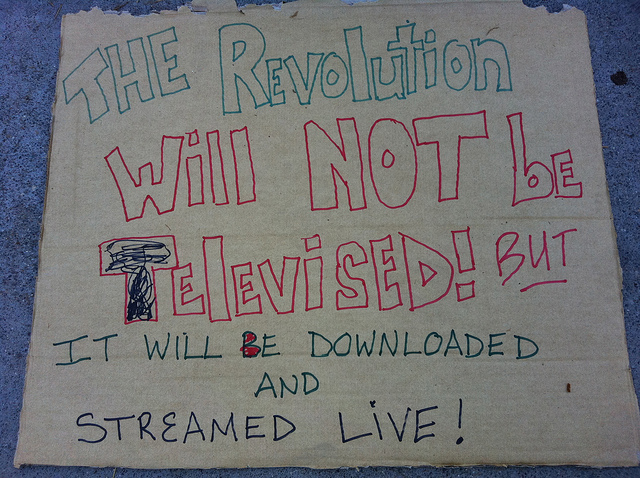
When the participatory web was new, activists and researchers alike were excited by the potential of this new medium to connect groups without the need for conventional gatekeepers. Because social media allows anyone to post information that anyone (everyone) else can theoretically access, it changed the broadcast model of communication from a one to many (or point to multi-point) to a many to many (or multi-point to multi-point) system. Initially, this change delivered on its promise, facilitating movements like #occupy, #idlenomore, and #blacklivesmatter. More recently, however, even though social media still connects people and facilitates some political organization, it has also revealed its darker side.
Protest Sign05 by a.mina. Available from Flikr: https://flic.kr/p/audzig
One of the hallmarks of the last year of US politics has been a steady stream of messages from the president about “fake news” or the “lying media”. Arguably, this has been a mainstay of Trump’s political strategy since he announced his run for the presidency, and it remains a tactic that he employs, and his followers seem to take at face value. So it’s not surprising to learn that in the US, trust in traditional media is at an all time low. In fact, recent research from the American Press Institute and Associated Press shows that 41% of Americans report having hardly any confidence in the traditional press.
Hashtag by Susanne Nilsson. Available from Flickr: https://flic.kr/p/VeKQb7
What was surprising for me though, as a Canadian researcher, was learning that this is more than just an American issue. In Canada, Statistics Canada reports that only 40% of Canadians report feeling confidence in the national media. With so much information available from so many different sources, it seems as though we just don’t know who or what we should trust anymore. This is true in 2017 and, unfortunately, my research also shows evidence of this trend as early as our Federal election in 2015. We collected thousands of tweets in the month leading up to the 2015 federal election, and we analyzed a sample of them using corpus analysis software along with human content analysis.