According to recent research at the Social Media Lab in Toronto, Canada, Canadians are somewhat comfortable with academic researchers accessing their social media data. 56% of Canadians indicate that they are ok with their data being used for academic research purposes. In contrast, only 34% of Canadians feel comfortable with marketers accessing their social media data, but this discomfort is unfortunately at odds with the way social media companies make money, meaning every day Canadians are exposing themselves to the groups which they don’t really (when asked) want to access their data.
“Mind The Gap” by Allen Brewer is licensed under CC by 2.0
Yes, it’s true, Facebook has been implicated in some incredible abuses of power. From Cambridge Analytica to Facebook’s role in the uprisings in Myanmar, to censorship in China and beyond, Facebook has some ‘splaining to do. And consumers (FB users) should just “vote with their feet” and leave the platform once and for all or Facebook will never be held accountable.
“don’t quit” by Sarah Page is licensed under CC by 2.0
I agree with most of the #QuitFacebook arguments. And also, I don’t agree that everyone can just stop using Facebook. Unfortunately, it’s not that simple.
Following on my previous post related to the privacy paradox, today I’m interested in discussing a curious social media related behavior that I’m calling the trust paradox.
Despite all the wailing and gnashing of teeth about fake news, biased journalism, and journalists as “very bad people“, the very people complaining the loudest about the press seem to be those who are most adept at manipulating it. Take for example, the current President of the United States, who employs a combination of direct to consumer social media tactics, and also maintains strong relationships with non-professiona,l we-cannot-really-call-them (cough cough) news organizations like infowars, in order to perform the idea of news while supplanting the actual purpose entirely.
“Fake fish, fake lomo” by Patrick Fitzgerald. CC-BY 2.0. Available from Flickr: https://www.flickr.com/photos/barelyfitz/34407290
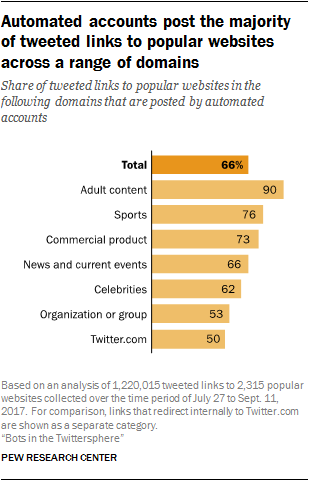
According to a recent report by the Pew Research Center that I, ironically enough learned about because it was shared on Twitter, “an estimated two-thirds of tweeted links to popular websites are posted by automated accounts” also known as bots.
I was fortunate enough to attend two great International academic conferences in the last two weeks. The first, The International Conference on Social Media and Society, took place at the Copenhagen Business School, and the second, the IEEE Professional Communications Conference, took place at the University of Toronto. The first conference was entirely about research having to do with social media, and included a panel about how social media research must change now that platforms are cutting access to their API’s in the wake of the Cambridge Analytica scandal. The second conference was, broadly speaking, about technical communication, but included a plenary about how the ways we communicate can either facilitate accuracy, truth and information access, or undermine all of these things. The IEEE Professional Communications Conference also included panels centred around using social media to teach and research communication. Now, after both of these conferences, I have a few reflections of my own on social media, data gathering, research and access to information in a post Cambridge Analytica world.
“Facebook” by Frank Hebbert. CC-BY-2.0. Available on Flickr: https://flic.kr/p/Sq4x8
Post truth issues such as “alternative facts”, polarization, and propaganda cannot simply be countered with more information. It is clear that people are not swayed by data. Providing additional arguments to back up your claims will likely be countered with additional false information from the other side. The information bounty of online spaces facilitates this. So if we can’t counter mistruths or propaganda with more information what can we do?
HOW you tell your story is very important in this context. This means that if you really want people to have access to truthful information, you have an obligation to present that information in a way that is accessible, including using plain language and easy-to-understand images, and telling a compelling story whenever possible. Humans tend to respond to narratives better than they respond to straight repetition of facts, so science communicators and researchers need to think about how we can remain faithful to the facts while also telling a compelling story.
Research therefore, and necessarily must focus on people – what do they want? What resonates with them? How do they access information? What do they believe to be true, and how does this influence how they engage with one another and with the information environment? Since access to API’s is becoming much more difficult in the wake of Cambridge Analytica, we will be challenged to come up with new methods for understanding what people do online, but this is also a wake up call for researchers, as we were becoming quite complacent scraping twitter for the low hanging fruit of our research, without having to ask critical questions about the limitations of API scraping.
Digital communication and PR professionals recognize a few truisms about online communication:
Strong emotions get shared more often on social media.
People tend to share things they really strongly agree or disagree with.
Google and Facebook tend to tailor or curate your feeds, giving you more of the stuff you already like, because that’s what we tend to view as more relevant.
Messages that are easily digestible and meet criteria 1-3 will be more shareable than ones that are not.
In this information environment then, if you want to get your message out, you try to craft something that arouses a strong emotion and is specifically targeted at the audience you want to reach. If you don’t believe me, then think about how Trump’s campaign so masterfully employed Facebook targeting to reach their key demographics. While many still claim that Russian meddling helped to win the election, in reality it was strong, emotional and tailored content that won the day.
“I Love Propaganda” by Newtown Graffiti CC BY 2.0. Available from Flickr: https://flic.kr/p/irEHoL
This is a repost of a blog post I originally contributed to Medium.com, related to my local news research project from 2015-2017.
“Generic charity” by Sascha Pohflepp is licensed under CC BY 2.0
Local news outlets contribute more to communities than just access to relevant information. Ryerson Professor, Joyce Smith, has published a paper in The Future of Local News: Research and Reflections that shows how embedded local news outlets have traditionally been in the practice of charitable giving in their communities. Her work details a historical connection between local news and charitable giving, and then touches on the ways that new media technologies have influenced, and in some cases disrupted this relationship.
Local news outlets play a role in their communities that digital replacements have yet to replicate… To read more visit Medium.