Giving Back to Our Communities: An Understated Value of Local News

This is a repost of a blog post I originally contributed to Medium.com, related to my local news research project from 2015-2017.

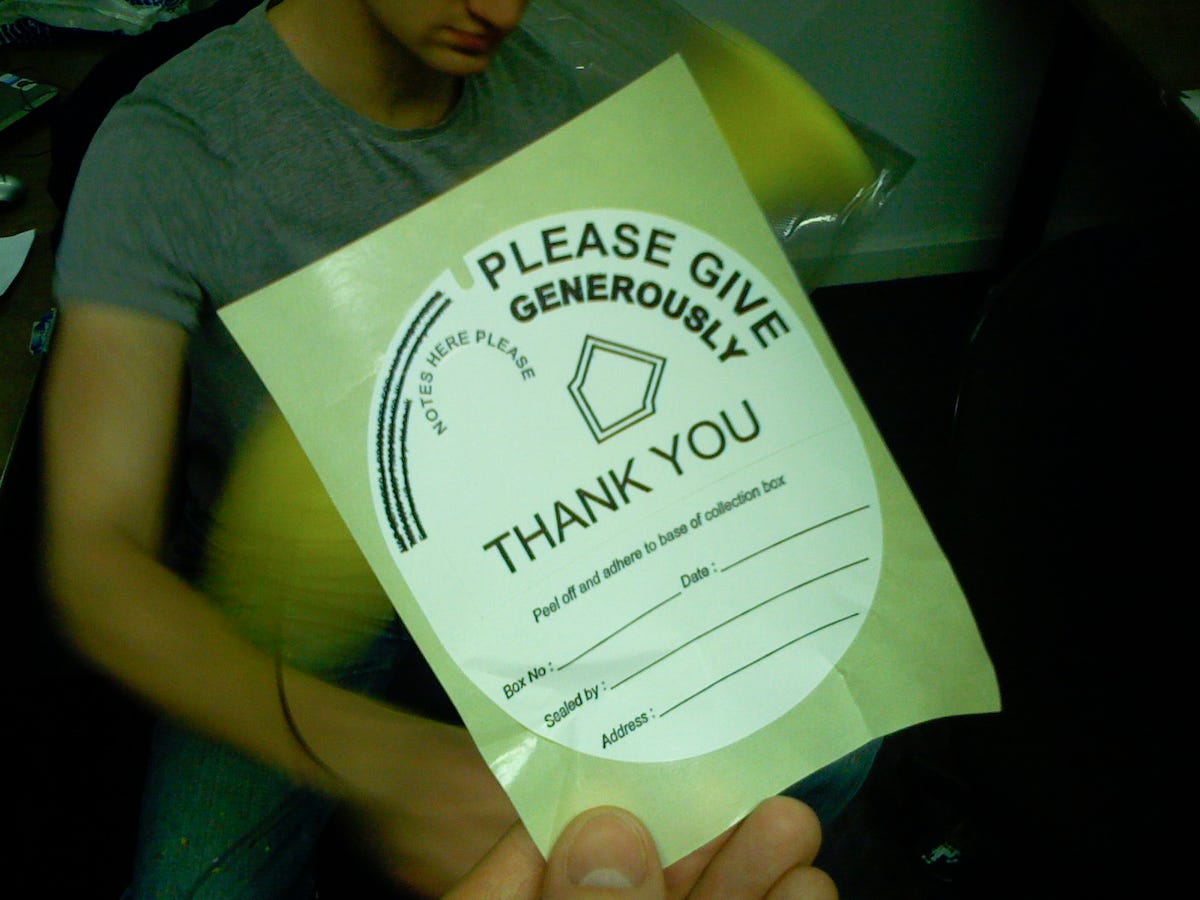
A large envelope with the text "Please Give Generously" printed on the side
“Generic charity” by Sascha Pohflepp is licensed under CC BY 2.0

Local news outlets contribute more to communities than just access to relevant information. Ryerson Professor, Joyce Smith, has published a paper in The Future of Local News: Research and Reflections that shows how embedded local news outlets have traditionally been in the practice of charitable giving in their communities. Her work details a historical connection between local news and charitable giving, and then touches on the ways that new media technologies have influenced, and in some cases disrupted this relationship.

Local news outlets play a role in their communities that digital replacements have yet to replicate… To read more visit Medium.

Giving Back to Our Communities: An Understated Value of Local News

Your Life is But a Game

You wake up in the morning, and what’s the first thing you do? If you’re like most people, you roll over and check your phone. When you look, you see that cheerful little dot on your social media, messaging, and email app icons – 10 new emails, 4 new social media comments, 3 new text messages. For a moment you feel popular, and maybe a little stressed out and compelled to respond. So, before even getting out of bed, you’ve answered some emails, sent back a few emoji’s via text, and looked at your Facebook and Instagram comments, and those little red notification dots are cleared from your apps. You breathe a sigh of relief, and feel the stress reside… for a while… until it starts all over again, with your phone vibrating, interrupting your train of thought or whatever you’re doing with a red notification dot on your various apps. The notification dot is feeling less and less cheerful and more and more like a burden every time it lights up on your phone, and you feel your stress mounting as you are compelled to deal with the interruption. Then you deal with it and feel relief again… until the cycle continues.

Continue reading “Your Life is But a Game”

Your Life is But a Game

Civil Society: Gone to the Bots?

Civil society is defined by the London School of Economics as:

“Civil Society refers to the arena of uncoerced collective action around shared interests, purposes and values. In theory, its institutional forms are distinct from those of the state, family, and market, though in practice, the boundaries between state, civil society, family and market are often complex, blurred and negotiated. Civil society commonly embraces a diversity of spaces, actors and institutional forms, varying in their degree of formality, autonomy and power. Civil societies are often populated by organizations such as registered charities, development non-governmental organizations, community groups, women’s organizations, faith-based organizations, professional associations, trade unions, self-help groups, social movements, business associations, coalitions and advocacy groups”

I’d like to put the emphasis on “uncoerced collective action” in that definition, because I’d like to talk about how civil society might be challenged or at least threatened in an era where we organize using digital communication technologies.

Continue reading “Civil Society: Gone to the Bots?”

Civil Society: Gone to the Bots?

(They)’ll be watching you

If I were to rewrite the iconic 1983 Police hit song “I’ll be watching you” for the information age, it might go something like this:

Black and white video image of a bass player from the music video for "Every Breath You Take" by the Police.
Sing it, Sting! Screen Capture from Youtube: https://www.youtube.com/watch?v=OMOGaugKpzs

Every pic you take,
Every move you make,
Every post you make,
Every word you say,
They’ll be watching you.

Oh can’t you see,
They’re using more than cookies.
They’re with you on every road,
On every app you download.

You clicked “I agree”,
And now they see what you see,
They’re tracking you,
And all your pictures too,
They’re always watching you.

Continue reading “(They)’ll be watching you”

(They)’ll be watching you

Social Media, the Separation of Time and Space, and a Plea for a Critical Look at Technology

Considered by James Carey to be the first medium of electronic communication, the telegraph was a revolutionary development, since it was the first communication medium to separate time and space for the purposes of communication. Before the invention of the telegraph, message speed was bound to how fast a messenger could travel: by foot, horse, or railroad. After the invention of the telegraph, messages could travel faster than a messenger ever could. This development thus had ripple effects on markets, democratic participation and community.

A picture of a telegraph machine
Telegraph by SparkFun Electronics. Available on Flickr: https://flic.kr/p/fCs2oC (CC by 2.0)


Continue reading “Social Media, the Separation of Time and Space, and a Plea for a Critical Look at Technology”

Social Media, the Separation of Time and Space, and a Plea for a Critical Look at Technology

Celebrity “trumps” truth: The key difference between the liberal press and Twitter

Today, The Verge published an article stating that Twitter has drawn a small line in the sand with respect to the tweeting habits of the 45 president of the United States. Adi Robertson reports that Twitter has suggested that while it is important not to censor or remove important public figures like the president from the platform, it will draw the line at “tweets that reveal a private address or phone number”. Of course, not all people agree with this stand. For example, Sam Harris clearly stated in a recent podcast that he thinks Trump should be banned from Twitter, since the damage he can do via a Tweet is just so great. Twitter’s response though, is one worth considering. When is it appropriate to silence a public figure on a platform like Twitter? And when is it actually in the public interest to support a person’s right to make even crazy or patently false claims on the site?

A tweet made my Donald Trump in which he complains about fake news
A tweet made by Donald Trump: Picture from “Mother Jones” http://www.motherjones.com/kevin-drum/2017/02/donald-trump-edits-tweet/


Continue reading “Celebrity “trumps” truth: The key difference between the liberal press and Twitter”

Celebrity “trumps” truth: The key difference between the liberal press and Twitter

A Level Playing Field? Social Media Logic and the Breakdown of Democratic Communication

When the participatory web was new, activists and researchers alike were excited by the potential of this new medium to connect groups without the need for conventional gatekeepers. Because social media allows anyone to post information that anyone (everyone) else can theoretically access, it changed the broadcast model of communication from a one to many (or point to multi-point) to a many to many (or multi-point to multi-point) system. Initially, this change delivered on its promise, facilitating movements like #occupy, #idlenomore, and #blacklivesmatter. More recently, however, even though social media still connects people and facilitates some political organization, it has also revealed its darker side.

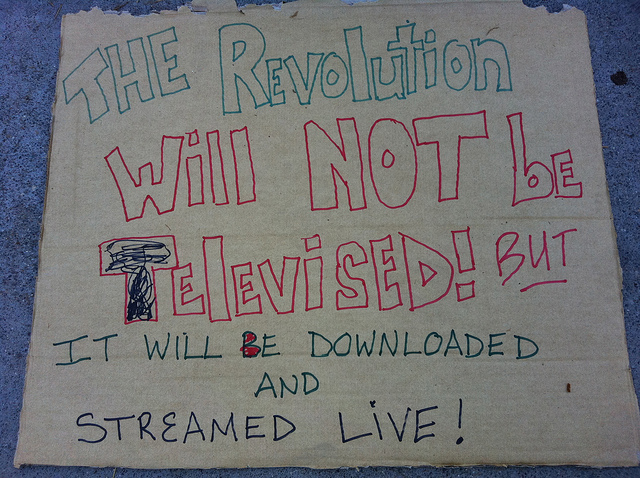
A handwritten protest sign, reading: The revolution will not be televised but it will be downloaded and streamed live
Protest Sign05 by a.mina. Available from Flikr: https://flic.kr/p/audzig


Continue reading “A Level Playing Field? Social Media Logic and the Breakdown of Democratic Communication”

A Level Playing Field? Social Media Logic and the Breakdown of Democratic Communication

Goliath vs. Goliath: Or Why the Net Neutrality Debate is Complicated

You may have noticed that net neutrality was in the news quite a bit this week after US FCC Chairman Ajit Pai tried to slip a release into the pre-long weekend news burial ground stating that he plans to roll back any legislation related to Net Neutrality. In response to this, Netflix released a statement that it opposes any attempts to roll back net neutrality rules. Back in July, when the idea of gutting net neutrality law was first floated under the Trump administration, all of the major platform players such as Google, Facebook, Twitter and Amazon, spoke out against these proposed regulations. But a Google search that I conducted this morning shows news in which Twitter, Pinterest, AirBnB and of course the aforementioned Netflix make statements opposing the new legislation while Facebook and Google are conspicuously absent.

Continue reading “Goliath vs. Goliath: Or Why the Net Neutrality Debate is Complicated”

Goliath vs. Goliath: Or Why the Net Neutrality Debate is Complicated

Because You’re a Media Company

Yesterday, Sandy Parakilas published an insightful op-ed in the NY Times. Titled We Can’t Trust Facebook to Regulate Itself. In this article, Parakilas,  a developer for Facebook leading up to the 2012 IPO, describes Facebook as “a company that prioritized data collection from its users over protecting them from abuse.” Parakilas writes:

Facebook knows what you look like, your location, who your friends are, your interests, if you’re in a relationship or not, and what other pages you look at on the web. This data allows advertisers to target the more than one billion Facebook visitors a day. It’s no wonder the company has ballooned in size to a $500 billion behemoth in the five years since its I.P.O.

The more data it has on offer, the more value it creates for advertisers. That means it has no incentive to police the collection or use of that data — except when negative press or regulators are involved. Facebook is free to do almost whatever it wants with your personal information, and has no reason to put safeguards in place.

In my PhD dissertation, completed in 2013, I made this very point from the outside, arguing for strong evidence that Facebook is in essence a media company rather than the technology provider that at that time they claimed to be. There is an important difference between a technology company and a media company of course. A technology company doesn’t tend to make money off of advertising whereas advertising is essential for media companies. What is particularly insidious about Facebook, as highlighted in Parakilas’ op-ed, is that beyond simply providing attention to advertisers, Facebook also mines and sells user data.

Continue reading “Because You’re a Media Company”

Because You’re a Media Company

Twitter politics, polarization and a lack of trust in media: The case of #cdnmedia

One of the hallmarks of the last year of US politics has been a steady stream of messages from the president about “fake news” or the “lying media”. Arguably, this has been a mainstay of Trump’s political strategy since he announced his run for the presidency, and it remains a tactic that he employs, and his followers seem to take at face value. So it’s not surprising to learn that in the US, trust in traditional media is at an all time low. In fact, recent research from the American Press Institute and Associated Press shows that 41% of Americans report having hardly any confidence in the traditional press.

Hashtag symbols painted on concrete
Hashtag by Susanne Nilsson. Available from Flickr: https://flic.kr/p/VeKQb7

What was surprising for me though, as a Canadian researcher, was learning that this is more than just an American issue. In Canada, Statistics Canada reports that only 40% of Canadians report feeling confidence in the national media. With so much information available from so many different sources, it seems as though we just don’t know who or what we should trust anymore. This is true in 2017 and, unfortunately, my research also shows evidence of this trend as early as our Federal election in 2015. We collected thousands of tweets in the month leading up to the 2015 federal election, and we analyzed a sample of them using corpus analysis software along with human content analysis.

Continue reading “Twitter politics, polarization and a lack of trust in media: The case of #cdnmedia”

Twitter politics, polarization and a lack of trust in media: The case of #cdnmedia