Chasing Meaningful Interaction: Facebook’s Declining Value

Have we reached peak Facebook?


A facebook error message
Facebook error by Beth Kanter on Flickr (CC by 2.0). Available from https://flic.kr/p/5iEcGp

A recent article in the Guardian reports that while people over 55 are still flocking to the social network in droves, a key demographic: teens and young adults, are leaving Facebook or even failing to join in the first place. Teens and young adults, according to the Guardian, are “defecting to snapchat”, and while Facebook initially managed to hang on to this group by buying up Instagram, it hasn’t been able to buy snapchat, and copying the popular features of snapchat on Instagram and the Facebook platform have not served to engage younger users.

Continue reading “Chasing Meaningful Interaction: Facebook’s Declining Value”

Chasing Meaningful Interaction: Facebook’s Declining Value

Your Life is But a Game

You wake up in the morning, and what’s the first thing you do? If you’re like most people, you roll over and check your phone. When you look, you see that cheerful little dot on your social media, messaging, and email app icons – 10 new emails, 4 new social media comments, 3 new text messages. For a moment you feel popular, and maybe a little stressed out and compelled to respond. So, before even getting out of bed, you’ve answered some emails, sent back a few emoji’s via text, and looked at your Facebook and Instagram comments, and those little red notification dots are cleared from your apps. You breathe a sigh of relief, and feel the stress reside… for a while… until it starts all over again, with your phone vibrating, interrupting your train of thought or whatever you’re doing with a red notification dot on your various apps. The notification dot is feeling less and less cheerful and more and more like a burden every time it lights up on your phone, and you feel your stress mounting as you are compelled to deal with the interruption. Then you deal with it and feel relief again… until the cycle continues.

Continue reading “Your Life is But a Game”

Your Life is But a Game

Civil Society: Gone to the Bots?

Civil society is defined by the London School of Economics as:

“Civil Society refers to the arena of uncoerced collective action around shared interests, purposes and values. In theory, its institutional forms are distinct from those of the state, family, and market, though in practice, the boundaries between state, civil society, family and market are often complex, blurred and negotiated. Civil society commonly embraces a diversity of spaces, actors and institutional forms, varying in their degree of formality, autonomy and power. Civil societies are often populated by organizations such as registered charities, development non-governmental organizations, community groups, women’s organizations, faith-based organizations, professional associations, trade unions, self-help groups, social movements, business associations, coalitions and advocacy groups”

I’d like to put the emphasis on “uncoerced collective action” in that definition, because I’d like to talk about how civil society might be challenged or at least threatened in an era where we organize using digital communication technologies.

Continue reading “Civil Society: Gone to the Bots?”

Civil Society: Gone to the Bots?

(They)’ll be watching you

If I were to rewrite the iconic 1983 Police hit song “I’ll be watching you” for the information age, it might go something like this:

Black and white video image of a bass player from the music video for "Every Breath You Take" by the Police.
Sing it, Sting! Screen Capture from Youtube: https://www.youtube.com/watch?v=OMOGaugKpzs

Every pic you take,
Every move you make,
Every post you make,
Every word you say,
They’ll be watching you.

Oh can’t you see,
They’re using more than cookies.
They’re with you on every road,
On every app you download.

You clicked “I agree”,
And now they see what you see,
They’re tracking you,
And all your pictures too,
They’re always watching you.

Continue reading “(They)’ll be watching you”

(They)’ll be watching you

Online Influencers: An Old Idea in a New Medium

This post is some thoughts pulled from a talk that I gave this week at Ryerson’s Start Up School. For more great resources for entrepreneurs, and to see the slide presentation that I gave, check out ryersonstartupschool.com

Since the dawn of PR, influencers have been an important tool for those people and organizations who want to reach others with their message. This is not an exaggeration. The practice of public relations was basically invented when Edward Bernays, the nephew of Sigmund Freud, hired women to march in the 1929 Easter Sunday Parade smoking cigarettes that they called their “torches of freedom“. Why did Bernays do this? Before this moment, smoking for women was considered taboo, dirty. Bernays effectively linked the act of smoking with the women’s equality movement, and changed public perception for decades to come.

Continue reading “Online Influencers: An Old Idea in a New Medium”

Online Influencers: An Old Idea in a New Medium

Social Media, the Separation of Time and Space, and a Plea for a Critical Look at Technology

Considered by James Carey to be the first medium of electronic communication, the telegraph was a revolutionary development, since it was the first communication medium to separate time and space for the purposes of communication. Before the invention of the telegraph, message speed was bound to how fast a messenger could travel: by foot, horse, or railroad. After the invention of the telegraph, messages could travel faster than a messenger ever could. This development thus had ripple effects on markets, democratic participation and community.

A picture of a telegraph machine
Telegraph by SparkFun Electronics. Available on Flickr: https://flic.kr/p/fCs2oC (CC by 2.0)


Continue reading “Social Media, the Separation of Time and Space, and a Plea for a Critical Look at Technology”

Social Media, the Separation of Time and Space, and a Plea for a Critical Look at Technology

Celebrity “trumps” truth: The key difference between the liberal press and Twitter

Today, The Verge published an article stating that Twitter has drawn a small line in the sand with respect to the tweeting habits of the 45 president of the United States. Adi Robertson reports that Twitter has suggested that while it is important not to censor or remove important public figures like the president from the platform, it will draw the line at “tweets that reveal a private address or phone number”. Of course, not all people agree with this stand. For example, Sam Harris clearly stated in a recent podcast that he thinks Trump should be banned from Twitter, since the damage he can do via a Tweet is just so great. Twitter’s response though, is one worth considering. When is it appropriate to silence a public figure on a platform like Twitter? And when is it actually in the public interest to support a person’s right to make even crazy or patently false claims on the site?

A tweet made my Donald Trump in which he complains about fake news
A tweet made by Donald Trump: Picture from “Mother Jones” http://www.motherjones.com/kevin-drum/2017/02/donald-trump-edits-tweet/


Continue reading “Celebrity “trumps” truth: The key difference between the liberal press and Twitter”

Celebrity “trumps” truth: The key difference between the liberal press and Twitter

A Level Playing Field? Social Media Logic and the Breakdown of Democratic Communication

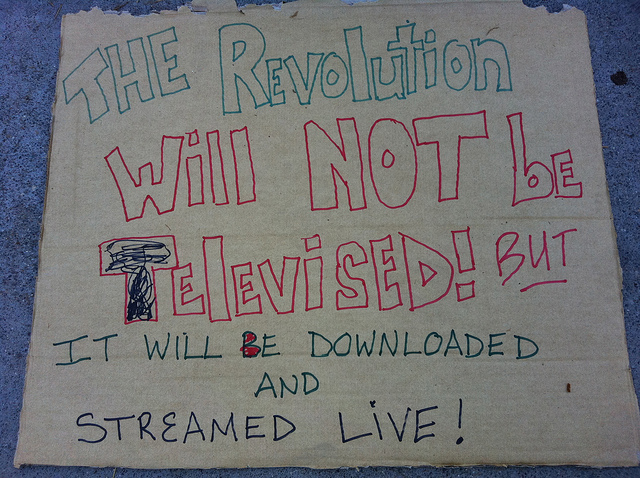
When the participatory web was new, activists and researchers alike were excited by the potential of this new medium to connect groups without the need for conventional gatekeepers. Because social media allows anyone to post information that anyone (everyone) else can theoretically access, it changed the broadcast model of communication from a one to many (or point to multi-point) to a many to many (or multi-point to multi-point) system. Initially, this change delivered on its promise, facilitating movements like #occupy, #idlenomore, and #blacklivesmatter. More recently, however, even though social media still connects people and facilitates some political organization, it has also revealed its darker side.

A handwritten protest sign, reading: The revolution will not be televised but it will be downloaded and streamed live
Protest Sign05 by a.mina. Available from Flikr: https://flic.kr/p/audzig


Continue reading “A Level Playing Field? Social Media Logic and the Breakdown of Democratic Communication”

A Level Playing Field? Social Media Logic and the Breakdown of Democratic Communication

Learning is Uncomfortable, or Why Self Help is Misleading

If you find your calling, everything will fall into place. You will receive a “sense of energy” or “flow”. Your inner voice will speak its “truth” and you will always feel like you have made the right choice. If you “align your personality with your purpose then no one can touch you“. Sound familiar? These might, because I’ve pulled them from popular life advice articles. These claims sound right to us, they sound (much like, it’s claimed our calling does) true. But I believe that I see evidence every day in the classroom that these claims and ones like them do us a grave disservice when it comes to our own personal development, growth and learning.

A picture of hot air balloons over a desert with inspiring words written on it
Balloons by foam. Available from Flickr: https://flic.kr/p/oqvMzp

Why are these beliefs troublesome? They feel right, and everyone wants to find their calling in life. By simplifying purpose though, I think they overlook important facts about how difficult true growth is, and how meaningful the experience of difficulty can be for growth. Though not explicit, the unspoken subtext of this and similar advice is this: If you find your true calling, if your purpose is aligned with your true self, then the steps you take in the process of achieving that calling will be smooth and without struggle. And this is just plain wrong. On the contrary – most meaningful growth requires tremendous struggle. Learning is uncomfortable.

Continue reading “Learning is Uncomfortable, or Why Self Help is Misleading”

Learning is Uncomfortable, or Why Self Help is Misleading

Just Because I Grade You, Doesn’t Mean I’m Judging Your Intelligence

Just in time for the term to end, and grading to begin at many institutions, I wanted to write about how I, and almost all other instructors or professors I know, view the grading process. I think it’s important as a student to approach assignments with this view in mind, as it will help you to let go of some of the feelings or road blocks that may be currently holding you back.

A stamp on plywood stating "Grade B" in large block letters
Grade B: Upper Queen Street, Ruined House. By wonderferret. Available on Flickr: https://flic.kr/p/33XsFf

Just because I grade your work, doesn’t mean I judge your intelligence, or your abilities, or your worth as a human being or contribution as an individual. That’s not what grading assignments is about at all. At least, not to me. Continue reading “Just Because I Grade You, Doesn’t Mean I’m Judging Your Intelligence”

Just Because I Grade You, Doesn’t Mean I’m Judging Your Intelligence