Never Gonna Give You Up: Creating a Musical Experience in a Digital Age

The music industry has been feeling the curse of digital communication technologies as a result of music streaming services such as Spotify (or even YouTube, which is a popular way of accessing music, with or without video). Streaming services pay very little – fractions of pennies, in fact, back to the musician when songs are played. And this year, the closure of HMV has shown us that there is no longer a market for physical recorded music. In fact, even the purchase of individual songs on iTunes has become less relevant as a result of streaming. In my private sector consulting work, I often coach independent musicians about how they might survive, and even thrive in a world where they cannot make money from their original product, and I think we can draw inspiration from this in the most unlikely of places: Tough Mudder – a fitness brand that is optimized for the digital age.

Continue reading “Never Gonna Give You Up: Creating a Musical Experience in a Digital Age”

Never Gonna Give You Up: Creating a Musical Experience in a Digital Age

Words Matter, Or Let’s Stop Naturalizing Tech Development

It’s become such a regular turn of phrase, we don’t even think twice about using it:

  1. From an old Forbes article: “How Google Search Results Will Evolve Throughout 2015
  2. From Social Media Today: “Facebook Continues to Evolve Facebook Live, Announces New Tools
  3. From Government Technology Magazine: “Twitter, Uber, Plan to Further Evolve Their Civic Engagement Strategies
  4. Even in TED talks: “Kevin Kelly: How Technology Evolves
  5. And I could go on and on, the examples being seemingly endless…


Do you see it?

Continue reading “Words Matter, Or Let’s Stop Naturalizing Tech Development”

Words Matter, Or Let’s Stop Naturalizing Tech Development

All hail our (kind of annoying) robot neighbours and their human overlords

Robots have been all over my various news feeds of late. Here are just a few examples:

  1. From Slate: Russian bots posing as regular people are trying to sow discord on Twitter after Charlottesville
  2. From the Guardian: The future of funerals? Robot priest launched to undercut human-led rites
  3. From Business Insider: Robots are starting to enter pre-K and kindergarten alongside kids
  4. And finally, from Engaget: Drones will watch Australian beaches for Sharks with AI help

Continue reading “All hail our (kind of annoying) robot neighbours and their human overlords”

All hail our (kind of annoying) robot neighbours and their human overlords

Digital Literacy: What Do We Really Need?


A picture of a google search box for digital literacy
Digital Literacy by AJC1. Available on Flickr: https://flic.kr/p/dwkZMM

Last week I mentioned that I would write a post discussing the gaps I see in current descriptions of digital literacy, particularly as it’s described in the popular press, and why a more holistic or even interdisciplinary understanding of digital literacy is needed. Well I’m back this week to continue that discussion. We must move beyond the idea that digital literacy is about teaching people how to create a website or learn to code. We need to recognize that a skills based approach to digital literacy will only serve to exacerbate certain social and democratic challenges inherent in digital communication, and we must instead consider digital literacy as something that stretches far beyond equipping students for jobs that may or may not exist in the ever-fickle digital economy. The best example, I think ,of why this is the case is the current problem of “fake news”.

Continue reading “Digital Literacy: What Do We Really Need?”

Digital Literacy: What Do We Really Need?

Yellow is the New Black

I’ve been thinking a great deal lately about social media as a source of news, and how we are currently experiencing parallels with yellow journalism. I think that if we can identify similarities with our current media environment, and the rise and management of yellow journalism during the Hearst/yellow journalismPulitzer years, we may be in a better position to brainstorm meaningful solutions to the fake news challenges that we are seeing today. And there are indeed many parallels to be drawn, so I’ll begin with a few important ones, as I see them:

Continue reading “Yellow is the New Black”

Yellow is the New Black

Twitter as a News Source and Consequences for Civic Engagement

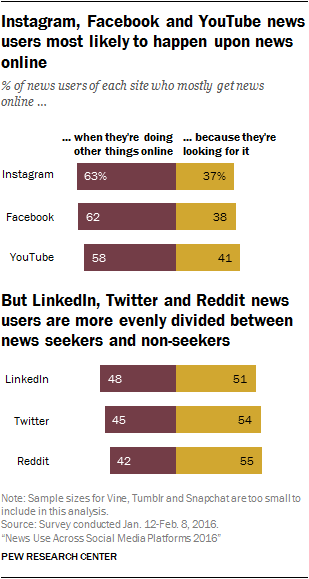
News Seekers from PEW http://assets.pewresearch.org/wp-content/uploads/sites/13/2016/05/PJ_2016.05.26_social-media-and-news_0-05.pngThis blog post stems from a podcast that I’m putting together for the Multimedia Local News Conference Publication. This publication is being put together by the Ryerson Journalism Research Centre following a very successful international conference on local news in a digital age, and I presented some research at the conference relating to how local news content shared on Twitter can be measured. I am also happy to serve on the conference and publication organizing committee.

The availability of relevant political information is central to a functioning public sphere. In some larger Canadian communities, such as Toronto, Ottawa or Vancouver, which are media centers for their respective provinces, the availability of locally relevant news that aids citizens in making meaningful voting decisions is not an issue. News in these communities is readily available. However, in other communities, this is simply not the case. local news outlets in smaller communities across Canada and around the world are being closed down, and studies have shown that when a community loses a source of local news, civic engagement declines.

Continue reading “Twitter as a News Source and Consequences for Civic Engagement”

Twitter as a News Source and Consequences for Civic Engagement

From Print to Digital – Information Overload and Folk Wisdom

Lee Rainie’s Keynote in Image Form from #SMSociety 2017

Last week, I had the great pleasure of presenting my work at the International Conference on Social Media and Society (#SMSociety2017), hosted by the esteemed team at the Social Media Lab at Ryerson University. While in attendance, I listened to a fantastic keynote by Lee Rainie, the director of Internet and Policy Research at the Pew Research Center. His keynote, titled “The Reckoning for Social Media” focused on the research work conducted by the Pew Internet and Technology research center, about how social media have changed the relationship of people to each other and to public institutions. Some of his findings were disheartening such as, for example, recent research that shows that people polled in the US are experiencing declining trust in academic institutions, or that people are becoming more polarized in their political views. Other findings were more hopeful, such as the fact that there is substantial reciprocity across social media platforms.

Continue reading “From Print to Digital – Information Overload and Folk Wisdom”

From Print to Digital – Information Overload and Folk Wisdom

FakeBook? Facebook’s fight against fake news mostly hot air

Facebook
“Facebook” by Sarah Marshall on Flickr. Available from https://www.flickr.com/photos/sarahmarshall/

A recent  article in Fortune discusses how Facebook, after launching it’s ‘Journalism Project‘ in January 2017 as a way to fight fake news, has just over six months in, released a progress update.

Continue reading “FakeBook? Facebook’s fight against fake news mostly hot air”

FakeBook? Facebook’s fight against fake news mostly hot air

Back to the Future? History in oral, literate and digital forms

Cave paintings, Magura CaveCave paintings, Magura Caves by MarleBrlzrd on Flikr: farm3.static.flickr.com/2789/4387489763_6fbbd42824_o.jpg

Fake News on The Rise

According to the Daily Mail, a recent study out of Oxford University has reported that fake news is on the rise around the world. The study found that automated bots play an outsized role in spreading fake news, and are often employed as a form of astroturfing or to deliberately spread propaganda. Reflecting on this phenomenon, and also the ways that online propaganda played a role in the most recent US election, I can’t help but draw upon Walter Ong’s foundational work, Orality and Literacy: Technologizing the Word. Though the text was written prior to the development of Facebook and Twitter, re-reading this book in light of recent events has lent some weight for me on ideas of orality, literacy, and the new world of electronic secondary orality, particularly as these cultures relate to how people make sense of history, and how we determine the nature of truth. At the same time, I also think that recent events challenge Ong’s original ideas about what secondary orality looks like, and thus I’d like to propose a slightly new definition in light of new digital trends and the worrying disruption of the archive. I’ll begin to discuss these ideas here, and may also return to them later, as these topics are big ones.

Continue reading “Back to the Future? History in oral, literate and digital forms”

Back to the Future? History in oral, literate and digital forms

Hello World: On Writing and Scholarship in Public

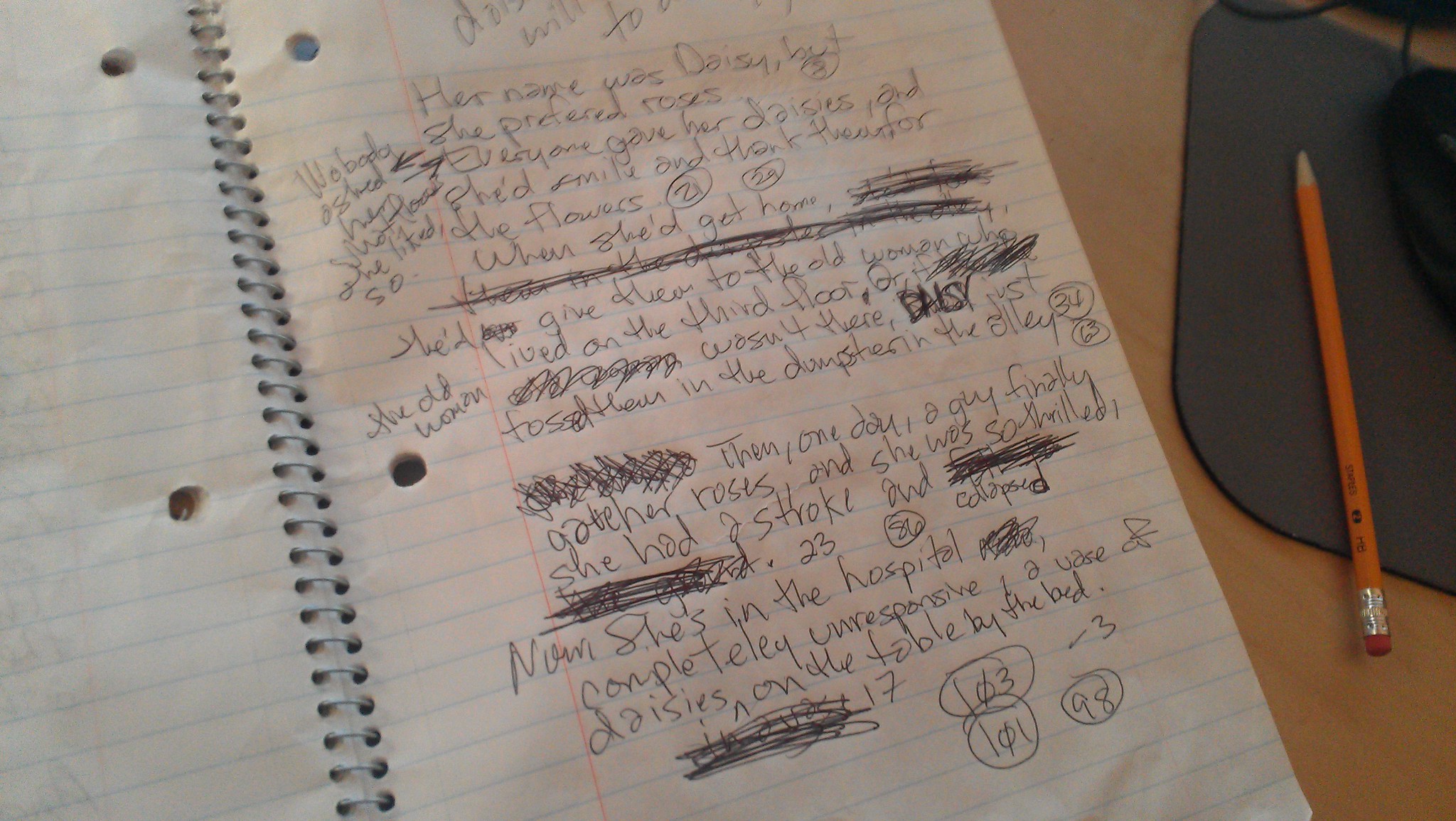
Writing longhand “Writing Longhand” by R. Crap Mariner on Flikr

As with any new WordPress blog, the first post you see when you load it up for the first time is the ubiquitous “Hello World” post. I’m thinking of leaving that post on my blog as I write this. Not to indicate a lack of familiarity with how to edit a blog, or to demonstrate a lack of professionalism, or a sort of ambivalence to blogging, but rather, because that phrase sums up an insecurity that I think we all have regarding public writing and public scholarship in particular.

Continue reading “Hello World: On Writing and Scholarship in Public”

Hello World: On Writing and Scholarship in Public