A Media Ecology of Online Misinformation: What can Postman teach us?

We are living in what some call an era of unprecedented global information flows. Participatory online communication technologies such as social media have allowed anyone with access to the internet to upload information for anyone else can see. Though not everyone participates as an active prosumer of information, enough people do that we are overwhelmed with information. 300 videos are uploaded to YouTube every minute, five new Facebook profiles are created every second, and every second about 6,000 tweets are posted to Twitter. The numbers are mind boggling.

Street art depicting a boy in a striped shirt sitting on a partially open laptop computer
“Information overload! #streetart #berlin” by Acid Midget is licensed under CC by 2.0

Continue reading “A Media Ecology of Online Misinformation: What can Postman teach us?”

A Media Ecology of Online Misinformation: What can Postman teach us?

The Privacy Paradox

In a post Cambridge Analytica world, why are people still using social media platforms like Facebook and Instagram? Despite the fact that people threatened to leave the social network in droves after the data breach was revealed, most people actually stayed on and things returned to normal. Why is this the case?

A window printed with the words "private meeting room"
“Private” by Duane Tate is licensed under CC BY 2.0

Social media scholars have identified  a phenomenon called the privacy paradox that can help to explain this behavior. Put succinctly, the privacy paradox refers to the fact that though people state they do not intend to disclose their personal information online, they do so anyway; or the fact that though people say they do not trust that their information will be private online, they still end up disclosing a large amount of personal information on social networks.

Continue reading “The Privacy Paradox”

The Privacy Paradox

21st Century PR: When All Else Fails, Pretend You’re a Journalist

Despite all the wailing and gnashing of teeth about fake news, biased journalism, and journalists as “very bad people“, the very people complaining the loudest about the press seem to be those who are most adept at manipulating it. Take for example, the current President of the United States, who employs a combination of direct to consumer social media tactics, and also maintains strong relationships with non-professiona,l we-cannot-really-call-them (cough cough) news organizations like infowars, in order to perform the idea of news while supplanting the actual purpose entirely.

A yellow plastic fish caught in a net hangs against a grey cubicle wall
“Fake fish, fake lomo” by Patrick Fitzgerald. CC-BY 2.0. Available from Flickr: https://www.flickr.com/photos/barelyfitz/34407290

Continue reading “21st Century PR: When All Else Fails, Pretend You’re a Journalist”

21st Century PR: When All Else Fails, Pretend You’re a Journalist

Is your content bot or not?

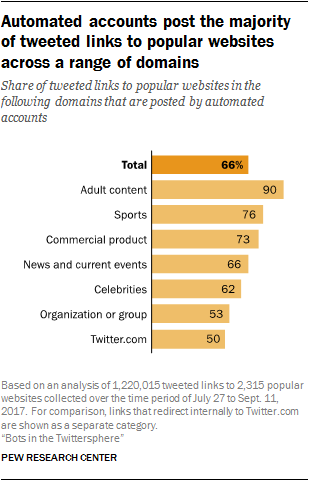
According to a recent report by the Pew Research Center that I, ironically enough learned about because it was shared on Twitter, “an estimated two-thirds of tweeted links to popular websites are posted by automated accounts” also known as bots.

Automated accounts post the majority of tweeted links to popular websites across a range of domains

Two thirds.

To me, this means three things:

Continue reading “Is your content bot or not?”

Is your content bot or not?

Using Technology to Understand Local News

This post is cross posted from medium.com. You can access the original here.

A map showing changes to local news outlets across Canada
A screen capture from Lindgren and Corbett’s (2018) Local News Map. Available at localnews.geolive.ca

This week marks the one year anniversary of our international conference: Is No Local News Bad News: Local Journalism and Its Future which was sponsored by SSHRC and the Ryerson Journalism Research Centre and held at Ryerson University in Toronto, Canada. This groundbreaking conference brought together an interdisciplinary and international group of scholars, journalists and media entrepreneurs to discuss the importance of local news to communities, the current state of local news around the world, the role of technology in local news, and what the future of local news could look like.

Continue reading “Using Technology to Understand Local News”

Using Technology to Understand Local News

Communicating for social change

We know it happens, because it’s influenced elections.

We know it happens, because it’s impacted people’s careers.

We know it happens, because it’s spawned effective protest movements, and even encouraged people to take up knitting and crocheting.

Communication, via popular social media platforms CAN create social change.

But HOW?

#womensmarch by Rob Kall. Available from Flickr: https://flic.kr/p/23AMGwE

Continue reading “Communicating for social change”

Communicating for social change

Social Media Mindfulness Is Not Enough

A group of virtual reality avatars sitting in a circle engaging in meditation
“VR Meditation Guided by Jeremy Nickel” posted to Flickr by Sansar VR. Available at https://flic.kr/p/GBrspR CC-BY 2.0

It used to be only a few voices on the margin: Ian Bogost, Sherry Turkle, Geert Lovink, or Evgeny Morozov, for example, who urged people to think a little more about the time they were spending on social media. But soon the whisper grew and now the movement may be reaching the mainstream. With the rise to prevalence of former Google design ethicist Tristan Harris and his Center for Humane Technology, and with the Facebook Privacy/Cambridge Analytical scandal all over congress and the world news, people are starting to have conversations that were considered almost laughable before. Continue reading “Social Media Mindfulness Is Not Enough”

Social Media Mindfulness Is Not Enough

Your Life is But a Game

You wake up in the morning, and what’s the first thing you do? If you’re like most people, you roll over and check your phone. When you look, you see that cheerful little dot on your social media, messaging, and email app icons – 10 new emails, 4 new social media comments, 3 new text messages. For a moment you feel popular, and maybe a little stressed out and compelled to respond. So, before even getting out of bed, you’ve answered some emails, sent back a few emoji’s via text, and looked at your Facebook and Instagram comments, and those little red notification dots are cleared from your apps. You breathe a sigh of relief, and feel the stress reside… for a while… until it starts all over again, with your phone vibrating, interrupting your train of thought or whatever you’re doing with a red notification dot on your various apps. The notification dot is feeling less and less cheerful and more and more like a burden every time it lights up on your phone, and you feel your stress mounting as you are compelled to deal with the interruption. Then you deal with it and feel relief again… until the cycle continues.

Continue reading “Your Life is But a Game”

Your Life is But a Game

Civil Society: Gone to the Bots?

Civil society is defined by the London School of Economics as:

“Civil Society refers to the arena of uncoerced collective action around shared interests, purposes and values. In theory, its institutional forms are distinct from those of the state, family, and market, though in practice, the boundaries between state, civil society, family and market are often complex, blurred and negotiated. Civil society commonly embraces a diversity of spaces, actors and institutional forms, varying in their degree of formality, autonomy and power. Civil societies are often populated by organizations such as registered charities, development non-governmental organizations, community groups, women’s organizations, faith-based organizations, professional associations, trade unions, self-help groups, social movements, business associations, coalitions and advocacy groups”

I’d like to put the emphasis on “uncoerced collective action” in that definition, because I’d like to talk about how civil society might be challenged or at least threatened in an era where we organize using digital communication technologies.

Continue reading “Civil Society: Gone to the Bots?”

Civil Society: Gone to the Bots?