(They)’ll be watching you

If I were to rewrite the iconic 1983 Police hit song “I’ll be watching you” for the information age, it might go something like this:

Black and white video image of a bass player from the music video for "Every Breath You Take" by the Police.
Sing it, Sting! Screen Capture from Youtube: https://www.youtube.com/watch?v=OMOGaugKpzs

Every pic you take,
Every move you make,
Every post you make,
Every word you say,
They’ll be watching you.

Oh can’t you see,
They’re using more than cookies.
They’re with you on every road,
On every app you download.

You clicked “I agree”,
And now they see what you see,
They’re tracking you,
And all your pictures too,
They’re always watching you.

Continue reading “(They)’ll be watching you”

(They)’ll be watching you

Social Media, the Separation of Time and Space, and a Plea for a Critical Look at Technology

Considered by James Carey to be the first medium of electronic communication, the telegraph was a revolutionary development, since it was the first communication medium to separate time and space for the purposes of communication. Before the invention of the telegraph, message speed was bound to how fast a messenger could travel: by foot, horse, or railroad. After the invention of the telegraph, messages could travel faster than a messenger ever could. This development thus had ripple effects on markets, democratic participation and community.

A picture of a telegraph machine
Telegraph by SparkFun Electronics. Available on Flickr: https://flic.kr/p/fCs2oC (CC by 2.0)


Continue reading “Social Media, the Separation of Time and Space, and a Plea for a Critical Look at Technology”

Social Media, the Separation of Time and Space, and a Plea for a Critical Look at Technology

A Level Playing Field? Social Media Logic and the Breakdown of Democratic Communication

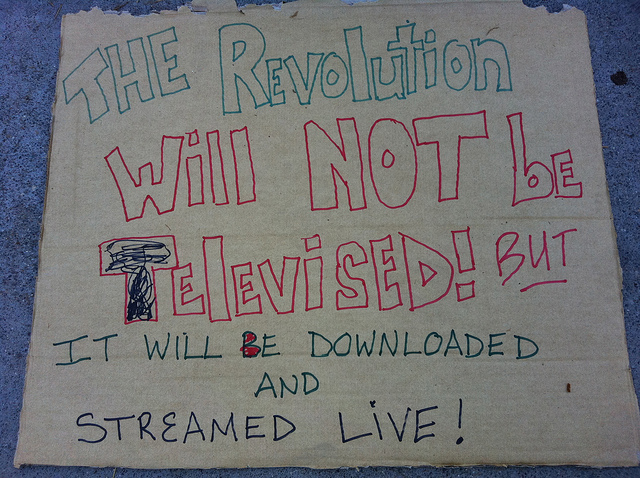
When the participatory web was new, activists and researchers alike were excited by the potential of this new medium to connect groups without the need for conventional gatekeepers. Because social media allows anyone to post information that anyone (everyone) else can theoretically access, it changed the broadcast model of communication from a one to many (or point to multi-point) to a many to many (or multi-point to multi-point) system. Initially, this change delivered on its promise, facilitating movements like #occupy, #idlenomore, and #blacklivesmatter. More recently, however, even though social media still connects people and facilitates some political organization, it has also revealed its darker side.

A handwritten protest sign, reading: The revolution will not be televised but it will be downloaded and streamed live
Protest Sign05 by a.mina. Available from Flikr: https://flic.kr/p/audzig


Continue reading “A Level Playing Field? Social Media Logic and the Breakdown of Democratic Communication”

A Level Playing Field? Social Media Logic and the Breakdown of Democratic Communication

Goliath vs. Goliath: Or Why the Net Neutrality Debate is Complicated

You may have noticed that net neutrality was in the news quite a bit this week after US FCC Chairman Ajit Pai tried to slip a release into the pre-long weekend news burial ground stating that he plans to roll back any legislation related to Net Neutrality. In response to this, Netflix released a statement that it opposes any attempts to roll back net neutrality rules. Back in July, when the idea of gutting net neutrality law was first floated under the Trump administration, all of the major platform players such as Google, Facebook, Twitter and Amazon, spoke out against these proposed regulations. But a Google search that I conducted this morning shows news in which Twitter, Pinterest, AirBnB and of course the aforementioned Netflix make statements opposing the new legislation while Facebook and Google are conspicuously absent.

Continue reading “Goliath vs. Goliath: Or Why the Net Neutrality Debate is Complicated”

Goliath vs. Goliath: Or Why the Net Neutrality Debate is Complicated

Because You’re a Media Company

Yesterday, Sandy Parakilas published an insightful op-ed in the NY Times. Titled We Can’t Trust Facebook to Regulate Itself. In this article, Parakilas,  a developer for Facebook leading up to the 2012 IPO, describes Facebook as “a company that prioritized data collection from its users over protecting them from abuse.” Parakilas writes:

Facebook knows what you look like, your location, who your friends are, your interests, if you’re in a relationship or not, and what other pages you look at on the web. This data allows advertisers to target the more than one billion Facebook visitors a day. It’s no wonder the company has ballooned in size to a $500 billion behemoth in the five years since its I.P.O.

The more data it has on offer, the more value it creates for advertisers. That means it has no incentive to police the collection or use of that data — except when negative press or regulators are involved. Facebook is free to do almost whatever it wants with your personal information, and has no reason to put safeguards in place.

In my PhD dissertation, completed in 2013, I made this very point from the outside, arguing for strong evidence that Facebook is in essence a media company rather than the technology provider that at that time they claimed to be. There is an important difference between a technology company and a media company of course. A technology company doesn’t tend to make money off of advertising whereas advertising is essential for media companies. What is particularly insidious about Facebook, as highlighted in Parakilas’ op-ed, is that beyond simply providing attention to advertisers, Facebook also mines and sells user data.

Continue reading “Because You’re a Media Company”

Because You’re a Media Company

Twitter politics, polarization and a lack of trust in media: The case of #cdnmedia

One of the hallmarks of the last year of US politics has been a steady stream of messages from the president about “fake news” or the “lying media”. Arguably, this has been a mainstay of Trump’s political strategy since he announced his run for the presidency, and it remains a tactic that he employs, and his followers seem to take at face value. So it’s not surprising to learn that in the US, trust in traditional media is at an all time low. In fact, recent research from the American Press Institute and Associated Press shows that 41% of Americans report having hardly any confidence in the traditional press.

Hashtag symbols painted on concrete
Hashtag by Susanne Nilsson. Available from Flickr: https://flic.kr/p/VeKQb7

What was surprising for me though, as a Canadian researcher, was learning that this is more than just an American issue. In Canada, Statistics Canada reports that only 40% of Canadians report feeling confidence in the national media. With so much information available from so many different sources, it seems as though we just don’t know who or what we should trust anymore. This is true in 2017 and, unfortunately, my research also shows evidence of this trend as early as our Federal election in 2015. We collected thousands of tweets in the month leading up to the 2015 federal election, and we analyzed a sample of them using corpus analysis software along with human content analysis.

Continue reading “Twitter politics, polarization and a lack of trust in media: The case of #cdnmedia”

Twitter politics, polarization and a lack of trust in media: The case of #cdnmedia

Why Does Fake News Spread on Social Media? Because Of Our Caveman Brains

In a world of 24/7 cable news, round the clock Amazon Deliveries, and infinite social media notifications, it’s been difficult to not notice how the ways we interact with each other and information is changing each passing day. Chief among these changes of course is the problem of fake news (#fakenews, I guess) or the spread of misinformation in an online environment. Some people blame Facebook and Twitter, who are currently in the news for the role their platforms played in Russian trolling of the 2016 US election. Their involvement notwithstanding, it seems to me that though the platforms had a role to play in the spread of fake news, it was more a passive role in which they took advantage of human frailty, rather than an active one in which their algorithms spread fake news because it’s more exciting content or something. Allow me to explain.

Continue reading “Why Does Fake News Spread on Social Media? Because Of Our Caveman Brains”

Why Does Fake News Spread on Social Media? Because Of Our Caveman Brains

Why I Don’t Use Facebook Part 1

I am a social media researcher, lecturer, and consultant. Invariably whenever I speak with someone about social media, the conversation turns from the theoretical and abstract (best practices for getting your posts noticed; or the effect of social media on democratic participation in society) to the mundane and personal. When this happens, we usually start talking about what social media accounts we use ourselves, or, innocently enough, someone will ask me to connect with them on their social media accounts – first among them, of course, being the eponymous Facebook. When this conversation occurs, I attempt to casually mention that I no longer have a Facebook account, and it is there that my friends, colleagues, students, peers in the industry look at me as if I have suddenly grown a second head.

“Whaaaaaaat? You’re a social media expert (their words, not mine) and you are not on Facebook?”

or

“How can you not be on Facebook? You STUDY social media”

Continue reading “Why I Don’t Use Facebook Part 1”

Why I Don’t Use Facebook Part 1

Words Matter, Or Let’s Stop Naturalizing Tech Development

It’s become such a regular turn of phrase, we don’t even think twice about using it:

  1. From an old Forbes article: “How Google Search Results Will Evolve Throughout 2015
  2. From Social Media Today: “Facebook Continues to Evolve Facebook Live, Announces New Tools
  3. From Government Technology Magazine: “Twitter, Uber, Plan to Further Evolve Their Civic Engagement Strategies
  4. Even in TED talks: “Kevin Kelly: How Technology Evolves
  5. And I could go on and on, the examples being seemingly endless…


Do you see it?

Continue reading “Words Matter, Or Let’s Stop Naturalizing Tech Development”

Words Matter, Or Let’s Stop Naturalizing Tech Development

Digital Literacy: What Do We Really Need?


A picture of a google search box for digital literacy
Digital Literacy by AJC1. Available on Flickr: https://flic.kr/p/dwkZMM

Last week I mentioned that I would write a post discussing the gaps I see in current descriptions of digital literacy, particularly as it’s described in the popular press, and why a more holistic or even interdisciplinary understanding of digital literacy is needed. Well I’m back this week to continue that discussion. We must move beyond the idea that digital literacy is about teaching people how to create a website or learn to code. We need to recognize that a skills based approach to digital literacy will only serve to exacerbate certain social and democratic challenges inherent in digital communication, and we must instead consider digital literacy as something that stretches far beyond equipping students for jobs that may or may not exist in the ever-fickle digital economy. The best example, I think ,of why this is the case is the current problem of “fake news”.

Continue reading “Digital Literacy: What Do We Really Need?”

Digital Literacy: What Do We Really Need?