A Level Playing Field? Social Media Logic and the Breakdown of Democratic Communication

When the participatory web was new, activists and researchers alike were excited by the potential of this new medium to connect groups without the need for conventional gatekeepers. Because social media allows anyone to post information that anyone (everyone) else can theoretically access, it changed the broadcast model of communication from a one to many (or point to multi-point) to a many to many (or multi-point to multi-point) system. Initially, this change delivered on its promise, facilitating movements like #occupy, #idlenomore, and #blacklivesmatter. More recently, however, even though social media still connects people and facilitates some political organization, it has also revealed its darker side.

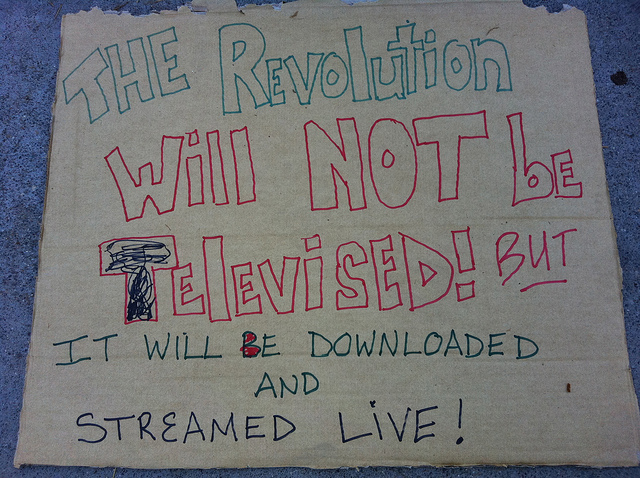
A handwritten protest sign, reading: The revolution will not be televised but it will be downloaded and streamed live
Protest Sign05 by a.mina. Available from Flikr: https://flic.kr/p/audzig


Continue reading “A Level Playing Field? Social Media Logic and the Breakdown of Democratic Communication”

A Level Playing Field? Social Media Logic and the Breakdown of Democratic Communication

Goliath vs. Goliath: Or Why the Net Neutrality Debate is Complicated

You may have noticed that net neutrality was in the news quite a bit this week after US FCC Chairman Ajit Pai tried to slip a release into the pre-long weekend news burial ground stating that he plans to roll back any legislation related to Net Neutrality. In response to this, Netflix released a statement that it opposes any attempts to roll back net neutrality rules. Back in July, when the idea of gutting net neutrality law was first floated under the Trump administration, all of the major platform players such as Google, Facebook, Twitter and Amazon, spoke out against these proposed regulations. But a Google search that I conducted this morning shows news in which Twitter, Pinterest, AirBnB and of course the aforementioned Netflix make statements opposing the new legislation while Facebook and Google are conspicuously absent.

Continue reading “Goliath vs. Goliath: Or Why the Net Neutrality Debate is Complicated”

Goliath vs. Goliath: Or Why the Net Neutrality Debate is Complicated

Because You’re a Media Company

Yesterday, Sandy Parakilas published an insightful op-ed in the NY Times. Titled We Can’t Trust Facebook to Regulate Itself. In this article, Parakilas,  a developer for Facebook leading up to the 2012 IPO, describes Facebook as “a company that prioritized data collection from its users over protecting them from abuse.” Parakilas writes:

Facebook knows what you look like, your location, who your friends are, your interests, if you’re in a relationship or not, and what other pages you look at on the web. This data allows advertisers to target the more than one billion Facebook visitors a day. It’s no wonder the company has ballooned in size to a $500 billion behemoth in the five years since its I.P.O.

The more data it has on offer, the more value it creates for advertisers. That means it has no incentive to police the collection or use of that data — except when negative press or regulators are involved. Facebook is free to do almost whatever it wants with your personal information, and has no reason to put safeguards in place.

In my PhD dissertation, completed in 2013, I made this very point from the outside, arguing for strong evidence that Facebook is in essence a media company rather than the technology provider that at that time they claimed to be. There is an important difference between a technology company and a media company of course. A technology company doesn’t tend to make money off of advertising whereas advertising is essential for media companies. What is particularly insidious about Facebook, as highlighted in Parakilas’ op-ed, is that beyond simply providing attention to advertisers, Facebook also mines and sells user data.

Continue reading “Because You’re a Media Company”

Because You’re a Media Company

Why Does Fake News Spread on Social Media? Because Of Our Caveman Brains

In a world of 24/7 cable news, round the clock Amazon Deliveries, and infinite social media notifications, it’s been difficult to not notice how the ways we interact with each other and information is changing each passing day. Chief among these changes of course is the problem of fake news (#fakenews, I guess) or the spread of misinformation in an online environment. Some people blame Facebook and Twitter, who are currently in the news for the role their platforms played in Russian trolling of the 2016 US election. Their involvement notwithstanding, it seems to me that though the platforms had a role to play in the spread of fake news, it was more a passive role in which they took advantage of human frailty, rather than an active one in which their algorithms spread fake news because it’s more exciting content or something. Allow me to explain.

Continue reading “Why Does Fake News Spread on Social Media? Because Of Our Caveman Brains”

Why Does Fake News Spread on Social Media? Because Of Our Caveman Brains

Why I Don’t Use Facebook: Part 2

This is a follow up to my first post, which details why I think you can be an effective social media advisor, even if you are not personally on Facebook yourself. In this post, I’m going to briefly discuss some of the larger political and economic reasons why I do not engage on Facebook, and why I’m thinking about withdrawing my participation from social media completely, on a personal level that is.

A video camera pointed at a Facebook logo with barbed wire in the background
Facebook Video by Esther Vargas. Retrieved from Flickr: https://flic.kr/p/dC3AV4

Ahhhhh Facebook! The ubiquitous social network that allows us to freely cyber stalk each other, and live our FOMO best lives in the public eye! A platform that allows us to specify our likes and dislikes, to be collected for all to see! An online bazaar where marketers take all the information we have freely given and use it to sell us more stuff! Facebook how did we ever live without you?

Continue reading “Why I Don’t Use Facebook: Part 2”

Why I Don’t Use Facebook: Part 2

Access Denied? Public Scholarship and the peril of being a woman

Social media and web 2.0 have presented exciting new possibilities for sharing research with the world. While our research in the academy is often confined to discipline specific conferences and academic journals, stuck behind paywalls and accessible only to others in the academic community, self publishing our work on blogs, twitter, facebook, or other platforms allows researchers to communicate their work to a broad audience.

This trend is exciting. As you can see on this blog, I can, with no intermediary, share in plain language, why I think my research is important. People can access my work from around the world, and we can engage in debate or take research in new directions. Furthermore, it’s in the interests of society as a whole. As an academic, my work is at least in part funded by tax dollars. Thus it can be argued that I have an obligation to make my work available and accessible to the public who helps to fund my work.

With these social and scholarly benefits, it’s no wonder that many are advocating that all academics turn to social media platforms to share their research. Unfortunately, however, the question of whether or not to discuss your work in public online is neither simple nor straightforward for many women and people from marginalized populations – particularly those who work in critical gender and race studies, game studies and STEM.

Continue reading “Access Denied? Public Scholarship and the peril of being a woman”

Access Denied? Public Scholarship and the peril of being a woman

Yellow is the New Black

I’ve been thinking a great deal lately about social media as a source of news, and how we are currently experiencing parallels with yellow journalism. I think that if we can identify similarities with our current media environment, and the rise and management of yellow journalism during the Hearst/yellow journalismPulitzer years, we may be in a better position to brainstorm meaningful solutions to the fake news challenges that we are seeing today. And there are indeed many parallels to be drawn, so I’ll begin with a few important ones, as I see them:

Continue reading “Yellow is the New Black”

Yellow is the New Black

From Print to Digital – Information Overload and Folk Wisdom

Lee Rainie’s Keynote in Image Form from #SMSociety 2017

Last week, I had the great pleasure of presenting my work at the International Conference on Social Media and Society (#SMSociety2017), hosted by the esteemed team at the Social Media Lab at Ryerson University. While in attendance, I listened to a fantastic keynote by Lee Rainie, the director of Internet and Policy Research at the Pew Research Center. His keynote, titled “The Reckoning for Social Media” focused on the research work conducted by the Pew Internet and Technology research center, about how social media have changed the relationship of people to each other and to public institutions. Some of his findings were disheartening such as, for example, recent research that shows that people polled in the US are experiencing declining trust in academic institutions, or that people are becoming more polarized in their political views. Other findings were more hopeful, such as the fact that there is substantial reciprocity across social media platforms.

Continue reading “From Print to Digital – Information Overload and Folk Wisdom”

From Print to Digital – Information Overload and Folk Wisdom

FakeBook? Facebook’s fight against fake news mostly hot air

Facebook
“Facebook” by Sarah Marshall on Flickr. Available from https://www.flickr.com/photos/sarahmarshall/

A recent  article in Fortune discusses how Facebook, after launching it’s ‘Journalism Project‘ in January 2017 as a way to fight fake news, has just over six months in, released a progress update.

Continue reading “FakeBook? Facebook’s fight against fake news mostly hot air”

FakeBook? Facebook’s fight against fake news mostly hot air