Considered by James Carey to be the first medium of electronic communication, the telegraph was a revolutionary development, since it was the first communication medium to separate time and space for the purposes of communication. Before the invention of the telegraph, message speed was bound to how fast a messenger could travel: by foot, horse, or railroad. After the invention of the telegraph, messages could travel faster than a messenger ever could. This development thus had ripple effects on markets, democratic participation and community.
Telegraph by SparkFun Electronics. Available on Flickr: https://flic.kr/p/fCs2oC (CC by 2.0)
Today, The Verge published an article stating that Twitter has drawn a small line in the sand with respect to the tweeting habits of the 45 president of the United States. Adi Robertson reports that Twitter has suggested that while it is important not to censor or remove important public figures like the president from the platform, it will draw the line at “tweets that reveal a private address or phone number”. Of course, not all people agree with this stand. For example, Sam Harris clearly stated in a recent podcast that he thinks Trump should be banned from Twitter, since the damage he can do via a Tweet is just so great. Twitter’s response though, is one worth considering. When is it appropriate to silence a public figure on a platform like Twitter? And when is it actually in the public interest to support a person’s right to make even crazy or patently false claims on the site?
A tweet made by Donald Trump: Picture from “Mother Jones” http://www.motherjones.com/kevin-drum/2017/02/donald-trump-edits-tweet/
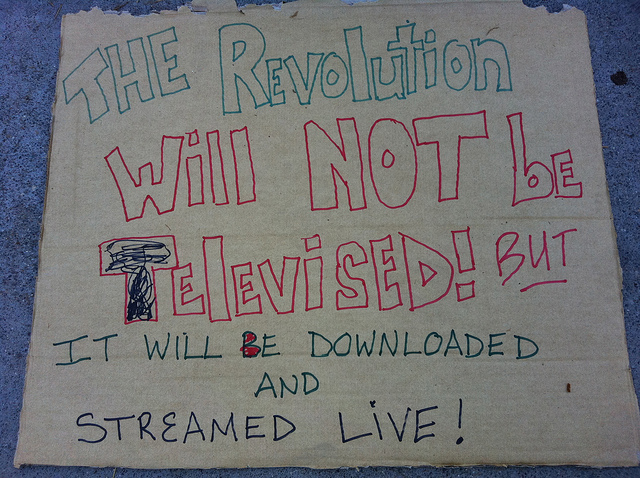
When the participatory web was new, activists and researchers alike were excited by the potential of this new medium to connect groups without the need for conventional gatekeepers. Because social media allows anyone to post information that anyone (everyone) else can theoretically access, it changed the broadcast model of communication from a one to many (or point to multi-point) to a many to many (or multi-point to multi-point) system. Initially, this change delivered on its promise, facilitating movements like #occupy, #idlenomore, and #blacklivesmatter. More recently, however, even though social media still connects people and facilitates some political organization, it has also revealed its darker side.
Protest Sign05 by a.mina. Available from Flikr: https://flic.kr/p/audzig
You may have noticed that net neutrality was in the news quite a bit this week after US FCC Chairman Ajit Pai tried to slip a release into the pre-long weekend news burial ground stating that he plans to roll back any legislation related to Net Neutrality. In response to this, Netflix released a statement that it opposes any attempts to roll back net neutrality rules. Back in July, when the idea of gutting net neutrality law was first floated under the Trump administration, all of the major platform players such as Google, Facebook, Twitter and Amazon, spoke out against these proposed regulations. But a Google search that I conducted this morning shows news in which Twitter, Pinterest, AirBnB and of course the aforementioned Netflix make statements opposing the new legislation while Facebook and Google are conspicuously absent.
One of the hallmarks of the last year of US politics has been a steady stream of messages from the president about “fake news” or the “lying media”. Arguably, this has been a mainstay of Trump’s political strategy since he announced his run for the presidency, and it remains a tactic that he employs, and his followers seem to take at face value. So it’s not surprising to learn that in the US, trust in traditional media is at an all time low. In fact, recent research from the American Press Institute and Associated Press shows that 41% of Americans report having hardly any confidence in the traditional press.
Hashtag by Susanne Nilsson. Available from Flickr: https://flic.kr/p/VeKQb7
What was surprising for me though, as a Canadian researcher, was learning that this is more than just an American issue. In Canada, Statistics Canada reports that only 40% of Canadians report feeling confidence in the national media. With so much information available from so many different sources, it seems as though we just don’t know who or what we should trust anymore. This is true in 2017 and, unfortunately, my research also shows evidence of this trend as early as our Federal election in 2015. We collected thousands of tweets in the month leading up to the 2015 federal election, and we analyzed a sample of them using corpus analysis software along with human content analysis.
This blog post stems from a podcast that I’m putting together for the Multimedia Local News Conference Publication. This publication is being put together by the Ryerson Journalism Research Centre following a very successful international conference on local news in a digital age, and I presented some research at the conference relating to how local news content shared on Twitter can be measured. I am also happy to serve on the conference and publication organizing committee.
The availability of relevant political information is central to a functioning public sphere. In some larger Canadian communities, such as Toronto, Ottawa or Vancouver, which are media centers for their respective provinces, the availability of locally relevant news that aids citizens in making meaningful voting decisions is not an issue. News in these communities is readily available. However, in other communities, this is simply not the case. local news outlets in smaller communities across Canada and around the world are being closed down, and studies have shown that when a community loses a source of local news, civic engagement declines.



 This blog post stems from a podcast that I’m putting together for the