Tiny Ecology Part 1
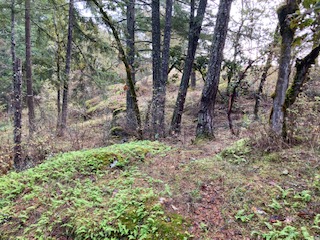
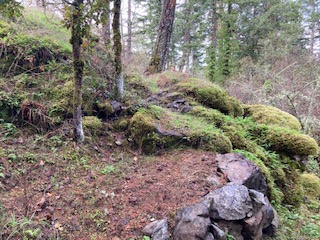
My sit spot is tucked in between mossy rock and a grove of maples and garry oaks in my backyard. It has already become a tranquil place for me to sit with my thoughts and listen to the wonder of the natural world that surrounds me. I can almost hear the stories as the wind blows by. Storytelling is part of our natural world. It is in the trees, the moss, and the rock. It always has been. Indigenous cultures all over the world have used storytelling as a way to pass down oral history from generation to generation. Stories and “oral history are told in relation to the land, the water, and the sky” (Sium & Ritskes, 2013, p. VI).
As I have begun to frequent my sit spot, I have noticed more and more how the diverse life forms have welcomed me in without hesitation. I simply become yet another piece of the puzzle of life and begin to “recognize the personhood of all beings” that surround me (Kimmerer, 2014, p. 21). Each plant and animal continues to go about its tasks. Tasks, I might add, that are necessary for survival. In many ways, the natural world embodies mindfulness in the most purest of forms. Being where one is in that exact moment in time. Focused on the now so sincerely that thought of past or future is irrelevant. I am grateful to be in the presence of such mindful pursuits and such simplicity.
Each experience in my sit spot is so unique. The birds hovering overhead and chirping loudly as the rain begins to fall, almost warning each other of the change in weather. At one point, two robins flew right by the left side of my face while I was seated. For a moment, it took me by surprise. I was alarmed by the proximity. How could they fly so close to me? Don’t I embody what our natural world has become so afraid of? What I soon realized was quite the opposite. In that moment in time, there was no fear. I was merely a visitor in the beautiful life of these two birds playfully chasing each other through the trees.
Sitting, listening, and respectfully admiring the beauty and life within my sit spot has made me reflect on a few core themes; the practice of mindfulness, its impact on gratitude for our natural world, and the importance of storytelling. When we are in touch with our surroundings we are in touch with ourselves. This allows us to communicate in a more connected way. The practice of mindfulness “promotes a new pattern of thinking whereby self and nature overlap and bring about a reconnection and integration between humans and nature” (Wang et al., 2019, p.8).
Over a year ago, I was presented with an opportunity through my work, at the Victoria Native Friendship Centre, to facilitate a program named, Mind Medicine, which helps Indigenous youth who struggle with anxiety and depression by using the practice of mindfulness. In our most recent cohort, which completed a couple of months ago, I noticed one very interesting and powerful thing. Our original program, which was overly psycho-educational and focused too much on concept and too little on practice, did not allow for our youth to deeply connect with themselves within the context of the natural environment. We decided to shift entirely from classroom to land based programming. What I noticed was an immediate decrease in anxiety and an increase in self awareness while immersed in nature. We frequented the same hiking trail once a week, journals in hand, and facilitated observational exercises for our youth to sit with and interpret the natural world around them in conjunction with their own emotional state. The growth and transformation was tangible.
I specifically bring forward this example because I strongly believe connection with the land leads to a deeper connection with the self. Wang et al. (2019) define ‘connectedness with nature as the extent to which an individual includes nature within his/her cognitive representation of self’ (p.6). The experience of a mindful practice, such as immersing oneself in a sit spot, takes away the hierarchy deeply engrained in our world, makes us all equals, and connects us to our environment in a unique and necessary way. Even if it is for a brief moment in time that moment is profound and impactful and can lead to a different interpretation of our role, as human beings on this earth, and an enhanced relationship to the life forms that surround us.
If we encouraged our politicians and leaders to engage in mindfulness and find their own sit spot would we see a shift in policy, politics, and belief systems? Would the logging industry still have priority over clean drinking water or Indigenous land rights? Or would we start to see a shift in ideals, values, and actions? I would argue that gratitude for our natural world be more common than sparse and the climate crisis would be confronted and communicated in a much different way.
References
Kimmerer, R. W. (2014). Returning the Gift. Minding Nature, 7(2), 18-24. Retrieved from https://www.humansandnature.org/returning-the-gift-article-177.php
Sium, A., & Ritskes, E. (2013). Speaking truth to power: Indigenous storytelling as an act of living resistance. Decolonization: Indigeneity, Education & Society, 2(1), I-X. https://jps.library.utoronto.ca/index.php/des/article/view/19626
Wang, J., Geng, L., Schultz, P. W., & Zhou, K. (2017). Mindfulness increases the belief in climate change: The mediating role of connectedness with nature. Environment and Behavior, 51(1), 3–23. https://doi.org/10.1177/0013916517738036