My value system is deeply connected to my outlook on life and the way I chose to walk this earth. However, values can be hard to live by at times. We are surrounded by distractions and stressors that can impede in our ability to live and act how we truly wish to. No matter how hard we try to filter through the clutter that surrounds us. Climate action is rooted in so many of the values that I believe in and, because of that, is a career path that has chosen me.
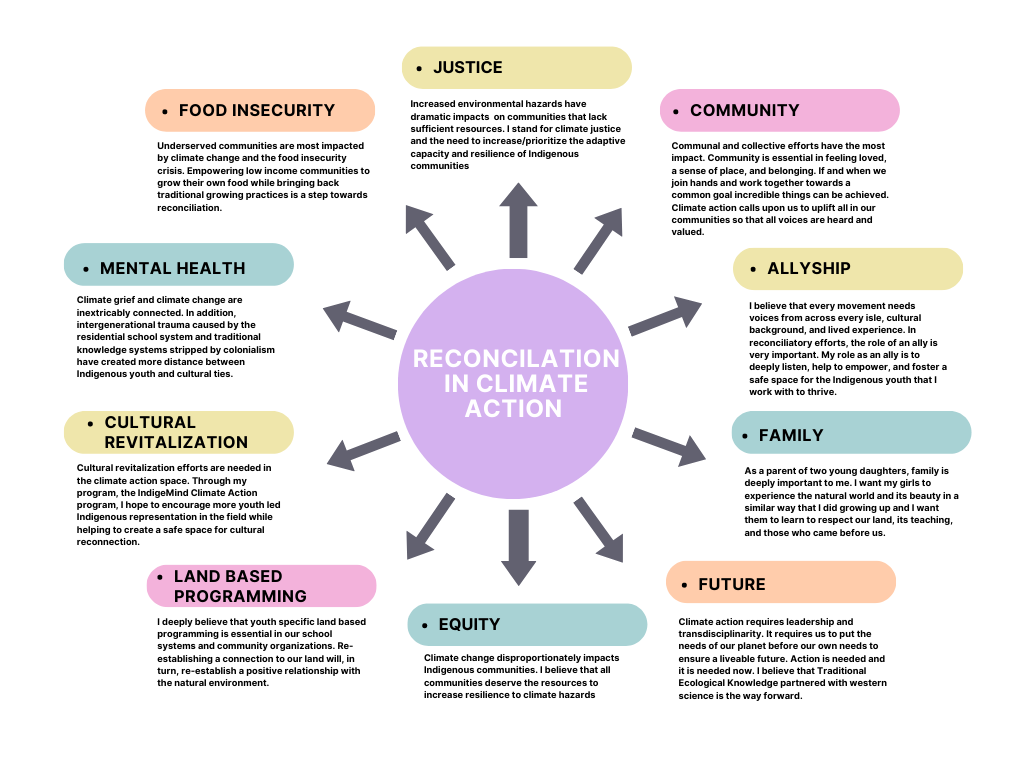
The concept map above portrays what is important to me in both my personal and professional lives. I am an ally and an advocate in my work with Indigenous youth and have been for a number of years. Allyship is deeply important to me. I recently was hired to design and run a youth centered climate action program for Indigenous youth, called the IndigeMind Climate Action program. It represents the intersection between mental health, cultural revitalization, and land based programming. To me, this is reconciliation in action. Helping to create and foster a safe space where re-connection to the self and the land can occur while fostering growth, education, and opportunity for our next generation of climate action leaders.
Climate action calls upon us to be just, equitable, and uphold cultural diversity as we continue to explore solutions to the complex and ‘wicked problems’ posed by climate change. I believe inclusivity, community engagement, and partnerships allow us to build a unified front so that we can adapt and built resilience. The unfortunate reality of our world is that underserved communities are most impacted by climate change. There is an increasing food insecurity crisis and a need for communities to develop more green spaces and prioritize local and regenerative food growing operations. Growing food connects people back to the land and allows for the sharing of traditional ways of knowledge from elders to youth.
Family is a value that is deeply important to me and motivates me in the climate action work that I do. When I became a parent I was confronted with the realization that my children may not witness the natural world in the same day that I did growing up. This is more fact than opinion at this point, however, what I hope to pass on is a respect for the land and those who came before us. The understanding that living in harmony with the land, through a co-beneficial relationship, is attainable through conscious actions and viewing the natural world as an extension of ourselves.
Through a combination of Traditional Ecological Knowledge (TEK) and western science I believe that we can help heal and repair some of the self-inflicted wounds we have subjected our planet to. In addition, it is a step in the right direction to heal relations with Indigenous communities and show the prioritization of acting in accordance with the Truth and Reconciliations Calls to Action and “establish…community based youth organizations to deliver programs on reconciliation [and climate action]” (TRC Calls to Action, 2015, p. 8). Action is a value that is rooted in my core and, more than anything, it shows what we truly stand for. As a climate action leader, I take it upon myself to live and act by my values to ensure a future for our planet and all who inhabit it.
Truth and Reconciliation Commission of Canada. (2015). Truth and Reconciliation
Commission of Canada: Calls to Action. https://publications.gc.ca/collections
/collection_2015/trc/IR4-8-2015-eng.pdf