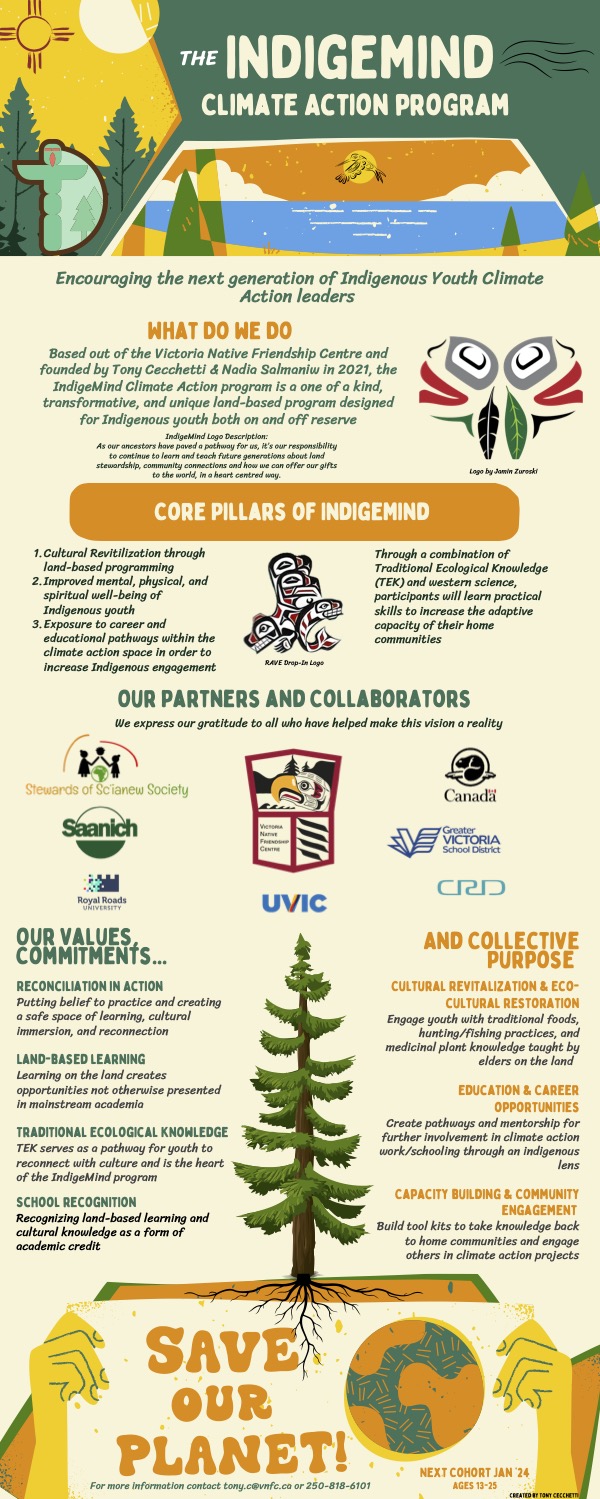
CALS601 Assignment 3: Part 2-Conference Reflection
As I come to the end of my degree, I can’t help but reflect on the journey that it has been to get to this point. There have been many twists and turns along the way and much adversity that had to be sifted and waded through. There will always be bumps in the road. This is what climate action leadership is, the constant overcoming of adversity, and it is reflected in so many areas of my own life.
This past weeks Climate events at RRU along with the two day Climate Accelerator led by Solvable reminded me of the reasons why I am immersed in Climate Action Leadership work. I am a values driven person and my belief system dictates much of how I walk this earth. I try to live and work gracefully and at ‘the pace of the land,’ as my good friend Cristina Armstrong of Stewards of Sc’ianew reminds me. Specifically, the values that came up for me in this weeks conference were that of family, community, and reconciliation.
When I started this program my oldest daughter was one year old and at the conclusion of my degree I am blessed to now have three daughters( 4 and a half, 21 months, and 6 weeks). I am extremely proud to have made it to the finish line. It has been a long and trying road. Fatherhood and being a parent shifted my perspective on life, as it does to many. Most importantly, I want to live by example and show my girls the importance of respecting the land and that investing energy, effort, and time into what you believe in is important. I want my girls to be raised in a space that upholds relationship with the land and our natural environment. Hatala et al. (2019) add that in Cree the word “Miyo-wicehtowin…mean[s] having or possessing good relations…with the land…and mother earth” (p. 122). Good relations is essential to all things and we must rediscover the meaning of what that is and how it looks. At the very least, if I can raise my children with the value and belief of land stewardship at the forefront I am doing my part in this race against time.
Second, the value of community came up often in this past week. How are we able to do this work if we don’t surround ourselves with similar and like-minded folks? The reality about the climate action space is that, although, it is filled with hope it is simultaneously filled with grief, loss, and immense worry. However, embedded in the anxiety of climate change are incredible people fighting and working everyday to prioritize mother earth and her needs. I saw this first hand throughout the past week. There are brilliant minds and hearts at work to heal our damaged land and infiltrate the minds of the disbelievers to get them on our side. McGregor (2014) defines transdisciplinarity as “going beyond disciplines to engage civil society” (p. 201). We need to be creative in how we communicate the need for climate action and we need to do so in a heart centered way.
Lastly, reconciliation came up time and time again or ‘reconciliation in action,’ as I like to call it, and my role as an ally in that space. I am a firm believer that Indigenous leadership and the use of traditional ecological knowledge is the most important step towards revisioning and recreating a future of proper land stewardship. This starts with governments giving land back that was unjustly taken from the Indigenous peoples and listening, truly listening, to what Indigenous communities have to say. In addition, colonial culture and society has a massive role to play too. The work can’t simply be done by those who had their land and culture stripped away. All of us ‘uninvited guests’ on Indigenous land must work hand in hand with Indigenous leaders and youth voices. That is true reconciliation-a collective effort centred around a unified belief. I have always said that every movement requires people from across every isle, belief system, and cultural background. That is how we move forward with inclusivity and momentum. The western world has to understand that allyship is needed in climate action. That starts with inner reflection and decolonizing the colonizer inside of all of us. Kluttz et al. (2019) add that “Co-existing and, through that, co-resisting requires compassion. Compassion for oneself, as an ally attempting to decolonize oneself, and compassion for Indigenous peoples… An ally’s…personal decolonization journey should include a combination of conscience, values, and a commitment to staying open to constant self-evaluation and self-correction, without ego” (pp. 63-64). This is how we move forward. It is first through the acknowledgment of wrong doings but then it is through action. How do we, as the colonizers, collectively act in a way that reflects the true meaning of reconciliation?
As I come to the end of this blog and the end of my time in the inaugural MACAL cohort this does not mark the end. It marks the beginning of a new journey. One that surely will have many unknowns and more twists and turns. I am determined and ready to face those head on with my toolkit rooted in compassion, love, and forward thinking. As a climate action leader. As a father. And as a Ally.
May we protect the land so that it may nourish our children, as it has nourished us.
Onwards. Forever and Always.
References
Hatala, A. R., Morton, D., Njeze, C., Bird-Naytowhow, K., & Pearl, T. (2019). Re-imagining miyo- wicehtowin: Human-nature relations, land-making, and wellness among Indigenous youth in a Canadian urban context. Social Science & Medicine, 230, 122–130. https://doi.org/10.1016/j.socscimed.2019.04.012
Kluttz, J., Walker, J., & Walter, P. (2019). Unsettling allyship, unlearning and learning towards decolonising solidarity. Studies in the Education of Adults, 52(1), 49–66. https://doi.org/ 10.1080/02660830.2019.1654591
McGregor, S. L. T. (2014). Transdisciplinarity and Conceptual Change. World Futures, 70(3-4), 200–232. https://doi.org/10.1080/02604027.2014.934635
*VNFC IndigeMind Logo by Jamin Zuroski