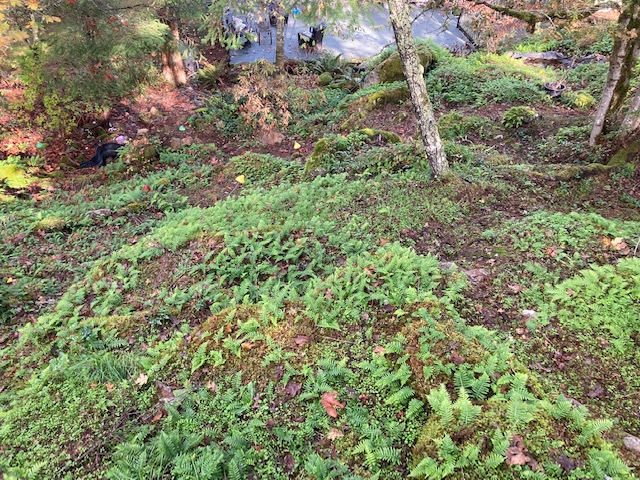
This weeks reflection focuses on how disability affects people in the greater Victoria area, where I reside with my family. I’d like to focus, specifically, on physical disabilities and the inaccessibility of my own sit spot.
Living on Vancouver Island is magical and unique in so many ways. There is unparalleled access to natural beauty with trails to hike, waves to surf, and mountains to ski. However, what’s important to note is that not everyone has access to the same places and activities that I do. Those with certain disabilities can’t just go on a run like I do most lunch breaks. This is a freedom and luxury in my life that I often take for granted.
As I was at my sit spot today, I looked down at the small walking path that I built in my backyard last summer. It’s a path that weaves through rocks, trees, and roots. It is steep and, for many, would be quite dangerous. The first time I took my parents up it I was terrified watching them navigate terrain they infrequently engage with in their day to day lives. After some thought and reflection, I realized just how inaccessible my own sit spot is. It is not a place that many people could access and, especially, people with physical disabilities.
For a moment, this concept made me feel guilty. I recall putting ample thought into where I wanted my sit spot to be. When I came up with the particular location, it was partly because of how rugged and wild it was. I wanted to pick a place where I felt most immersed in the natural environment that surrounded me. I didn’t once think about who would be able to access it and who wouldn’t be able to.
The aftermath of Hurricane Katrina in 2005
It is important to understand that those with disabilities are much more vulnerable to the effects of climate change. Natural disasters expose the inequities that those with disabilities face. Jampel (2018) notes that “disability status can lead to differential vulnerability and to differential exposure, as illustrated in the example of Hurricane Katrina” (p. 131). I remember in 2005, when Hurricane Katrina hit, reading about emergency evacuations that were in place to rescue those with disabilities in the Lower 9th Ward of New Orleans. There were videos of people in wheel chairs on the roof tops of their homes. It was a staggering sight that has stuck with me to this day. In his post for the UX Collective, Wright (2020) adds that “approximately 155,000 disabled and elderly were affected by Hurricane Katrina…[and] half the deaths…were people…[with] disabilities and health conditions that increased their vulnerability” (para. 14).
I am not impacted in my daily life by a disability, and therefore, have not actively and adequately thought about how to make my vision of the climate action movement more accessible to the disabled population. I know now that inclusivity is one of the most pivotal and important themes when communicating climate action and that it must always be brought to the forefront. Dines (2019) adds that “it is everyone’s future, and that needs to be represented in both climate [action] and climate policy” (para. 1).
Learning more about how disability relates to climate change would enhance my capacity to communicate to a wider audience. Notably, it would allow me to broaden my knowledge base on the social justice piece of climate action, one that I am passionate about and believe is necessary for the movements success in the long term. Rallo et al.(2019) emphasize that “accessibility should not be considered add-on or feature [and that] it works best and is the most…effective when it is a core consideration from the beginning” (p. 6). Climate action requires inclusivity, engagement, agency, and story from all walks of life. People with disabilities offer perspectives that are valuable and issues associated with climate change need to be communicated so that information is accessible to everyone that is impacted.
How can we make the climate action movement more accessible to everyone? What steps must be taken to ensure that everyone’s voices are heard?
My sit spot has become a place for my own mental well-being. It allows me to breathe and take a step back from the hustle of my face paced life, where there is always a feeling that there isn’t enough time. Today’s visit embodied the true weather of the northwest spirit. The rain gently fell on my head as I looked up at the trees. Trees that have been on this land much longer than I have. Although, the pattern of the weather has turned to overcast days and cold mornings, there is still such an immense beauty and power to this climate. I couldn’t help but think of the correlation between being immersed in nature and its effects on mental health. The more we find ourselves in a natural environment there is a deeper connection and understanding established that is indescribable. We come to know ourselves in a more pure and true form.
What I chose to focus on from the Connor et al. paper is the domain of health, and specifically, youth mental health in relation to climate change. Connor et al. (2016) add that, “environmental degradation [is] a common public concern” and impacts youth in a dramatic way (p. 466). I believe that mental health suffers when there is a lack of engagement with the natural world. This loss-frame is exacerbated by climate change and the inability of our young ones to fully process and comprehend how environmental and climatic shifts impact their mental wellbeing. I argue that our young ones are the most affected by climate change, as they are left to undo the generations of harm done to our planet. Sanson et al. (2019) add that “climate change poses an urgent threat to future generations…Children are more susceptible to its effects than adults, with immediate and life long impacts on their physical and mental health” (p. 201). Our efforts, as parents, academics, educators, and climate action leaders, must focus on interpreting mental health through a climate based lens. What I mean by this, is more land based counselling and therapeutic approaches to help process the relationship between anxiety, for example, and a changing climate.
There are ways to take action and to do so thoughtfully with the objective of creating and framing a compelling message to the public. Sanson & Bellemo (2021) note that, “professionals can support young people…by supporting their capacity to take action, raising awareness on the impact of the climate crisis on youth mental health and physical health, and taking actions themselves to work for a secure climate future” (p. 205).
I think a wonderful way to reach a larger audience would be in the form of an educational tv show. Topp et al. (2019) add that “entertainment increas[es] cognitive engagement associated with climate change” (p. 697). I spend quite a bit of time watching shows with my two year old daughter. How impactful would it be, if from a young age, children could watch an animated show based around climate change and how it impacts kids? Communication through entertainment in a creative way. The show’s episodes could take place in various cities and rural areas around the world highlighting that regions most pressing climate concerns and its effects on local children and their way of life.
For future consideration, I would like to further explore the direct impacts of climate change on youth mental health and strategies to help youth cope with the lasting impacts of climate change and climate grief. What can be done? How can we tackle youth mental health while simultaneously making space for our next generation of climate action leaders?
Resources
Connor, P., Harris, E., Guy, S., Fernando, J., Shank, D. B., Kurz, T., Bain, P. G., & Kashima, Y. (2016). Interpersonal communication about climate change: how messages change when communicated through simulated online social networks. Climatic Change, 136(3-4), 463–476. https://doi.org/ 10.1007/s10584-016-1643-z
Sanson, A., & Bellemo, M. (2021). Children and youth in the climate crisis. BJPsych Bulletin, 45(4), 205–209. https://doi.org/10.1192/bjb.2021.16
Sanson, A. V., Van Hoorn, J., & Burke, S. E. L. (2019). Responding to the Impacts of the Climate Crisis on Children and Youth. Child Development Perspectives, 13(4), 201-207. https://doi.org/10.1111/ cdep.12342
Topp, K., Thai, M., & Hryciw, D. H. (2019). The role of entertainment in engagement with climate change. Environmental Education Research, 25(5), 691–700. https://doi.org/ 10.1080/13504622.2019.1572072
A fisherman in the bayou country of Southern Lousianna
The access rights of this film are open to anyone with internet or social media. The short film can be found on the Emergence Magazine website. A full reference in APA format will be provided at the bottom of this analysis.
The intended audience for this film are educated activists and environmentally conscious individuals. I do understand the limitations of the reach of this film due to the small community of Emergence Magazine. Drawing from Global Warming’s Six Americas, the short film caters to those that are already alarmed, concerned, and cautious about climate change (Maibach et al., 2011, p. 17). I would add that those who subscribe to this reputable journalism outlet are also engaged, in one way or another, either through the consumption of climate based information or specific climate action in their respective communities. Emergence Magazine is an online publication and journalism outlet that caters to progressive minded folks that believe in climate change and the threats it poses.
The film shares the story of the residents of Isle de Jean Charles, how climate alterations have changed the landscape of the island over time, and how the increase in severe weather patterns poses serious risks for future habitation. The short film, titled Isle de Jean Charles, is directed by Emmanuel Vaughan-Lee and was published on the Emergence Magazine website on August 31, 2021.
Techniques List
The following list highlights techniques used for the analysis of this film and its style of climate communication.
1. Identify and understand your audience
As noted by Dupar (2019), “understand the intended audience’s knowledge and values. Use framing and language that will resonate with target audiences and evolve their understanding of, and contribution to, an issue” (p. 9). This short film was specifically published to the Emergence Magazine website and intended for their audience base.
2. Tailor knowledge products and use multiple formats
Specifically, “mak[ing] content easy to access, easy to use, [and] easy to share. Make sure content can be readily understood, applied, and distributed by your intended audiences” (Dupar, 2019, p. 10). Given that the short film has been uploaded to an open resource and digital platform it is easy to find and share if the viewer desires. The film is also short in length, can be viewed in one sitting, and straight forward to digest and interpret. The film was also uploaded to Emergence Magazine’s instagram page where it is accessible to anyone with social media.
3. The use of storytelling
Bayer and Hettinger (2019) argue that, “storytelling can serve as an effective tool for community engagement, particularly with regard to environmental issues” (p. 1). Emmanuel Vaughan-Lee utilizes story to captivate and draw in the audience raising awareness to Isle de Jean Charles through the story of those living on the island.
4. Localize the issue
This can, “help reveal local angles of a global problem, thereby making the problem more concrete, and moving the location of impacts closer to home” (Maibach et al., 2011, p. 19). The environmental issue portrayed in the short film is specific to Isle de Jean Charles, in the heart of the bayou in Southern Louisiana, yet this doesn’t mean that it doesn’t impact people off of the island. More and more people are affected by increasingly severe weather patterns, including the audience of Emergence Magazine, possibly encouraging these individuals to get out into their communities to see what can be done to counter the impacts of climate change.
5. Frame the issue as a human health problem, not as an environmental problem
Reframing is a powerful tool. Maibach et al. (2011) add that “making the case that climate change is a major threat to people’s health and well being has the potential to engage a much larger cross section…of the public” (p. 18). The short film frames the issue primarily from a human-centric lens, showing how impacted the lives of a few families left on the island are due to a rapidly changing climate and rising sea levels.
6. Cater to values and belief systems
It can be assumed that the values of those watching this video are fairly similar. The audience reads articles or watches short films from Emergence Magazine because they specifically sought out the information shared through its platform. Using a “frame that resonates with people’s broadly shared values…helps people ground their understanding of an issue in the context of their previously existing, carefully considered, and deeply held belief systems and motivations” (Maibach et al., 2011, p. 18).
7. Use the fundamentals of good communication
Emmanuel Vaughan-Lee deliberately uses “emotion to accentuate [his] message…and bring[s] the message to life by telling the story about how the issue has affected real people” (Maibach et al., 2011, p. 24). The short film has an emotional element to it that draws in the viewers values, beliefs, and hearts into the story.
Analysis
There are many aspects of analysis when approaching the effectiveness in communication of Emmanuel Vaughan-Lee’s short film. The techniques list above identifies the many tactics used to engage the audience of this film. Some were successful and others could be improved upon. I will dive deeper into each technique and assess the strengths and weaknesses exhibited.
Understanding one’s audience is a pivotal step in conveying any message or story. There are a couple main points that stood out to me here when analyzing the effectiveness in identifying and understanding who will gravitate to this film. The film was specifically placed onto the Emergence Magazine website, where I first discovered it during my research for this assignment. This is important in identifying the audience because Emergence Magazine has a small yet dedicated following in comparison to other journalism outlets. It is a niche platform that touches on relevant stories associated with climate change and conveys them through abstract and creative mediums. Isle de Jean Charles is a captivating film. The placement of such a film on a platform that attracts engaged environmentalists, activists, and thinkers is an effective technique within this specific community.
Where this technique lacks is in its ability to draw in more viewers outside of the Emergence Magazine following. Sure, the short film is open sourced but how does one find it if they don’t find themselves on the Emergence Magazine website? How can the story reach more minds and hearts that care about a changing climate and those most affected by it? I would argue that the film needs to be distributed more among like minded journalism outlets to further the reach and increase the audience base and potential impact.
Emmanuel Vaughan-Lee does a good job using multiple formats to share his short film, Isle de Jean Charles. He uses digital media, through the Emergence Magazine website, and utilizes social media, through Emergence Magazine’s instagram page. If more research was conducted on the film it may in fact appear on more platforms such as Facebook, Twitter, and Youtube, however, it did not immediately appear in my search. Vaughan-Lee is also effective in tailoring his knowledge products. The content of the film and the message it conveys is not difficult to understand and decipher. Isle de Jean Charlesis changing due to both human induced and climatic changes. The risk of the island being fully underwater is real yet the strong connection to place keeps the small community of residents put. It is almost impossible to not think about climate refugees while watching this film. Where will these people go if they are in fact forced to leave the island that they love? Will they ever leave if the water levels rise to high?
What I found most captivating about watching this film was how storytelling was used to connect the audience to the lives of those living on Isle de Jean Charles. As Bayer and Hettinger (2019) add, “stories make us who we are…they are central to human existence: our most instinctive and universal means of communicating” (p. 5). By showing the impacts of climate change on the residents of the island, a theme of empathy runs throughout the film. How can one not feel deeply for the residents of Isle de Jean Charles?Emmanuel Vaughan-Lee brings emotion into the story to draw in the viewer. At one point in the film, Chris Brunet, one of the long time residents of Isle de Jean Charles, shows a picture of his grandfather tilling the soil in his backyard. He speaks about how, just a couple of generations removed, those same fields his grandfather tilled are now fully underwater. This story is meaningful because it connects the audience to their own past and the histories of their own families linking together the human experience. It shows how dramatic and abrupt the changes in landscape are. The element of story in this short film is powerful and well crafted.
Another strength of Isle de Jean Charles is how the global issue of rising sea levels is localized to a specific place. Conveying a message through a global lens is a difficult and daunting task and rising sea levels is a universal concern across the map. What this film does is bring a local example of rising waters and pairs it with the story of the residents of a small island in southern Louisiana. Showing a specific example of where, how, and why an area is being impacted by climate change is a strong way to communicate an issue. It contextualizes the issue for an audience and associates place with concern of future. The human race is driven to act when we, ourselves, are directly affected. Localizing an issue shows not only the impact on geography and landscape but also on the people living in the observed region.
The next part of my analysis focuses on the power of reframing the issue of climate change as a human health problem. Maibach et al. (2019) note that, “by framing climate change as a local public health issue, it is possible to replace people’s mental associations of climate change…with more proximate and relevant…associations, such as the risks to children…the poor…[and] local communities” (p. 20). Vaughan-Lee does just this in his film. His specific messaging of the need to confront a changing climate is passed through the story of the health and well being of the few remaining residents on the island. Would the film have the same effect if it were simply about the island and not the people living on it? I would argue that its impact would lessen and the specific audience tailored to Emergence Magazine might not feel as compelled to act. Overall, the integration of a public health challenge makes this a stronger film, although, it could of concluded with some practical steps to engage a caring and thoughtful audience.
Reframing an environmental problem so that it incorporates and focuses on public health is effective because it caters to peoples values and belief systems. The intended audience of this film will care about Isle de Jean Charles, especially, because there is a direct correlation with the health, livelihood, and future of the families living on the island. Emergence Magazine subscribers are deeply thoughtful, intellectual, and environmentally driven individuals with strong values geared towards interpreting and highlighting ecological changes through story. Health and the sharing of story, are values that Vaughan-Lee hones in on in his film. I would argue that one area of potential growth in the film, when considering public health, would be a stronger emphasis on food security and how a changing climate impacts availability and access to food for the residents of Isle de Jean Charles.
The last component of my analysis focuses on the fundamentals of good communication. The ability to effectively communicate is essential in conveying a message to any audience. As Moser (2016) adds, “effective communication requires detailed understanding of one’s audience” (p. 350). In his film, Vaughan-Lee uses emotion to communicate and share the story of Isle de Jean Charles. He focuses on the stories of two families who have such a strong connection to place that they chose to live with the increasing risks due to hurricanes and rising water levels. Leaving the island they call home for a safer and more secure future does not appear to be an option. This story is powerful. It invites the audience to put themselves into the shoes of those living on Isle de Jean Charles and creates empathy. Through emotion, the story is heard and interpreted differently. It is communicated in a way that is felt in heart.
Overall, I feel that this short film captured many of the essential elements of effective climate communication. Although I believe that the film was made for a very specific demographic of like minded thinkers, activists, environmentalists, and human rights advocates, it clearly illustrated the precarious situation occurring on Isle de Jean Charles and the immediate impacts of climate change in our world today. The film was captivating, concise, educational, and easy to digest and has the potential to have a much larger impact if seen by a larger audience.
References
Bayer, S., & Hettinger, A. (2019). Storytelling: A natural tool to weave the threads of science and community together. The Bulletin of the Ecological Society of America, 100(2), 1-6. https://doi.org/10.1002/bes2.1542
Moser, S. C. (2016). Reflections on climate change communication research and practice in the second decade of the 21st century: what more is there to say? Wiley Interdisciplinary Reviews: Climate Change, 7(3), 345–369. https://doi.org/10.1002/wcc.403