Onwards Towards a Brighter Future: A CALS501 Final Reflection

meadow, field, sunset-2667461.jpg

As we come to the end of our CALS501 design challenge, I reflect on the growth, transformation, and learnings that have come along the way. Each course has challenged me immensely, all with the clear objective of harnessing the necessary skills to become a climate action leader in today’s world.

Our team’s prototype shifted quite dramatically since the beginning of this design challenge. Initially, we wanted to create change so vast that we could touch every corner of the world inspiring youth to engage in climate action. Throughout the past year, our scope narrowed and our focus honed in on how to effectively bring about change locally. The course work, interview phase, and testing phase helped shape what is now a practical prototype ready to impact, educate, and inspire. 

CALS502 inspired communication. How do we effectively communicate climate action? Throughout the design challenge, it became more and more apparent to me that listening and engaging various expertise, cultural backgrounds, and ways of knowing is the way forward. A transdisciplinary approach is what is needed to bring climate action to the forefront. McGregor (2014) defines transdisciplinarity as “going beyond disciplines to engage civil society” (p. 201). We need to be creative in how we communicate the need for climate action. 

CALS503 centered around climate risk management. I learned how to assess risk and present findings and strategies to mitigate the impacts of climatic hazards. My thinking during this course shifted towards what risks were associated with our prototype? Who would benefit from it and who wouldn’t? The theme of accessibility came up time and time again. Open educational resources are powerful. They have incredible potential but they also lack in certain areas. A large aspect of the vision of our prototype centers around Indigenous ways of knowing and traditional ecological knowledge. That said, for remote communities in Canada, most of which are Indigenous, how is a prototype that requires cellular data and wifi accessed? We decided to create a downloadable version of our prototype, specifically, for those remote communities. However, even a downloadable version requires use of a technological device. Access is a clear limitation to our prototype design. 

CALS504, our current course, focuses on building a business case and crafting adaptation strategies to encourage climate action across sectors. How do we pitch climate action projects so that we can encourage organizations to act? Our prototype aims to be attractive, functional, and inspiring. We understand we are selling an idea and that, unfortunately, financial incentive goes hand in hand with climate action. From a business standpoint, can both profit and social good be simultaneously prioritized? We aimed to tackle these profound questions. 

What next? The prototype design challenge produced a mere hypothetical idea. It represents an accumulation of the wealth of knowledge that this program has graced us with. It is now our obligation and responsibility to take the lessons learned throughout this past year and apply them in our professional lives. It is up to us to bring forth change in our communities. Climate action leaders are needed and it is an honor to take on that responsibility. Lonsdale et al. (2015) add that “effective leadership is needed for transformational change” in the climate action space (p. 7). This design thinking challenge taught me that climate action leadership centers around building a network of diverse thinkers with a common goal: to ensure the well being of our planet for generations to come. 

References 

Lonsdale, K., Pringle, P. & Turner, B. 2015. Transformational adaptation: what it is, why it matters & what is needed. UK Climate Impacts Programme. 

McGregor, S. L. T. (2014). Transdisciplinarity and Conceptual Change. World Futures70(3-4), 200–232. https://doi.org/10.1080/02604027.2014.934635

It’s Worth the Risk: Transformational Adaptation

digitization, transformation, woman-5194816.jpg

In order to create systematic change in the climate action space transformational adaptation must occur. We have found ourselves at a point in history where we have lost the luxury of time. In only a short period of human history, we have dismantled the cohesive fabric linking ourselves to the very nature that surrounds us. We have exploited natural resources and pillaged landscapes as far as the eye can see. We have deforested and overfished our oceans. We no longer have the time to fret and consider our options. Incremental change is not an option, unless we care to watch our planet, as we know it, continue to plummet into uninhabitable spaces. 

Climate change is happening in real time. If climate action were at the forefront fifty years ago, incremental adaptation could very well of been a feasible option. However, it was not. Fedele et al. (2019) add that “conventional coping strategies and incremental adaptation to climate change may not always be effective at helping people or ecosystems to reduce their vulnerabilities to severe climatic changes” (p. 116). Take the province of British Columbia as an example. In the fall and winter we now have extreme riverine flooding washing away roads and interior towns. In the summer months we have extreme heat events where temperatures have exceeded 40 degrees celsius. In addition, we have wildfires and urban interface fires that ravage our forests and jeopardize our cities. Climate change and its impacts and hazards are year round reoccurring events. How does incremental adaptation help to sustain, preserve, and protect our social-ecological systems?

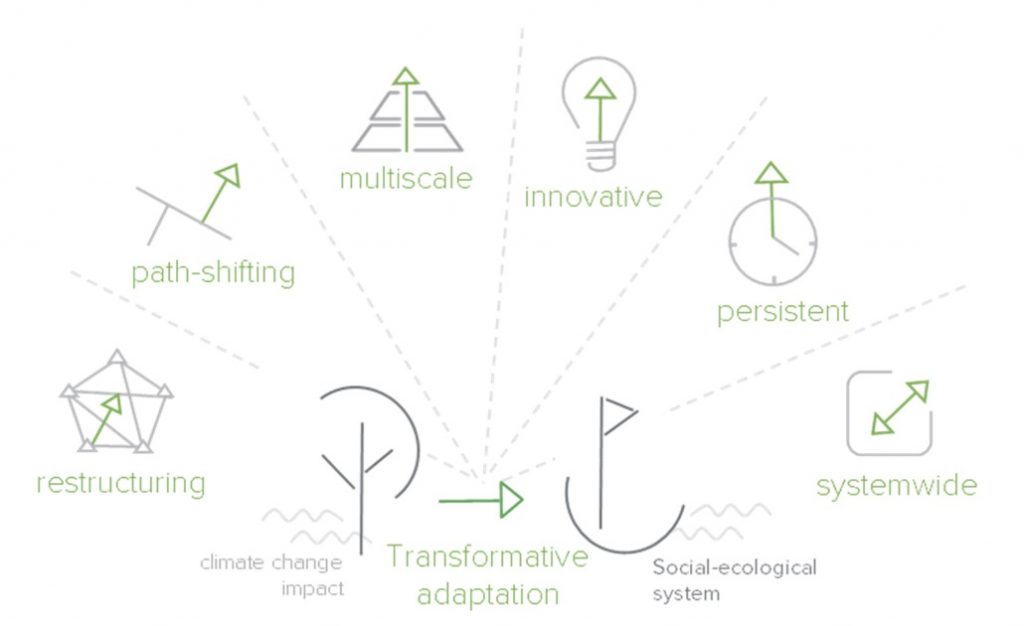
Transformative adaptation presents us with an opportunity. However, within transformation is embedded and inherent risk. Risk that is necessary to take. For transformational adaptation to work, transdisciplinary expertise and cross sector unity must be established from business to educational institution to non-profit. Lonsdale et al. (2015) note that “transformation may occur at different levels and dimensions, mediated by power relations, but usually implies a systemic or paradigm shift” (p. 7). A shift in thinking is integral to transformational adaptation, as there needs to be persuasion and belief that ones actions can hold profound weight resulting in significant outcomes. The climate action space is transformative and calls for thinkers and doers that see outside of the box. It calls for those that are removed from the traditional norms of society that have hindered movement and growth and inspire change towards climate action.


Figure 3: Characteristics of transformational adaptation (Fedele et al., 2019, p. 120)

How can we dive head first into transformational adaptation? At the forefront is leadership, as “effective leadership is needed for transformational change” (Lonsdale et al., 2015, p. 7). Voices for change in the climate action space are needed now more than ever. Those of us in the MACAL program represent that, however, we are the first cohort in the country. 

Law makers and politicians have the ability to push the transformational adaptation platform. Pelling et al. (2015) add that “transformation as an adaptive response to climate change opens a range of…policy options” (p. 113). Although my skepticism of the willingness of policy makers to take a chance are high, they are still in the drivers seat to enact policies that must be adhered to across the country. Policies that can shape the future of our planet.

Systematic change calls for risk. It calls for stepping outside of one’s comfort zone and detaching from self interest. The only way forward is to be transformative in our adaptation strategies. If we don’t act, and don’t do so now, the climate will continue to change at an increasingly rapid rate and we will find ourselves questioning our inability to be forward and progressive thinkers. 

References

Fedele, G., Donatti, C. I., Harvey, C. A., Hannah, L., & Hole, D. G. (2019). Transformative adaptation to climate change for sustainable social-ecological systems. Environmental Science & Policy101, 116–125. https://doi.org/10.1016/j.envsci.2019.07.001

Lonsdale, K., Pringle, P. & Turner, B. 2015. Transformational adaptation: what it is, why itmatters & what is needed. UK Climate Impacts Programme. 

Pelling, M., O’Brien, K., & Matyas, D.  (2015). Adaptation and transformation. Climatic Change, 133.  113- 127. https://doi.org/10.1007/s10584-014-1303-0