CALS503-Climate Risk Management Blog Post
Assignment 2-Part B
A Hazard, Risk, and Vulnerability Analysis (HRVA) was produced for the Regional District of Nanaimo, Town of Qualicum Beach, and City of Parksville on Vancouver Island, British Columbia in September of 2019. For assignment 2-part b, I analyzed and critiqued the methods, approach, results, and knowledge of terms, as well as important omissions from the produced document. The intention of the assessment was to “help [the] community make risk-based choices to address vulnerabilities, mitigate hazards, and prepare for response to, and recovery from, a range of hazard events” (EMBC, 2020, p. 6). As climate change, and environmental hazards and impacts associated with it, continues to increase in magnitude and occurrence, it is imperative that efforts are put in place to prepare for the inevitable realities. This HRVA is a step in the right direction.
The critiqued HRVA was produced based on a qualitative analysis of accumulated non-scientific data using a bottom-up approach by gaining knowledge and insights from “local government…First Nations community representatives, subject matter experts, and other agency stakeholders” (CCEM, 2019. p. v). There were a total of three public engagement sessions held over a nine month period of time. The intended audience of the document were local community members, invested stakeholders, and decision makers within Nanaimo, Qualicum Beach, and Parksville.
The assessment defined the key terms of hazard, vulnerability, and risk using up to date definitions from various governmental agencies (the UN Office for Disaster Risk Reduction and the Government of British Columbia) and placed such terms in accessible, accurate, and relevant locations throughout the document.
Results were communicated through ‘risk scores’ that were allocated to each natural hazard. Scores were determined by multiplying the likelihood of a hazard occurring by its overall consequence, the higher the number the greater the risk. An example of the how risk scores were demonstrated can be seen below. Natural hazards are represented with the symbol of a leaf under the word ‘Category’.
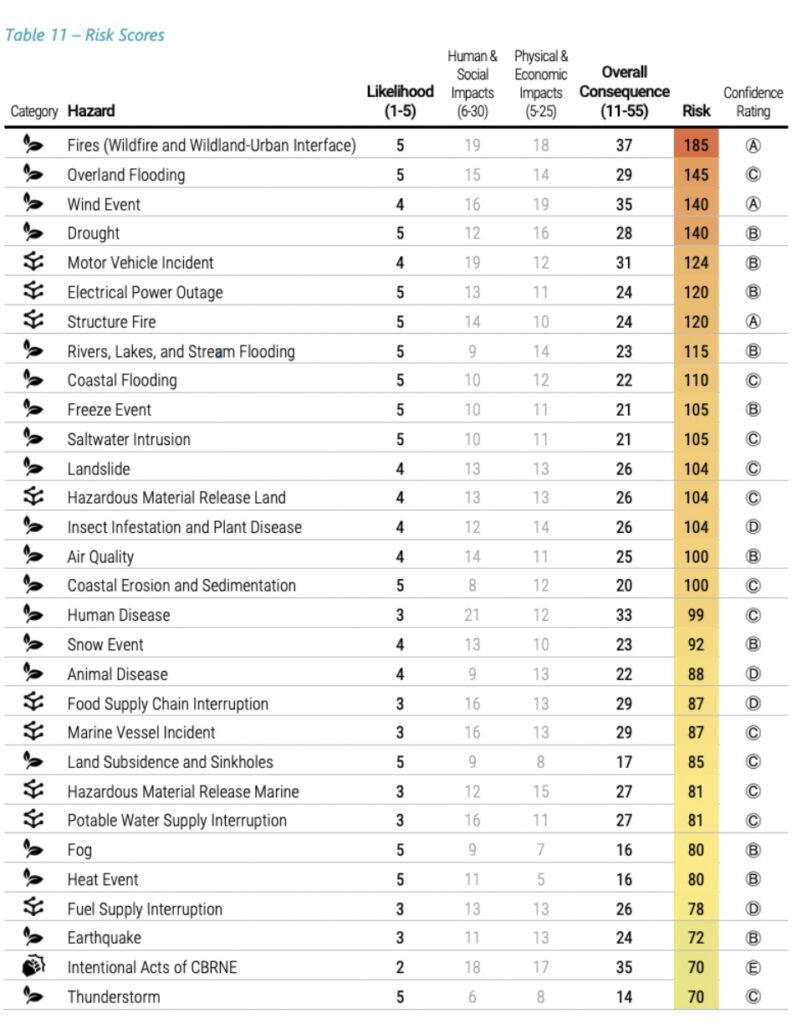
Table 11- Risk Scores (p. 45)
It was concluded that the Regional District of Nanaimo, Town of Qualicum Beach, and City of Parksville are increasingly susceptible to the impacts of “severe wildfire and [urban interface fire] seasons and seasonal water shortages” as well as overland flooding and wind events (CCEM, 2019, p. 93).
Although the document was quite informative, organized, and produced utilizing a variety of regional expertise there was need for improvement in multiple areas. The HRVA omitted local Indigenous knowledge from the Qualicum, Snaw-naw-as, and Snuneymuxw First Nations. There was no mention of traditional ecological knowledge as well as little to no Indigenous representation at the three public engagement sessions. Not only does the document inaccurately represent the historical knowledge of the region but it alienates communities with incredible resiliency and adaptive capacity to climate impacts. Indigenous knowledge must be present within future HRVAs and should inform the overall process from start to finish.
An additional critique lies in the engagement sessions and the limited outreach done in community. Of the three engagement sessions, 70% of the total participants attended at least two sessions (CCEM, 2019, pp. 6-7). This points to limited public representation with few voices guiding the results and findings of the HRVA. Additional engagement sessions are encouraged for a more thorough analysis of the community perspectives of climate hazards, risks, and vulnerabilities.
Lastly, the HRVA lacked in sufficient recommendations to increase resiliency and better prepare the region for a changing climate and the impacts of future environmental hazards. Subsequent assessments could benefit from having more practical steps for community stokeholders to increase engagement and awareness within the climate action space.
References
CCEM Strategies Ltd. (2019, September). Hazard, risk, and vulnerability analysis: Regional District of Nanaimo, Town of Qualicum Beach, and City of Parksville. Retrieved from https://www.rdn.bc.ca/sites/default/files/inline-files/2019%20RDN%20HRVA%20Report
%20FINAL.pdf
EMBC. (2020). Hazard, risk, and vulnerability analysis (HRVA) for local authorities and First Nations: Companion guide for the HRVA tool. Retrieved from https://www2.gov.bc.ca/ assets/gov/public-safety-and-emergency-services/emergency-preparedness-response- recovery/local-government/hrva/guides/companion_guide_to_the_hrva.pdf