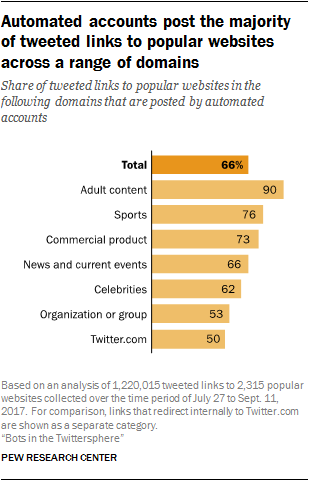
According to a recent report by the Pew Research Center that I, ironically enough learned about because it was shared on Twitter, “an estimated two-thirds of tweeted links to popular websites are posted by automated accounts” also known as bots.
I was fortunate enough to attend two great International academic conferences in the last two weeks. The first, The International Conference on Social Media and Society, took place at the Copenhagen Business School, and the second, the IEEE Professional Communications Conference, took place at the University of Toronto. The first conference was entirely about research having to do with social media, and included a panel about how social media research must change now that platforms are cutting access to their API’s in the wake of the Cambridge Analytica scandal. The second conference was, broadly speaking, about technical communication, but included a plenary about how the ways we communicate can either facilitate accuracy, truth and information access, or undermine all of these things. The IEEE Professional Communications Conference also included panels centred around using social media to teach and research communication. Now, after both of these conferences, I have a few reflections of my own on social media, data gathering, research and access to information in a post Cambridge Analytica world.
“Facebook” by Frank Hebbert. CC-BY-2.0. Available on Flickr: https://flic.kr/p/Sq4x8
Post truth issues such as “alternative facts”, polarization, and propaganda cannot simply be countered with more information. It is clear that people are not swayed by data. Providing additional arguments to back up your claims will likely be countered with additional false information from the other side. The information bounty of online spaces facilitates this. So if we can’t counter mistruths or propaganda with more information what can we do?
HOW you tell your story is very important in this context. This means that if you really want people to have access to truthful information, you have an obligation to present that information in a way that is accessible, including using plain language and easy-to-understand images, and telling a compelling story whenever possible. Humans tend to respond to narratives better than they respond to straight repetition of facts, so science communicators and researchers need to think about how we can remain faithful to the facts while also telling a compelling story.
Research therefore, and necessarily must focus on people – what do they want? What resonates with them? How do they access information? What do they believe to be true, and how does this influence how they engage with one another and with the information environment? Since access to API’s is becoming much more difficult in the wake of Cambridge Analytica, we will be challenged to come up with new methods for understanding what people do online, but this is also a wake up call for researchers, as we were becoming quite complacent scraping twitter for the low hanging fruit of our research, without having to ask critical questions about the limitations of API scraping.
This post was originally posted to Medium, you can view the original here
One of the key benefits often ascribed to local news is that local news outlets facilitate more hyperlocal reporting. That is to say, the presence of a local news outlet is associated, at least in many people’s minds, with an increased coverage of local stories in a community. But is this correlation true in practice?
This post is cross posted from medium.com. You can access the original here.
A screen capture from Lindgren and Corbett’s (2018) Local News Map. Available at localnews.geolive.ca
This week marks the one year anniversary of our international conference: Is No Local News Bad News: Local Journalism and Its Future which was sponsored by SSHRC and the Ryerson Journalism Research Centre and held at Ryerson University in Toronto, Canada. This groundbreaking conference brought together an interdisciplinary and international group of scholars, journalists and media entrepreneurs to discuss the importance of local news to communities, the current state of local news around the world, the role of technology in local news, and what the future of local news could look like.
We see it all across North America and the UK: small local news outlets are shutting down, or are bought out and amalgamated into much larger regional or national outlets. At first this doesn’t seem to be of much consequence. If local news outlets do not make money, perhaps the laws of the marketplace should dictate their demise. And without them, we can perhaps still share the information that is important to our communities using social media platforms like Facebook, Google and Twitter, right?
“Local Sunday News” by Bernard Goldbach is licensed under CC BY 2.0
Well maybe the local news situation is actually more complex than we might first think. Maybe there is some information that simply isn’t provided when local news outlets shut down. And maybe social media isn’t picking the slack in all cases, but rather exacerbating the problem. Well I, in partnership with a team of ace researchers from the Ryerson Journalism Research Centre wanted to find out the answers to these questions, so last year, we invited academics around the world to participate in a conference on the subject of local news and it’s future. Then we took the best submitted papers from that conference, along with some student journalism on the subject of Canadian local news, and we put together an interactive online publication: The Future of Local News: Research and Reflections.
Recently, Dr. Ann Dale, researcher Brigitte Petersen and I conducted a study in which we looked at the hashtag community formed by people who post using the tag #ClimateChange on Instagram. We wanted to see whether this community showed evidence of the potential for community agency, that is to say, do the posts related to this hashtag seem like content that could, under the right circumstances, inspire community action around the issue of global warming?
“Social change not climate change” by Global Justice Now is licensed under CC BY 2.0
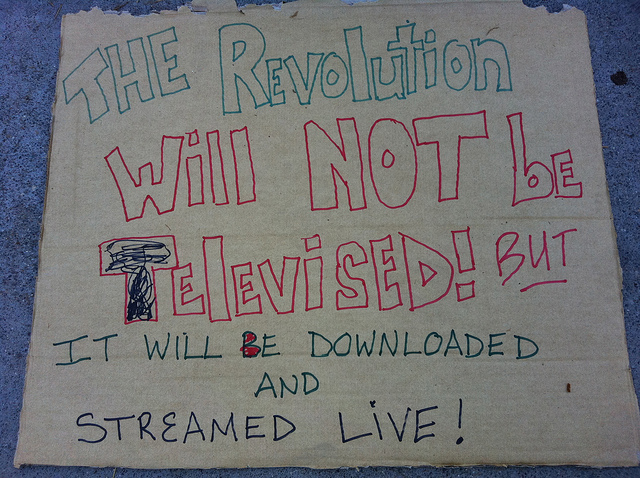
When the participatory web was new, activists and researchers alike were excited by the potential of this new medium to connect groups without the need for conventional gatekeepers. Because social media allows anyone to post information that anyone (everyone) else can theoretically access, it changed the broadcast model of communication from a one to many (or point to multi-point) to a many to many (or multi-point to multi-point) system. Initially, this change delivered on its promise, facilitating movements like #occupy, #idlenomore, and #blacklivesmatter. More recently, however, even though social media still connects people and facilitates some political organization, it has also revealed its darker side.
Protest Sign05 by a.mina. Available from Flikr: https://flic.kr/p/audzig
This blog post stems from a podcast that I’m putting together for the Multimedia Local News Conference Publication. This publication is being put together by the Ryerson Journalism Research Centre following a very successful international conference on local news in a digital age, and I presented some research at the conference relating to how local news content shared on Twitter can be measured. I am also happy to serve on the conference and publication organizing committee.
The availability of relevant political information is central to a functioning public sphere. In some larger Canadian communities, such as Toronto, Ottawa or Vancouver, which are media centers for their respective provinces, the availability of locally relevant news that aids citizens in making meaningful voting decisions is not an issue. News in these communities is readily available. However, in other communities, this is simply not the case. local news outlets in smaller communities across Canada and around the world are being closed down, and studies have shown that when a community loses a source of local news, civic engagement declines.



 This blog post stems from a podcast that I’m putting together for the