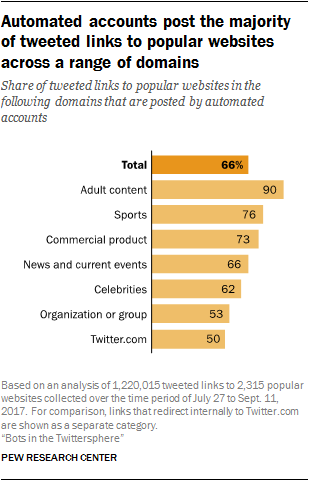
According to a recent report by the Pew Research Center that I, ironically enough learned about because it was shared on Twitter, “an estimated two-thirds of tweeted links to popular websites are posted by automated accounts” also known as bots.
Digital communication and PR professionals recognize a few truisms about online communication:
Strong emotions get shared more often on social media.
People tend to share things they really strongly agree or disagree with.
Google and Facebook tend to tailor or curate your feeds, giving you more of the stuff you already like, because that’s what we tend to view as more relevant.
Messages that are easily digestible and meet criteria 1-3 will be more shareable than ones that are not.
In this information environment then, if you want to get your message out, you try to craft something that arouses a strong emotion and is specifically targeted at the audience you want to reach. If you don’t believe me, then think about how Trump’s campaign so masterfully employed Facebook targeting to reach their key demographics. While many still claim that Russian meddling helped to win the election, in reality it was strong, emotional and tailored content that won the day.
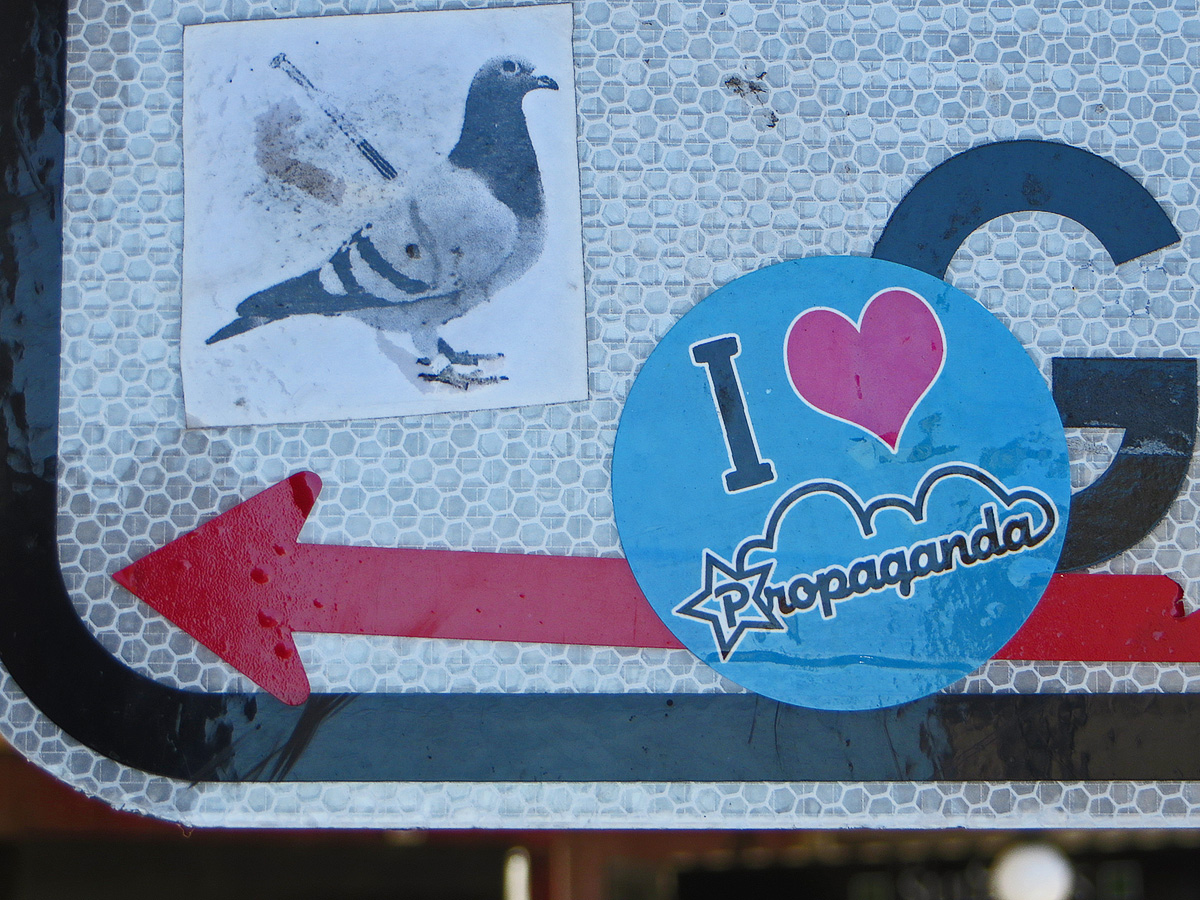
“I Love Propaganda” by Newtown Graffiti CC BY 2.0. Available from Flickr: https://flic.kr/p/irEHoL
This is a repost of a blog post I originally contributed to Medium.com, related to my local news research project from 2015-2017.
“Generic charity” by Sascha Pohflepp is licensed under CC BY 2.0
Local news outlets contribute more to communities than just access to relevant information. Ryerson Professor, Joyce Smith, has published a paper in The Future of Local News: Research and Reflections that shows how embedded local news outlets have traditionally been in the practice of charitable giving in their communities. Her work details a historical connection between local news and charitable giving, and then touches on the ways that new media technologies have influenced, and in some cases disrupted this relationship.
Local news outlets play a role in their communities that digital replacements have yet to replicate… To read more visit Medium.
This post was originally posted to Medium, you can view the original here
One of the key benefits often ascribed to local news is that local news outlets facilitate more hyperlocal reporting. That is to say, the presence of a local news outlet is associated, at least in many people’s minds, with an increased coverage of local stories in a community. But is this correlation true in practice?
This post is cross posted from medium.com. You can access the original here.
A screen capture from Lindgren and Corbett’s (2018) Local News Map. Available at localnews.geolive.ca
This week marks the one year anniversary of our international conference: Is No Local News Bad News: Local Journalism and Its Future which was sponsored by SSHRC and the Ryerson Journalism Research Centre and held at Ryerson University in Toronto, Canada. This groundbreaking conference brought together an interdisciplinary and international group of scholars, journalists and media entrepreneurs to discuss the importance of local news to communities, the current state of local news around the world, the role of technology in local news, and what the future of local news could look like.
We see it all across North America and the UK: small local news outlets are shutting down, or are bought out and amalgamated into much larger regional or national outlets. At first this doesn’t seem to be of much consequence. If local news outlets do not make money, perhaps the laws of the marketplace should dictate their demise. And without them, we can perhaps still share the information that is important to our communities using social media platforms like Facebook, Google and Twitter, right?
“Local Sunday News” by Bernard Goldbach is licensed under CC BY 2.0
Well maybe the local news situation is actually more complex than we might first think. Maybe there is some information that simply isn’t provided when local news outlets shut down. And maybe social media isn’t picking the slack in all cases, but rather exacerbating the problem. Well I, in partnership with a team of ace researchers from the Ryerson Journalism Research Centre wanted to find out the answers to these questions, so last year, we invited academics around the world to participate in a conference on the subject of local news and it’s future. Then we took the best submitted papers from that conference, along with some student journalism on the subject of Canadian local news, and we put together an interactive online publication: The Future of Local News: Research and Reflections.
I learned it on Instagram today: The Chive has officially left Facebook.
Ok, well they haven’t fully left. But they will no longer be posting their articles, videos and other content directly to their Facebook page. Instead, they will be sharing links only in Facebook, and the links will take people back to their webpage. The way God Herself intended.
Considered by James Carey to be the first medium of electronic communication, the telegraph was a revolutionary development, since it was the first communication medium to separate time and space for the purposes of communication. Before the invention of the telegraph, message speed was bound to how fast a messenger could travel: by foot, horse, or railroad. After the invention of the telegraph, messages could travel faster than a messenger ever could. This development thus had ripple effects on markets, democratic participation and community.
Telegraph by SparkFun Electronics. Available on Flickr: https://flic.kr/p/fCs2oC (CC by 2.0)
Today, The Verge published an article stating that Twitter has drawn a small line in the sand with respect to the tweeting habits of the 45 president of the United States. Adi Robertson reports that Twitter has suggested that while it is important not to censor or remove important public figures like the president from the platform, it will draw the line at “tweets that reveal a private address or phone number”. Of course, not all people agree with this stand. For example, Sam Harris clearly stated in a recent podcast that he thinks Trump should be banned from Twitter, since the damage he can do via a Tweet is just so great. Twitter’s response though, is one worth considering. When is it appropriate to silence a public figure on a platform like Twitter? And when is it actually in the public interest to support a person’s right to make even crazy or patently false claims on the site?
A tweet made by Donald Trump: Picture from “Mother Jones” http://www.motherjones.com/kevin-drum/2017/02/donald-trump-edits-tweet/