Goliath vs. Goliath: Or Why the Net Neutrality Debate is Complicated

You may have noticed that net neutrality was in the news quite a bit this week after US FCC Chairman Ajit Pai tried to slip a release into the pre-long weekend news burial ground stating that he plans to roll back any legislation related to Net Neutrality. In response to this, Netflix released a statement that it opposes any attempts to roll back net neutrality rules. Back in July, when the idea of gutting net neutrality law was first floated under the Trump administration, all of the major platform players such as Google, Facebook, Twitter and Amazon, spoke out against these proposed regulations. But a Google search that I conducted this morning shows news in which Twitter, Pinterest, AirBnB and of course the aforementioned Netflix make statements opposing the new legislation while Facebook and Google are conspicuously absent.

Continue reading “Goliath vs. Goliath: Or Why the Net Neutrality Debate is Complicated”

Goliath vs. Goliath: Or Why the Net Neutrality Debate is Complicated

Twitter politics, polarization and a lack of trust in media: The case of #cdnmedia

One of the hallmarks of the last year of US politics has been a steady stream of messages from the president about “fake news” or the “lying media”. Arguably, this has been a mainstay of Trump’s political strategy since he announced his run for the presidency, and it remains a tactic that he employs, and his followers seem to take at face value. So it’s not surprising to learn that in the US, trust in traditional media is at an all time low. In fact, recent research from the American Press Institute and Associated Press shows that 41% of Americans report having hardly any confidence in the traditional press.

Hashtag symbols painted on concrete
Hashtag by Susanne Nilsson. Available from Flickr: https://flic.kr/p/VeKQb7

What was surprising for me though, as a Canadian researcher, was learning that this is more than just an American issue. In Canada, Statistics Canada reports that only 40% of Canadians report feeling confidence in the national media. With so much information available from so many different sources, it seems as though we just don’t know who or what we should trust anymore. This is true in 2017 and, unfortunately, my research also shows evidence of this trend as early as our Federal election in 2015. We collected thousands of tweets in the month leading up to the 2015 federal election, and we analyzed a sample of them using corpus analysis software along with human content analysis.

Continue reading “Twitter politics, polarization and a lack of trust in media: The case of #cdnmedia”

Twitter politics, polarization and a lack of trust in media: The case of #cdnmedia

Why Does Fake News Spread on Social Media? Because Of Our Caveman Brains

In a world of 24/7 cable news, round the clock Amazon Deliveries, and infinite social media notifications, it’s been difficult to not notice how the ways we interact with each other and information is changing each passing day. Chief among these changes of course is the problem of fake news (#fakenews, I guess) or the spread of misinformation in an online environment. Some people blame Facebook and Twitter, who are currently in the news for the role their platforms played in Russian trolling of the 2016 US election. Their involvement notwithstanding, it seems to me that though the platforms had a role to play in the spread of fake news, it was more a passive role in which they took advantage of human frailty, rather than an active one in which their algorithms spread fake news because it’s more exciting content or something. Allow me to explain.

Continue reading “Why Does Fake News Spread on Social Media? Because Of Our Caveman Brains”

Why Does Fake News Spread on Social Media? Because Of Our Caveman Brains

Why I Don’t Use Facebook: Part 2

This is a follow up to my first post, which details why I think you can be an effective social media advisor, even if you are not personally on Facebook yourself. In this post, I’m going to briefly discuss some of the larger political and economic reasons why I do not engage on Facebook, and why I’m thinking about withdrawing my participation from social media completely, on a personal level that is.

A video camera pointed at a Facebook logo with barbed wire in the background
Facebook Video by Esther Vargas. Retrieved from Flickr: https://flic.kr/p/dC3AV4

Ahhhhh Facebook! The ubiquitous social network that allows us to freely cyber stalk each other, and live our FOMO best lives in the public eye! A platform that allows us to specify our likes and dislikes, to be collected for all to see! An online bazaar where marketers take all the information we have freely given and use it to sell us more stuff! Facebook how did we ever live without you?

Continue reading “Why I Don’t Use Facebook: Part 2”

Why I Don’t Use Facebook: Part 2

Tribes

Quick, what do Donald Trump, Crossfit, and FanExpo have in common?

A man lifting a very heavy barbell loaded with weight
345, Grinnin’ by Travis Isaacs, available from Flikr:https://flic.kr/p/batZUR

No, it’s not a rugged devotion to protein, cool outfits, weird hair or comic book villains – although any of these would have been a good guess.

Actually, it’s that all of these have benefited, in a digital age, from the rise of tribes.

Continue reading “Tribes”

Tribes

Yellow is the New Black

I’ve been thinking a great deal lately about social media as a source of news, and how we are currently experiencing parallels with yellow journalism. I think that if we can identify similarities with our current media environment, and the rise and management of yellow journalism during the Hearst/yellow journalismPulitzer years, we may be in a better position to brainstorm meaningful solutions to the fake news challenges that we are seeing today. And there are indeed many parallels to be drawn, so I’ll begin with a few important ones, as I see them:

Continue reading “Yellow is the New Black”

Yellow is the New Black

Twitter as a News Source and Consequences for Civic Engagement

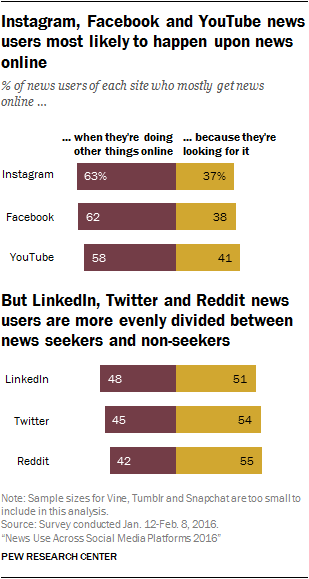
News Seekers from PEW http://assets.pewresearch.org/wp-content/uploads/sites/13/2016/05/PJ_2016.05.26_social-media-and-news_0-05.pngThis blog post stems from a podcast that I’m putting together for the Multimedia Local News Conference Publication. This publication is being put together by the Ryerson Journalism Research Centre following a very successful international conference on local news in a digital age, and I presented some research at the conference relating to how local news content shared on Twitter can be measured. I am also happy to serve on the conference and publication organizing committee.

The availability of relevant political information is central to a functioning public sphere. In some larger Canadian communities, such as Toronto, Ottawa or Vancouver, which are media centers for their respective provinces, the availability of locally relevant news that aids citizens in making meaningful voting decisions is not an issue. News in these communities is readily available. However, in other communities, this is simply not the case. local news outlets in smaller communities across Canada and around the world are being closed down, and studies have shown that when a community loses a source of local news, civic engagement declines.

Continue reading “Twitter as a News Source and Consequences for Civic Engagement”

Twitter as a News Source and Consequences for Civic Engagement