Tiny Ecology Part 3
This weeks reflection focuses on how disability affects people in the greater Victoria area, where I reside with my family. I’d like to focus, specifically, on physical disabilities and the inaccessibility of my own sit spot.
Living on Vancouver Island is magical and unique in so many ways. There is unparalleled access to natural beauty with trails to hike, waves to surf, and mountains to ski. However, what’s important to note is that not everyone has access to the same places and activities that I do. Those with certain disabilities can’t just go on a run like I do most lunch breaks. This is a freedom and luxury in my life that I often take for granted.
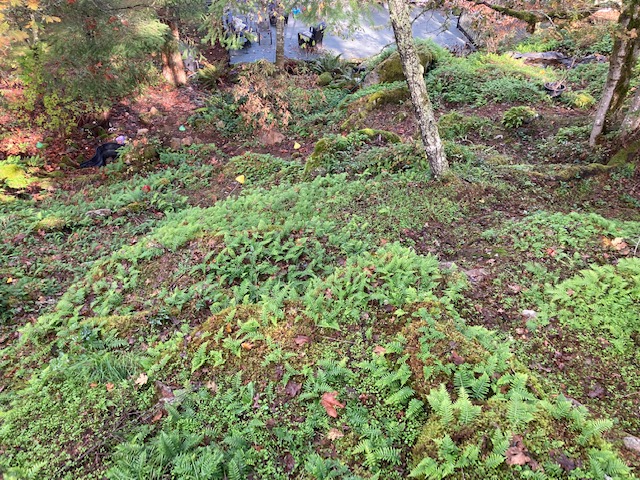
As I was at my sit spot today, I looked down at the small walking path that I built in my backyard last summer. It’s a path that weaves through rocks, trees, and roots. It is steep and, for many, would be quite dangerous. The first time I took my parents up it I was terrified watching them navigate terrain they infrequently engage with in their day to day lives. After some thought and reflection, I realized just how inaccessible my own sit spot is. It is not a place that many people could access and, especially, people with physical disabilities.
For a moment, this concept made me feel guilty. I recall putting ample thought into where I wanted my sit spot to be. When I came up with the particular location, it was partly because of how rugged and wild it was. I wanted to pick a place where I felt most immersed in the natural environment that surrounded me. I didn’t once think about who would be able to access it and who wouldn’t be able to.

It is important to understand that those with disabilities are much more vulnerable to the effects of climate change. Natural disasters expose the inequities that those with disabilities face. Jampel (2018) notes that “disability status can lead to differential vulnerability and to differential exposure, as illustrated in the example of Hurricane Katrina” (p. 131). I remember in 2005, when Hurricane Katrina hit, reading about emergency evacuations that were in place to rescue those with disabilities in the Lower 9th Ward of New Orleans. There were videos of people in wheel chairs on the roof tops of their homes. It was a staggering sight that has stuck with me to this day. In his post for the UX Collective, Wright (2020) adds that “approximately 155,000 disabled and elderly were affected by Hurricane Katrina…[and] half the deaths…were people…[with] disabilities and health conditions that increased their vulnerability” (para. 14).
I am not impacted in my daily life by a disability, and therefore, have not actively and adequately thought about how to make my vision of the climate action movement more accessible to the disabled population. I know now that inclusivity is one of the most pivotal and important themes when communicating climate action and that it must always be brought to the forefront. Dines (2019) adds that “it is everyone’s future, and that needs to be represented in both climate [action] and climate policy” (para. 1).
Learning more about how disability relates to climate change would enhance my capacity to communicate to a wider audience. Notably, it would allow me to broaden my knowledge base on the social justice piece of climate action, one that I am passionate about and believe is necessary for the movements success in the long term. Rallo et al.(2019) emphasize that “accessibility should not be considered add-on or feature [and that] it works best and is the most…effective when it is a core consideration from the beginning” (p. 6). Climate action requires inclusivity, engagement, agency, and story from all walks of life. People with disabilities offer perspectives that are valuable and issues associated with climate change need to be communicated so that information is accessible to everyone that is impacted.
How can we make the climate action movement more accessible to everyone? What steps must be taken to ensure that everyone’s voices are heard?
References
Dines, H. (2019). The climate revolution must be accessible – this fight belongs to disabled people too. The Guardian. https://www.theguardian.com/commentisfree/2019/oct/15/climate-revolution-disabled-people-activism
Jampel, C. (2018). Intersections of disability justice, racial justice and environmental justice. Environmental Sociology, 4(1), 122–135. https://doi.org/10.1080/23251042.2018.1424497
Rallo, A., Forest, E., Kuo, J., Boutilier, R., and Li, E. (2019). Access Ability 2: A practical handbook on accessible graphic design. Revised + Supersized Second Edition. The Association of Registered Graphic Designers. https://www.rgd.ca/database/files/library/RGD_AccessAbility2_Handbook_2019_06_01(1).pdf
Wright, E. (2020). Climate Change, Disability, and Eco-Ableism: Why we need to be inclusive to save the planet. UX Collective. https://uxdesign.cc/climate-change-disability-and-eco-ableism-why-we-need-to-be-inclusive-when-trying-to-save-the-88bb61e82e4e
Thanks for your reflection Tony. It can be a bit overwhelming when we think about all the ways justice needs to be manifested in a deeply unjust culture, and it’s good to see you thinking about this in a practical day to day way, such as through access to the natural world around us, but also in terms of the broader climate justice movement. It’s a good question about how we can make sure voices are heard. When working with smaller to medium-sized groups this can be facilitated by things like community agreements, where everyone agrees to step in and step back as they need to, and everyone works with a goal of repair when harm is caused. We are all going to make mistakes and overlook things, but what we do when those things are brought before us can change everything.