Building a Resilient Future

trees, explosion, forest-4313701.jpg

A changing climate and world calls for rapid action across sectors in order to build a resilient future for the generations to come. We are increasingly in a state of panic as climatic hazards continue to intensify and displacement and climate refugees have become the new norm. As noted by Elmqvist et al. (2019) “A large proportion of the urban and therefore global human population are located in low-lying coastal zones and are at risk from urban development intensification exposing people and social, ecological, and technological assets to coastal storms and the effects of sea level rise” (p. 1). So much of the world population is situated in coastal zones and often don’t have the means to adequately prepare for future climate impacts. The Expert Panel on Disaster Resilience in a Changing Climate adds “communities and individuals often lack the necessary resources to pursue resilient strategies, and often the most vulnerable populations are least able to choose resilience owing to a wide range of constraints” (p. 125). How do we adapt with sufficient action to temper the inevitable impacts of climate change? Where do we begin? With such a reality comes a burden and an opportunity. The field of resilience offers an optimistic lens into, what otherwise, is a daunting and depressing reality that we face. Throughout the readings I couldn’t help but be brought back to the idea of adaptive capacity. Described as the “the ability of a system to adjust to climate change (including climate variability and extremes), to moderate potential damages, to take advantage of opportunities, or to cope with the consequences” (Wall & Marzall, 2006, p. 377). Being resilient and simultaneously adaptive is a strong combination when facing the difficult task of climate action within a rapidly changing climate. 

I am drawn to the intersection of resilience as it relates to First Nations communities and forest management. I recently finished a road trip with my family down to California where I was raised. While visiting we drove up to Lake Tahoe where my folks own a little A frame cabin in the backcountry. On our drive up my breath was taken away by the changes to the scenery I knew so well. For miles and miles blackened trees hugged the highway burned by the recent wildfires. As we continued driving, we began to pass areas of forest not yet burned where the practice of selective harvesting was utilized as a fire prevention tactic. Controlled burns were orchestrated in spaces with excess debris. For thousands of years Indigenous peoples have managed land with care and precision, however, “in Canada, the last two centuries have seen Aboriginal people largely excluded from forest management activities” (McGregor, 2002, p. 833). It’s time Indigenous ways of knowing be reintegrated into forest management practice to mitigate the impacts of wildfire up and down the coast. As highlighted by O’Flaherty et al. (2008), “bringing together Indigenous and science-based knowledge systems in a unified forest management planning effort [is essential]” in reestablishing sustainable forest systems, ecological health, and relationship building (p. 1). 

Resilience is achieved through collaboration, transdisciplinarity, western science, and traditional ecological knowledge. It is an all encompassing approach that I believe increases the overall adaptive capacity of a community. As noted by Moser et al. (2019) “resilience is increasingly presented as an organizing concept and strategy for handling complexity and uncertainty within and between dynamic systems” (p. 28). Not only should resilience be a focal point in the climate action space but it should also coincide with reconciliatory efforts. Building a resilient community encompasses a social justice component, one that should prioritize the needs of Indigenous communities and raise Indigenous voices. In addition, “a cross cultural approach to engaging…Indigenous peoples in…forest management will require addressing not only the role of Indigenous knowledge in decision making, but also the role of Indigenous people” (O’Flaherty et al., 2008, p. 1). It is, by its very nature, reconciliation in action. 

Indigenous communities are incredibly resilient and adaptive due to historical abuses, systematic oppression, and colonial imposition. It is the voice of lived experience, observation, and relationship to the land that can aid in the efforts to create a more resilient future and Indigenous voices bring just that to the table.  

References 

Elmqvist, T., Andersson, E., Frantzeskaki, N., McPhearson, T., Olsson, P., Gaffney, O., Takeuchi, K., & Folke, C. (2019). Sustainability and resilience for transformation in the urban century. Nature Sustainability, 2(4), 267–273. https://doi.org/10.1038/s41893-019-0250-1

McGregor, D. (2002). Indigenous knowledge in sustainable forest management: Community-based approaches achieve greater success. The Forestry Chronicle, 78(6), 833–836.https://doi.org/10.5558/tfc78833-6

O’Flaherty, R. M., Davidson-Hunt, I. J., & Manseau, M. (2008). Indigenous Knowledge and Values in Planning for Sustainable Forestry: Pikangikum First Nation and the Whitefeather Forest Initiative. Ecology and Society, 13(1). https://doi.org/10.5751/es-02284-130106

Wall, E., & Marzall, K. (2006). Adaptive capacity for climate change in Canadian rural communities. Local Environment, 11(4), 373–397. https://doi.org/10.1080/13549830600785506

The Expert Panel on Disaster Resilience in a Changing Climate. (2022). Building a resilient Canada.

Navigating Complex Situations

change, wall, painter-2850274.jpg

CALS505

As I continue to reflect on my leadership style and goals throughout this course, I am reminded of potential areas of growth. What I have always valued about the idea of leadership is that it grows as we do. Our experiences influence our actions and decisions and the more we live the more we learn to navigate certain things. As Bolman and Deal (2017) note, “a messy, turbulent world rarely presents bounded, well defined problems, and decoding complex situations is not a single frame activity” (p. 295). My reflection as of late has been concentrated around how I navigate conflict and adversity as a leader. What is my role in diffusing complex situation? How can I navigate adversity more efficiently and effectively?

I think that the ability to navigate a complex situation speaks to the true strengths of a leader. The very nature of leadership requires maneuvering through the mucky waters that come with being in a position of authority. That position is not always easy to navigate. Personally, I struggle with conflict. I shy away, at times, from intervening in professional disputes or heated debates. Even if I strongly believe in something it can be hard for me to speak up.

This past year I was a counsellor for School District 61 in Victoria, BC. I represented the Indigenous students at a large local high school and was contracted (by the Victoria Native Friendship Centre) as an effort towards reconciliation within the school district. I was one of two new positions created as a member of the Indigenous Education Department. When I began at the high school I was stationed out of I quickly realized why I was there. The administration was a clear representation of racist behaviour without even knowing. There was no safe space for Indigenous students to congregate, no existing programs or supports in place, and no effort to be a visible ally to Indigenous students or actively engage in decolonizing practices. My role there quickly became both counsellor and advocate for the Indigenous students. I was a one person team and had many uncomfortable conversations where it became my responsibility to call out the inaction of the principal and rest of the administration. Initially, I was exceptionally uncomfortable doing this. I took part in countless meetings where it was my role to hold people accountable for actively disengaging in reconciliatory practices. It was complex and messy, political and cultural, difficult and nerve racking all at the same time.

At the end of the school year we made some serious progress. We were granted a much larger space where a friend and muralist installed a beautiful mural representing Indigenous story and culture through imagery. The administration began to prioritize the needs of Indigenous students and the importance to adhering to local protocol. They turned their focus towards anti racist policies within the school and district. Some positive steps were made even if they were baby steps. 

My role within the school district was my first experience, professionally, where I felt, as a leader, that I needed to tread lightly. I had to cautiously navigate historical racism and colonial education while simultaneously holding an institution accountable for their inaction towards a more just academic environment for the Indigenous population. It was daunting but made me feel that I could lead within conflict. That said, I want to improve my leadership skills within the area of conflict resolution, advocacy, and decolonizing practices. Kerber and Buono add that, “ a combination of…approaches creates a dynamic rhythm of change leadership, especially in complex and uncertain change situations” (p. 55). It can be difficult to work in a space that is not welcoming to all but it also is an opportunity to uncover our own strengths and be a part of positive and influential change. 

References 

Bolman, L., & Deal, T. (2017). Reframing organizations: Artistry, choice and leadership (6th ed.). San Francisco, CA: John Wiley & Sons. 

Kerber, K., & Buono, A. (2018). The rhythm of change leadership. Organization Development Journal, 36(3), 55-72.

Building Bridges Through Reconciliation

wooden footbridge, footbridge, wooden bridge-2114668.jpg

CALS505

Where do I stand, as a non-Indigenous man, in the movement towards reconciliation? The more I reflect on what being a leader in the climate action space means the more I am brought to the idea that I must also be conscious and engage in reconciliatory actions. I must understand and acknowledge the deep history of colonial oppression that the Indigenous peoples of this continent have endured. Climate action is so directly linked to Indigenous knowledge that leading in one space requires being an ally and advocate in the other. I feel this strongly in my work. I advocate for Indigenous youth as a non-Indigenous person and take much pride in that. I am a firm believer that any movement requires cohesion and unity from multiple walks of life. From multiple backgrounds, cultures, and traditions. 

Climate action requires strong leadership yet so does reconciliation. Can one lead within the realm of reconciliation without being Indigenous? I think so. Leadership is not easy. It is not meant to be. It is complex in its nature and ever evolving. It requires taking chances and it requires making space for change to happen. The true leaders facilitate space for those around them to feel safe. When I think about the climate action program I am starting this is exactly what I hope to do. The program will lean heavily towards Indigenous practices and cultural knowledge sharing. If I can help create a comfortable space for an elder to come in and share his or her story then I feel I am leading in a good way. If I can help reconnect one young student to culture by way of land based programming then I am becoming the climate action leader that I hope to be. 

As a personal goal, I would like to continue to learn how to simultaneously be a leader and an ally when engaging in both climate action and reconciliation. How can I maintain cultural sensitivity in my work? At times, I am self conscious about pioneering a climate action department at an Indigenous organization. I don’t want that to be perceived in the wrong way. I want the program to be a bridge towards growth and transformation. A community where folks can reclaim what was stripped from them and become the next generation of climate action leaders. I believe that Indigenous voices are pivotal in the effort to combat climate change. A climate action department at an Indigenous organization seems like a perfect fit.

When I think of leadership I am reminded that overcoming adversity and criticism comes with the territory. There is never one singular right answer. Good leadership calls upon understanding the diversity of culture, perspective, and lived experience. It calls on us to be humble, sensitive, researched, and honest. And lastly, it is the leader who holds up those marginalized, persecuted, and oppressed and allows for identity to be reclaimed with honor and purpose that I wish to be. This is what I hope to do. This is how I hope to lead. 

Collective Leadership

eagle, fly, bird-864725.jpg

After reading the Spiller et al. (2020) article, Paradigm warriors: Advancing a radical ecosystems view of collective leadership from an Indigenous Māori perspective, I was struck with the powerful and profound notion of collective leadership. This idea, belief, and philosophy is one I have yet to explore. However, it embodies how leadership truly should be. 

I was raised in a western worldview where “leadership referred to the capacity of an individual to convince others to accept/follow his decisions and/or the associated underlying paradigm” (Vignola et al., 2017, p. 85). Leaders were determined by their strength, charisma, and ability to captivate, sway, and, in many ways, to this day still are. The Maori worldview brings forth the idea of collective leadership as a “new and emerging paradigm” (Spiller et al., 2020, p. 516). It is so vastly different than the western views of leadership that they are nearly incomparable. 

Collective leadership stems from an ecosystems view where relationships “across generations and across living and non-living entities” are valued with high regard (Spiller et al., 2020, p. 517). It is a paradigm that diverts from the “hierarchical, vertical, and individualized leadership styles to collective, horizontal forms” (Spiller et al., 2020, p. 517). I am deeply inspired by this paradigm, as it gives way to welcoming Indigenous knowledge into the present and future of climate action leadership. Leadership is not linear. It is fluid and circular. Leading through story, relationship, and vision is such a profound way to lead.

Collective leadership is rooted in Indigenous ecological knowledge, social ecological systems, and a Maori worldview. Three pillars that can educate and inform of the inevitable impacts of climate change. It is also rooted in wisdom passed on through proverbs, stories, parables, song, dance, and carvings (Spiller et al., 2020, p. 518). Collective leadership, therefore, becomes a part of culture, spirituality, and history. Past becomes a blueprint for present and future. It makes so much sense to me. I deeply believe that no one person can undue what has been done to our land and waters. We are to blame for those actions and wrongdoings. However, ‘collectively’ is the way forward. Spiller et al. (2020) add, “it is through the collective will of others that leaders earn respect, not through self proclamation and self assertion” (p. 518). The greatest leaders lead knowing that they are on this earth for a fraction of time and that their actions are meant to carve a way forward for generations to come. To me, that is climate action leadership at its core; a willingness to dedicate one’s life and professional pursuits to an unknown future. 

When I think of leadership what comes to mind is engaging community. How do we effectively join hands to create lasting, positive, and impactful change? How do leaders uplift more leaders in the climate action space? I had never heard of collective leadership before but it feels that it has been there inside of me all along. Knowing that the most powerful change comes from common ground and seeing eye to eye with our peers. Understanding that in order to lead in a good way comes with it a responsibility to represent those that speak but also those that do not. As climate action leaders, we are representing the land we walk and the air that we breath. We are representing all of our ancestors, all of our journeys, and all of our histories. 

References

Spiller, C., Maunganui Wolfgramm, R., Henry, E., & Pouwhare, R. (2019). Paradigm warriors: Advancing a radical ecosystems view of collective leadership from an Indigenous Māori perspective. Human Relations, 73(4), 516–543. https://doi.org/ 10.1177/0018726719893753

Vignola, R., Leclerc, G., Morales, M., & Gonzalez, J. (2017). Leadership for moving the climate change adaptation agenda from planning to action. Current Opinion in Environmental Sustainability, 26-27, 84–89. https://doi.org/10.1016/j.cosust.2017.03.005

Onwards Towards a Brighter Future: A CALS501 Final Reflection

meadow, field, sunset-2667461.jpg

As we come to the end of our CALS501 design challenge, I reflect on the growth, transformation, and learnings that have come along the way. Each course has challenged me immensely, all with the clear objective of harnessing the necessary skills to become a climate action leader in today’s world.

Our team’s prototype shifted quite dramatically since the beginning of this design challenge. Initially, we wanted to create change so vast that we could touch every corner of the world inspiring youth to engage in climate action. Throughout the past year, our scope narrowed and our focus honed in on how to effectively bring about change locally. The course work, interview phase, and testing phase helped shape what is now a practical prototype ready to impact, educate, and inspire. 

CALS502 inspired communication. How do we effectively communicate climate action? Throughout the design challenge, it became more and more apparent to me that listening and engaging various expertise, cultural backgrounds, and ways of knowing is the way forward. A transdisciplinary approach is what is needed to bring climate action to the forefront. McGregor (2014) defines transdisciplinarity as “going beyond disciplines to engage civil society” (p. 201). We need to be creative in how we communicate the need for climate action. 

CALS503 centered around climate risk management. I learned how to assess risk and present findings and strategies to mitigate the impacts of climatic hazards. My thinking during this course shifted towards what risks were associated with our prototype? Who would benefit from it and who wouldn’t? The theme of accessibility came up time and time again. Open educational resources are powerful. They have incredible potential but they also lack in certain areas. A large aspect of the vision of our prototype centers around Indigenous ways of knowing and traditional ecological knowledge. That said, for remote communities in Canada, most of which are Indigenous, how is a prototype that requires cellular data and wifi accessed? We decided to create a downloadable version of our prototype, specifically, for those remote communities. However, even a downloadable version requires use of a technological device. Access is a clear limitation to our prototype design. 

CALS504, our current course, focuses on building a business case and crafting adaptation strategies to encourage climate action across sectors. How do we pitch climate action projects so that we can encourage organizations to act? Our prototype aims to be attractive, functional, and inspiring. We understand we are selling an idea and that, unfortunately, financial incentive goes hand in hand with climate action. From a business standpoint, can both profit and social good be simultaneously prioritized? We aimed to tackle these profound questions. 

What next? The prototype design challenge produced a mere hypothetical idea. It represents an accumulation of the wealth of knowledge that this program has graced us with. It is now our obligation and responsibility to take the lessons learned throughout this past year and apply them in our professional lives. It is up to us to bring forth change in our communities. Climate action leaders are needed and it is an honor to take on that responsibility. Lonsdale et al. (2015) add that “effective leadership is needed for transformational change” in the climate action space (p. 7). This design thinking challenge taught me that climate action leadership centers around building a network of diverse thinkers with a common goal: to ensure the well being of our planet for generations to come. 

References 

Lonsdale, K., Pringle, P. & Turner, B. 2015. Transformational adaptation: what it is, why it matters & what is needed. UK Climate Impacts Programme. 

McGregor, S. L. T. (2014). Transdisciplinarity and Conceptual Change. World Futures, 70(3-4), 200–232. https://doi.org/10.1080/02604027.2014.934635

It’s Worth the Risk: Transformational Adaptation

digitization, transformation, woman-5194816.jpg

In order to create systematic change in the climate action space transformational adaptation must occur. We have found ourselves at a point in history where we have lost the luxury of time. In only a short period of human history, we have dismantled the cohesive fabric linking ourselves to the very nature that surrounds us. We have exploited natural resources and pillaged landscapes as far as the eye can see. We have deforested and overfished our oceans. We no longer have the time to fret and consider our options. Incremental change is not an option, unless we care to watch our planet, as we know it, continue to plummet into uninhabitable spaces. 

Climate change is happening in real time. If climate action were at the forefront fifty years ago, incremental adaptation could very well of been a feasible option. However, it was not. Fedele et al. (2019) add that “conventional coping strategies and incremental adaptation to climate change may not always be effective at helping people or ecosystems to reduce their vulnerabilities to severe climatic changes” (p. 116). Take the province of British Columbia as an example. In the fall and winter we now have extreme riverine flooding washing away roads and interior towns. In the summer months we have extreme heat events where temperatures have exceeded 40 degrees celsius. In addition, we have wildfires and urban interface fires that ravage our forests and jeopardize our cities. Climate change and its impacts and hazards are year round reoccurring events. How does incremental adaptation help to sustain, preserve, and protect our social-ecological systems?

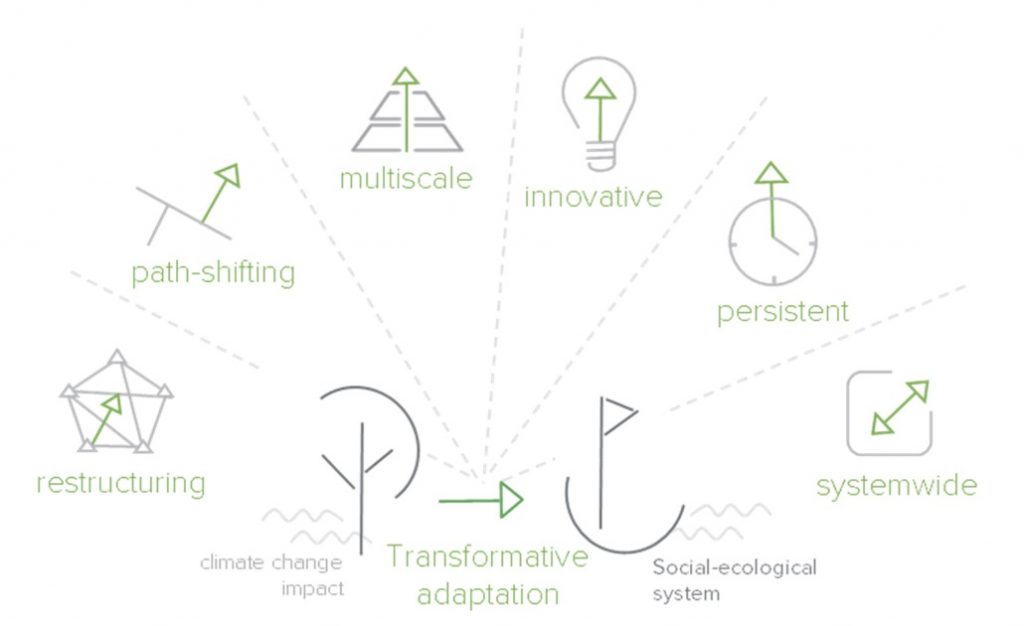
Transformative adaptation presents us with an opportunity. However, within transformation is embedded and inherent risk. Risk that is necessary to take. For transformational adaptation to work, transdisciplinary expertise and cross sector unity must be established from business to educational institution to non-profit. Lonsdale et al. (2015) note that “transformation may occur at different levels and dimensions, mediated by power relations, but usually implies a systemic or paradigm shift” (p. 7). A shift in thinking is integral to transformational adaptation, as there needs to be persuasion and belief that ones actions can hold profound weight resulting in significant outcomes. The climate action space is transformative and calls for thinkers and doers that see outside of the box. It calls for those that are removed from the traditional norms of society that have hindered movement and growth and inspire change towards climate action.


Figure 3: Characteristics of transformational adaptation (Fedele et al., 2019, p. 120)

How can we dive head first into transformational adaptation? At the forefront is leadership, as “effective leadership is needed for transformational change” (Lonsdale et al., 2015, p. 7). Voices for change in the climate action space are needed now more than ever. Those of us in the MACAL program represent that, however, we are the first cohort in the country. 

Law makers and politicians have the ability to push the transformational adaptation platform. Pelling et al. (2015) add that “transformation as an adaptive response to climate change opens a range of…policy options” (p. 113). Although my skepticism of the willingness of policy makers to take a chance are high, they are still in the drivers seat to enact policies that must be adhered to across the country. Policies that can shape the future of our planet.

Systematic change calls for risk. It calls for stepping outside of one’s comfort zone and detaching from self interest. The only way forward is to be transformative in our adaptation strategies. If we don’t act, and don’t do so now, the climate will continue to change at an increasingly rapid rate and we will find ourselves questioning our inability to be forward and progressive thinkers. 

References

Fedele, G., Donatti, C. I., Harvey, C. A., Hannah, L., & Hole, D. G. (2019). Transformative adaptation to climate change for sustainable social-ecological systems. Environmental Science & Policy, 101, 116–125. https://doi.org/10.1016/j.envsci.2019.07.001

Lonsdale, K., Pringle, P. & Turner, B. 2015. Transformational adaptation: what it is, why itmatters & what is needed. UK Climate Impacts Programme. 

Pelling, M., O’Brien, K., & Matyas, D.  (2015). Adaptation and transformation. Climatic Change, 133.  113- 127. https://doi.org/10.1007/s10584-014-1303-0

Self Interest as a Motive for Climate Action

earth, globe, water-216834.jpg

Our economy is driven by self interest. Companies and organizations across sectors act, and often do so in calculated measures, to fulfill an objective unique to a specific interest. Motive often initiates action and such action rarely defends and prioritizes the needs of our environment. How do we incentivize climate action? In order to lure in climate allies across sectors it is imperative that along with the buzz word of ‘climate action’ comes a reason to act more than just public approval from select constituents, clients, or consumers. Climate action needs to be marketable, attractive, and hold economic and financial appeal. It needs to hit at the heart of organizational pursuits. 

I’ve spent much of this week thinking about self interest and how it relates to undertaking climate action. I’ve come to the conclusion that tapping into an organizations self interest is the only way to broaden the climate action agenda. In our Climate Communications course (CALS502) we analyzed the importance of words and the immense meaning words can have in relation to driving and encouraging climate action. Words are what we all relate to. Language shapes our societies and how they operate. However, on a professional level, I can communicate much more proficiently with a climate scientist, activist, or leader than I can with those operating in the business sector or running large corporations, where I find emotion and passion for planetary welfare to be severely lacking. Financial motive, project output, outcome, and benefit are the objectives where social good or tackling the climate change crisis falls to the backburner. Economic self interest is the driving force behind organizational decision making and engaging in climate action needs to deliver results. We must rebrand climate action from an economic standpoint. That is how we move forward within the climate agenda. 

In addition, an aspect of self interest is driven by persuasion. In order to integrate climate action into an organization’s self interest, the representatives and decision makers of that organization must be persuaded to act for the climate. How can that be done? I am not well versed in the business world but I do know that organizations respond to numbers. The creation of a business case that shows numbers in favour of climate action will encourage more organizations to take that leap into the climate realm. 

shopping, cart, globe-4420906.jpg

In her article, Climate Change and Economic Self Interest, Julie Nelson discusses the idea of national economic self interest and its role in “achieving global sustainability” (Nelson, 2019, p. 114). She adds that, “moving towards cleaner technologies makes a country more competitive in the global economy…while also reducing problems at home such as health damaging levels of pollution”(Nelson, 2019, p. 113). Even at the national level do we see self interest as the dominant factor initiating action. Is saving the planet the reason a country participates in COP21? Not a chance. It’s in the best self interest of each nation to attend if they want to remain tongue in cheek with their competitors. It’s evident that across the board self interest is the motivator to act. Incentivizing climate action through economic means and gains seems to be the most logical path forward. In my heart, I wish we could all agree on the need to save our planet before it’s too late but our economy and world, unfortunately, doesn’t work that way. 

Self interest, outside of western colonial culture, is not as one sided and economically driven. Within Indigenous culture, the notion of self interest entails the well being of many, not a select few. It includes the welfare of people but also the land and the diverse lifeforms that inhabit it. The natural world is engrained in the self interest of the Indigenous world view. At the forefront of self interest is a co-beneficial relationship that exists due to respect and reciprocity. Kuokkanen (2006) adds that, “the understanding of the world which foregrounds human relationship with the natural environment…is manifested by gift[s]…given to the land as a recognition of its abundance” (pp. 255-256). In many ways, it feels unjust to even use the words ‘self interest’ when referring to the Indigenous perspective. It’s more fitting to use the words ‘collective interest’ or ‘communal interest,’ highlighting the core values found within Indigenous philosophy. Now just imagine if the economic self interest of our nations, corporations, and businesses was driven by a mutual desire to care for ‘self’ and the land in which we walk. 

Economic self interest has an immense role in encouraging climate action. We, as climate leaders, must find more innovative and unique ways to incentivize climate action and create business cases that organizations are willing to take on. 

References

Kuokkanen, R.  (2006).  The logic of the gift:  Reclaiming Indigenous peoples’ philosophies.  In Botz-Bornstein, T., & Hengelbrock, J. (Eds.). Re-ethnicizing the minds? Cultural revival in contemporary thought.  Brill Rodopi.  (pp. 251 – 271)

Nelson, J. (2019). Chapter 6: Climate change and economic self-interest. In Kanbur, R., & Shue, H. (Eds.). Climate justice:  Integrating economics and philosophy.  Oxford University Press.  (pp. 113- 122)

Critique of a Hazard, Risk, and Vulnerability Analysis (HRVA)

sea, ferry, mountain-5789797.jpg

CALS503-Climate Risk Management Blog Post

Assignment 2-Part B

A Hazard, Risk, and Vulnerability Analysis (HRVA) was produced for the Regional District of Nanaimo, Town of Qualicum Beach, and City of Parksville on Vancouver Island, British Columbia in September of 2019. For assignment 2-part b, I analyzed and critiqued the methods, approach, results, and knowledge of terms, as well as important omissions from the produced document. The intention of the assessment was to “help [the] community make risk-based choices to address vulnerabilities, mitigate hazards, and prepare for response to, and recovery from, a range of hazard events” (EMBC, 2020, p. 6). As climate change, and environmental hazards and impacts associated with it, continues to increase in magnitude and occurrence, it is imperative that efforts are put in place to prepare for the inevitable realities. This HRVA is a step in the right direction.

The critiqued HRVA was produced based on a qualitative analysis of accumulated non-scientific data using a bottom-up approach by gaining knowledge and insights from “local government…First Nations community representatives, subject matter experts, and other agency stakeholders” (CCEM, 2019. p. v). There were a total of three public engagement sessions held over a nine month period of time. The intended audience of the document were local community members, invested stakeholders, and decision makers within Nanaimo, Qualicum Beach, and Parksville. 

The assessment defined the key terms of hazard, vulnerability, and risk using up to date definitions from various governmental agencies (the UN Office for Disaster Risk Reduction and the Government of British Columbia) and placed such terms in accessible, accurate, and relevant locations throughout the document. 

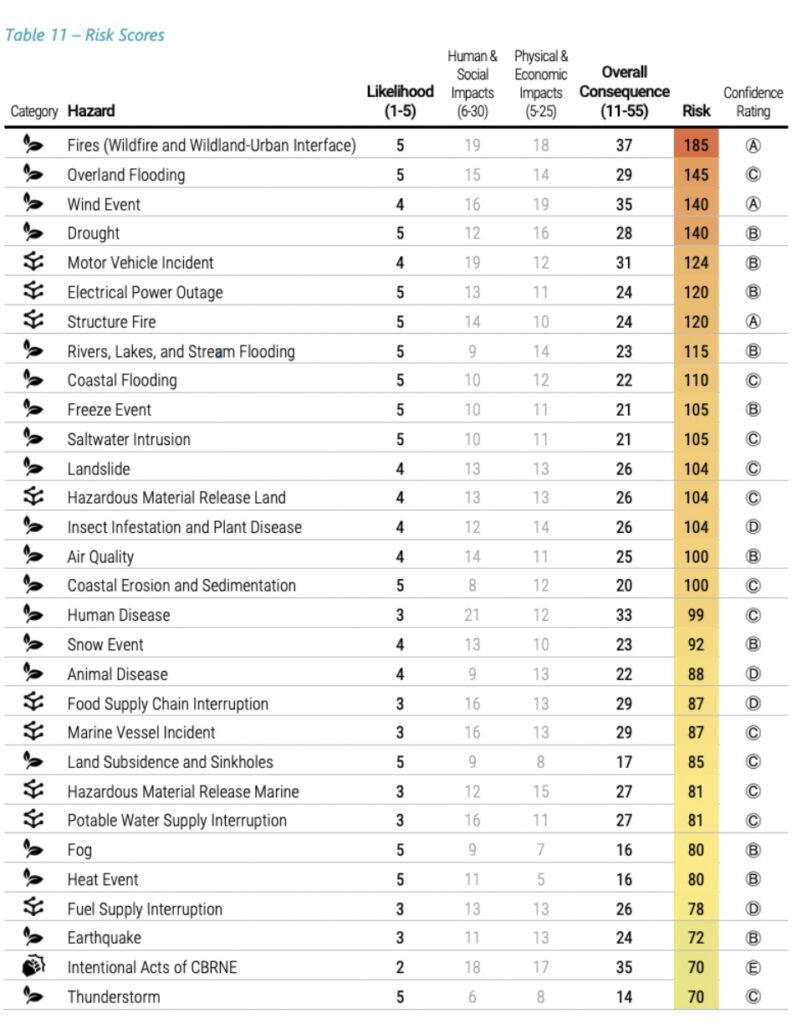
Results were communicated through ‘risk scores’ that were allocated to each natural hazard. Scores were determined by multiplying the likelihood of a hazard occurring by its overall consequence, the higher the number the greater the risk. An example of the how risk scores were demonstrated can be seen below. Natural hazards are represented with the symbol of a leaf under the word ‘Category’.


Table 11- Risk Scores (p. 45)

It was concluded that the Regional District of Nanaimo, Town of Qualicum Beach, and City of Parksville are increasingly susceptible to the impacts of “severe wildfire and [urban interface fire] seasons and seasonal water shortages” as well as overland flooding and wind events (CCEM, 2019, p. 93). 

Although the document was quite informative, organized, and produced utilizing a variety of regional expertise there was need for improvement in multiple areas. The HRVA omitted local Indigenous knowledge from the Qualicum, Snaw-naw-as, and Snuneymuxw First Nations. There was no mention of traditional ecological knowledge as well as little to no Indigenous representation at the three public engagement sessions. Not only does the document inaccurately represent the historical knowledge of the region but it alienates communities with incredible resiliency and adaptive capacity to climate impacts. Indigenous knowledge must be present within future HRVAs and should inform the overall process from start to finish. 

An additional critique lies in the engagement sessions and the limited outreach done in community. Of the three engagement sessions, 70% of the total participants attended at least two sessions (CCEM, 2019, pp. 6-7). This points to limited public representation with few voices guiding the results and findings of the HRVA. Additional engagement sessions are encouraged for a more thorough analysis of the community perspectives of climate hazards, risks, and vulnerabilities.   

Lastly, the HRVA lacked in sufficient recommendations to increase resiliency and better prepare the region for a changing climate and the impacts of future environmental hazards. Subsequent assessments could benefit from having more practical steps for community stokeholders to increase engagement and awareness within the climate action space. 

References

CCEM Strategies Ltd. (2019, September). Hazard, risk, and vulnerability analysis: Regional District of Nanaimo, Town of Qualicum Beach, and City of Parksville. Retrieved from https://www.rdn.bc.ca/sites/default/files/inline-files/2019%20RDN%20HRVA%20Report
%20FINAL.pdf

EMBC. (2020). Hazard, risk, and vulnerability analysis (HRVA) for local authorities and First Nations: Companion guide for the HRVA tool. Retrieved from https://www2.gov.bc.ca/ assets/gov/public-safety-and-emergency-services/emergency-preparedness-response- recovery/local-government/hrva/guides/companion_guide_to_the_hrva.pdf

Transdisciplinarity or Not: A Critique of Research and Academia

water, water drop, ripples-921067.jpg

Unit 3-Blog Post

Designing a prototype within the climate action space that is inclusive, useful, and unique is complex and multi-faceted. It requires utilizing a lens that incorporates a wealth of teachings from various backgrounds, fields of study, and ways of knowing. For the CALS501 design challenge, our group is undergoing the process of integrating Indigenous knowledge, story, and practice into our climate action software model. How can the integration of Indigenous knowledge, from various nations in a given region, be implemented into our prototype in a respectful, non-colonial, and conscientious way? 

The risk of creating a prototype that leans heavily on Indigenous knowledge is that there is an opportunity and space to appropriate and take advantage of the identified culture, language, or knowledge base. This is certainly not the intention, but as Professor Linda Tuhiwai Smith (2012) points out, researchers, by nature, have the role of enabling knowledge extraction, which is rooted in a colonial and racist agenda (p. 93). Research, at its core, is colonial as the “relationship between the researcher and researched can resemble that between the oppressor and the oppressed or the colonizer and the colonized” (Hales, 2006, p. 244). 

I interviewed a friend and colleague of mine recently for the design challenge, whose name I will leave out of this blog. He is a proud Indigenous man from the Tla’amin nation in what is now known as Powell River, BC. When I explained to him the goals and desired outcome of our prototype, he offered some important insights. First, he noted that Indigenous communities may not simply share their story, cultural practices, or traditional ecological knowledge for the sake of a research project driven by a colonial institution. The idea that one cannot go into a community and expect cultural and historical knowledge of a place and people to be handed over without reciprocity. Trust is built over time. What could we, as students and researchers, give in return? Is the creation of a prototype that is meant to educate and inform of local nations, climate related events, and drive youth engagement around climate action enough? Is that reciprocity? My colleague’s insights brought rise to a topic not yet discussed in our group. We have an expectation to fulfill the vision of a prototype but where is the cultural sensitivity and expressed gratitude in the process of obtaining information?

As we spoke more of integrating cultural sensitivity into the research and prototype development stage, my colleague brought up another valuable insight. Having the knowledge of a people and a culture is an immense privilege but how many conversations are needed in order to legitimize story and cultural practice of a nation? Families, within nations, may tell stories a different way and if knowledge is obtained, how is that information fact checked? And who builds the system to validate that knowledge? If that system is developed by the research institution, the knowledge will likely be validated and sorted through a colonial lens. I was once again brought to the conclusion that, yes, integrating, as a core component, Indigenous knowledge into our prototype is essential but more dialogue is needed around creating cultural sensitivity and establishing transdisciplinarity within the research process. 

As identified in both CALS501 and CALS503, the research process is often one-dimensional, lacking Indigenous perspective, and yet that process informs our thinking and, in many ways, the development of our western societal structure and how we are taught to perceive the world. In MACAL, there is such an emphasis on the concept and practice of transdisciplinarity, one that I believe will aid in the climate agenda moving forward, however, how prevalent really is it in the academic context? Given that the transdisciplinary approach seems rooted in the voice of Indigenous knowledge I see little evidence within academia and the traditional research agenda of this practice unfolding and allowing for inclusion of knowledge systems that aren’t backed by peer review.

The CALS501 design challenge has made me reflect on my own role within academia and how I envision transdisciplinarity impacting the climate action space. Nicolescu (2014) adds that the “goal [of transdisciplinarity] is the understanding of the present world, of which one of the imperatives is the unity of knowledge” (p. 187). It’s difficult for me to see past the need for the academic system to be restructured with a change in focus and priority from accolades to inclusion, collective action, or ‘unity,’ as Nicolescu states. We have much work to do and I thank my friend for sharing his input, wisdom, and expanding my intellectual horizon. 

References

Hales, J. (2006). An anti-colonial critique of research methodology (Dissertation). Available from Brill scholarly publishing database.

Nicolescu, B. (2014). Methodology of transdisciplinarity. World Futures, 70(3-4), 186–199. doi.org/10.1080/02604027.2014.934631

Tuhiwai Smith, L. (2012). Decolonizing methodologies: Research and Indigenous Peoples. 2nd Edition. Zed Books. Retrieved from the Ebook Central e-book database 

Land Mind: Discovery Through Nature

hands, earth, next generation-4091879.jpg

Double Content Remix-Assignment 4

Remix Part A

For Assignment 3, I took much more of an academic approach to my final product. I wrote a scholarly article geared towards mental health practitioners that aimed to highlight the correlation between youth mental health, climate change, and the need for increased immersion in the natural world. 

For Part A of my remix, I have decided to take a non academic approach and write a course proposal that is, specifically, for teachers of high school students, faculty who design curriculum at the Secondary level, and those who review potential new courses and proposals within School District 61 in Victoria, BC. The proposal will introduce a credited course with the purpose of encouraging more climate sensitive activity, engagement, and awareness of the natural world for high school students (ages 14-18).

The underlying message remains the same, that mental health is positively impacted by increased immersion in nature, however, in my experience working with youth, messaging must be conveyed so that it is engaging, relevant, and relatable. This course will be presented in a way that is captivating, a break from the traditional school setting, and incentivized by obtaining school credit upon completion. 

Course Proposal

Course Name: Land Mind: Discovery Through Nature

Course Abstract: The natural world is all around you. It lives inside of you. 

Do you want to rediscover your connection with the land where the natural world becomes your classroom and your teacher? 

Want to try something new and outside of the norm? 

This experiential and interdisciplinary course will take you outside of the traditional classroom setting and YOU will have a direct say in its formulation and creation. 

Land Mind: Discovery Through Nature is a new course that will be launched in SD61 beginning in September of 2022. We hope to see you there. 

Mission/Objective: To reconnect youth to the natural world. We believe that youth mental health is enhanced when students have the opportunity within their schools to immerse in and with the natural world. Land Mind: Discovery Through Nature, will be an opportunity for students to slow down, think, feel, and learn through a hands on, interactive, and youth empowered curriculum. 

Project Description: This course will take a three tiered approach. Core themes throughout will be youth mental health and wellness, land based climate action through immersion in nature, and youth leadership development. Most classes will be outside of the traditional school setting with occasional discussions being held within an available classroom provided by the respective school administration. With the use of a SD61 bus, students will be taken to different locations no further than a 30 minute drive from school property. Locations will include local farms, hiking trails, view points, beaches, botanical gardens, and forested areas. In addition, and in partnership with local First Nations and the Victoria Native Friendship Centre, students will go on medicine walks with Knowledge Keepers learning of traditional medicines and foods through the sharing of Traditional Ecological Knowledge (TEK) and will have one class a month reserved for Indigenous Storytelling led by a local Elder. A core aspect of the course will be to educate students about the traditional stewards of the land to gain an understanding of the history of place as well as the ongoing impact of colonialism and residential schools on Indigenous people. 

Upon arrival at each destination, students will be given a guiding question to help navigate their thoughts and learnings during class. At the end of each class, students will be given the opportunity to share ideas and lead a conversation with their peers. Developing leadership skills, beginning with the importance of being an active listener, will be a foundational component of the course. 

Land Mind: Discovery Through Nature will be assessed in an unconventional manner by way of self assessment. Students will assess their own learnings in the form of students blogs. Blogs can be made both private and public and will dive into the acquired knowledge of each individual youth. Students can focus on any aspect of the course and will be encouraged to draw linkages between core themes. Self assessments will be done four times a year resulting in two blogs a semester. A blog will be required for completion of each Unit of the course (4 Units in total). Acceptable blogs can be submitted in multiple mediums. Students will be encouraged to write a blog or can alternately document their learnings via the creation of a short film, Instagram reel, Tik Tok or via a painting, poem, song, or any other agreed upon expressive outlet.  

Number of Credits: Land Mind: Discovery Through Nature will be equivalent to any other credited course at any high school within the district. Working with a youth centred approach, students will be able to design how they would like the course to fit into their current schedule. School advisors and teachers will help students determine how many school credits are needed (if there are gaps in individual schedules) as well as desired outcomes of each student in the course. 

Course Structure: Land Mind: Discovery Through Nature, will be offered throughout the duration of the school year. Once a week for two and a half hours, enrolled students will gather and participate in the diverse offerings of the program.

Curriculum Development: Along with having two full time facilitators, prior to the course start date (September of 2022), a talking circle will be formed between interested youth, select school staff/faculty, and local Indigenous Elders and Knowledge Keepers to discuss where the greatest need for the program lies and what the focus of each cohort will be. Upon completion of each cohort, youth participants will review the course through a similar talking circle. Constructive feedback of what did and didn’t work, as well as limitations and additional needs within the course offering, will then be implemented into the planning and orchestrating of the subsequent cohort the following year. 

If there is a growing interest in the course among school students there is potential for two simultaneous offerings throughout the school year. An example of how this would look is detailed below. Additional staff may be required.

 1. Land Mind: Discovery Through Nature Cohort 1

Offering: Every Tuesday, 12:30-3:00 pm (September-June)

2. Land Mind: Discovery Through Nature Cohort 2

Offering: Every Thursday, 10-12:30 (September-June)

Prerequisites: No prerequisites are needed to enrol in this course. Offerings are available to students in Grades 9 through 12. 

Instructional Method: Each cohort will be offered entirely in person. There will be no remote learning associated with this course. The creators of this course are sensitive to the fact that the digital divide prevents opportunities to learn for students without computers, iPads, or access to internet at home. The intent of this course is to encourage space from cellular devices while, simultaneously, creating access for all learners regardless of socio-economic background. 

Course Capacity: The capacity of this course will strictly follow BC Health guidelines and will act in accordance with all necessary COVID-19 protocols. It is understood that changes may be required at a moments notice due to the ongoing state of COVID-19. The current estimated number of youth participants is 10-15 students. 

Faculty: Two full time staff will be needed for each course offering. Staff will create curriculum, alongside local First Nation partnerships, facilitate classes, and oversee youth self assessments. Additional staffing may be required dependent on student interest.

Budget: The only additional considerations will be for honorariums gifted to external facilitators and possible reallocation of funds to allow for a weekly driver to and from course destinations. All other funds should fall within the course creation guidelines of SD61 and fit within budget criteria. 

This course proposal was developed by Tony Cecchetti, Indigenous Youth and Family Counsellor with the Victoria Native Friendship Centre and Masters student of the MACAL program at Royal Roads University. All inquiries can be directed to the email address provided below. 

LandMind@SD61.ca

Remix Part B

For Part B of my remix, I chose to make an infographic depicting the objectives, themes, and overview of my course, Land Mind: Discovery Through Nature. The infographic was designed, specifically, to cater to high school students within SD61. The purpose and intention of creating a visual component was to intrigue students who may be lured in by more imagery and less words, a form of communication I believe works well with high school age students. Although, there are a few short sentences presented, the emphasis is heavily on the imagery and design to convey the details of the course and draw in potential participants. The idea behind the infographic was to create more accessibility to students who may otherwise be overwhelmed and deterred by a text heavy description of the course as well as attract a wide range of students from a wide range of backgrounds.

The infographic can be found below. 

Infographic made by Tony Cecchetti for the proposed course, Land Mind: Discovery Through Nature