
CALS692 Blog#8
The Sc’ianew Nation, like many other nations on Southern Vancouver Island, is investing in food security initiatives to educate, inform, and provide healthy and sustainably grown food for nation members. As highlighted by Cidro et al. (2015) “access to safe, affordable, and nutritious food is an obstacle facing many Indigenous people…while food security [remains] an urgent social, economic, cultural, and health issue” (p. 24). Through the leadership and guidance of Stewards of Sc’ianew and the support of the IndigeMind Climate Action Program funds were provided for the building of greenhouses, traditional/medicinal plants from Satin Flower nurseries, and a variety of vegetable plants from other local nurseries.
As part of a two day workshop, IndigeMind participants assisted, first, with the assembling of two-thirty foot greenhouses and, second, the planting of the greenhouses with the plants provided through the food security initiative. IndigeMind participants worked the first day with youth from the Sc’ianew Nation to build the greenhouses learning about proper assembly, maintenance, and the teamwork required to build large and durable structures. By the end of the first day both greenhouses were assembled. There were issues securing the coverings, as the material was low grade, however, extra reinforcements were installed to prevent the wind from blowing off the coverings. Sc’ianew is right on the water and is susceptible to large gusts of wind and powerful wind storms throughout the year so it was essential that the greenhouses were not only installed correctly but were secured properly. The base of the greenhouses were staked to the ground and the tarps were weighted down on the exterior using 2’ by 4’ pieces of dimensional lumber found at the shop.
Day two of the workshop consisted of hauling in wheel barrows full of dirt, preparing rows, and planting the inside of one of the greenhouses. A local earthworks company brought in approximately 15 cubic yards of high quality gardening soil to be used for constructing rows and building up the organic matter in the more compact and clay based soil in the area. The youth naturally selected tasks and worked together. It was inspiring to see the camaraderie develop and the ease at which the group tackled the tasks, including moving heavy wheel barrows of dirt and working in tight spaces inside of the greenhouse.
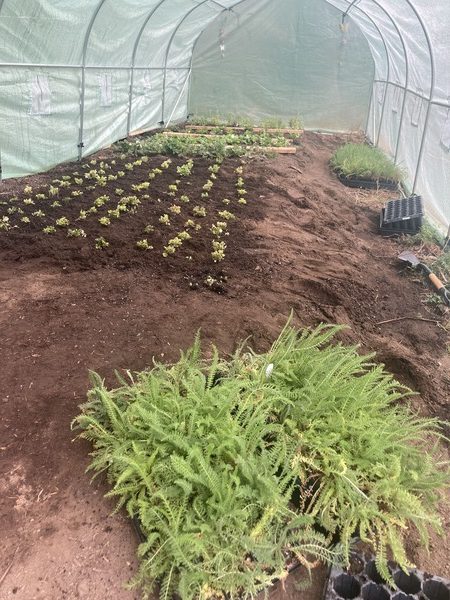
Once the dirt was brought into the greenhouse and the rows were built the plants were taken out of the nursery containers and placed into a large bin of rooting hormone. The rooting hormone was made from the willow tree and the same rooting liquid that the participants learned how to make with Tsawout Elder, Earl Clayton Jr. in the first cohort. The youth let the roots of the medicinal plants sit in the liquid for 15-30 seconds and then passed the plant to the youth in charge of planting. This went on for some time until the entire greenhouse was fully planted with sea blush, prunella vulgars (self-heal), alumroot, salal, and wild strawberry with yarrow and Oregon grape planted in open air outside of the greenhouse. More dirt was then brought to the base of a beautiful and natural rock wall on the backside of the greenhouse where nearly 100 yarrow plants were put into the ground in a zone that resembled their natural habitat.
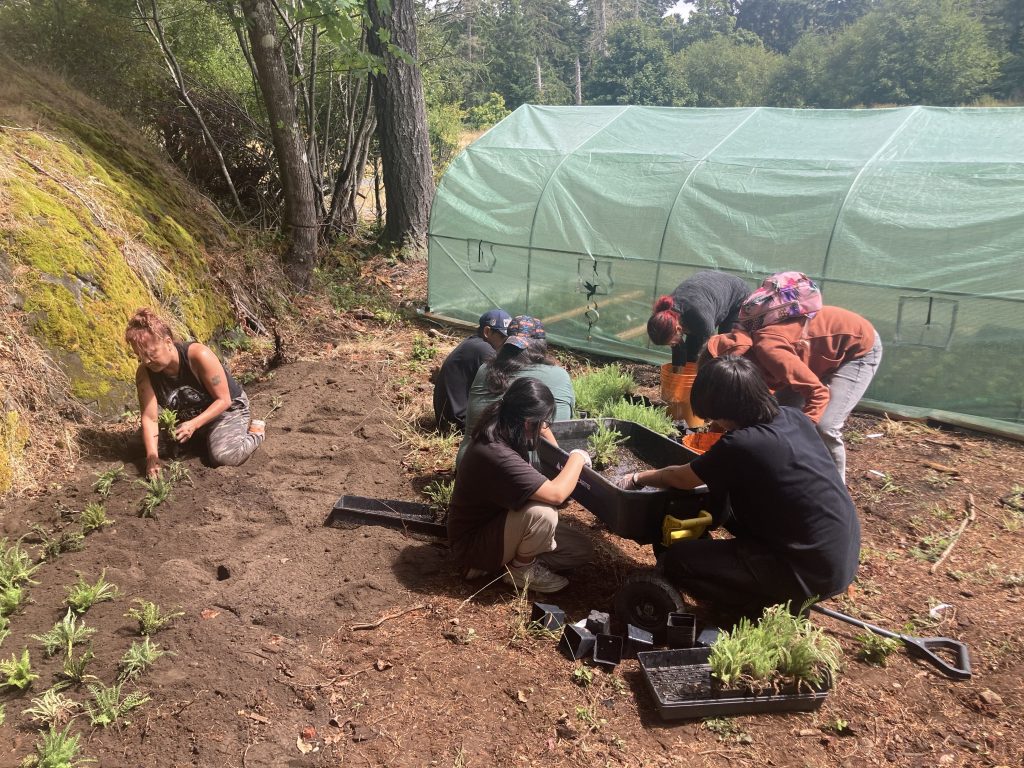
After all of the plants were put into the ground there was a feeling of satisfaction and accomplishment that could be felt within the group. The activity was practical hands on learning out on the land, like everything we do in IndigeMind, and the days work could be seen. It was tangible. Once mature and ready for harvest, Cristina Armstrong will lead IndigeMind cohorts in salve and balm making workshops using the medicinal plants from the greenhouse and traditional recipes from her family.
Food security is an essential part of Indigenous communities reclaiming their history, culture, and identity. Coté (2016) adds that on Vancouver Island, “the Nuu-chah-nulth-aht are actively engaging in decolonization and sustainable self-determination through reinstatement of authority over ha-huulhi (ancestral territory) and through the development of strategies and implementation of policies aimed at the sustainable production and consumption of traditional foods through an ecologically sound food system that honours sacred relationships to land, water, plants and all living things” (p. 11). With more Indigenous specific food security initiatives concentrated both on and off reserve Indigenous youth can learn traditional knowledge and become change makers in their communities.
References
Cidro, J., Adekunle, B., Peters, E., Martens, T. (2015). Beyond Food Security: Understanding Access to Cultural Food for Urban Indigenous People in Winnipeg as Indigenous Food Sovereignty. Canadian Journal of Urban Research, 24(1), 24-43. https://www.jstor.org/ stable/26195276
Coté, C. (2016). “Indigenizing” Food Sovereignty. Revitalizing Indigenous Food Practices and Ecological Knowledges in Canada and the United States. Humanities, 5(3), 57. https:// doi.org/10.3390/h5030057