CALS692 Blog#3
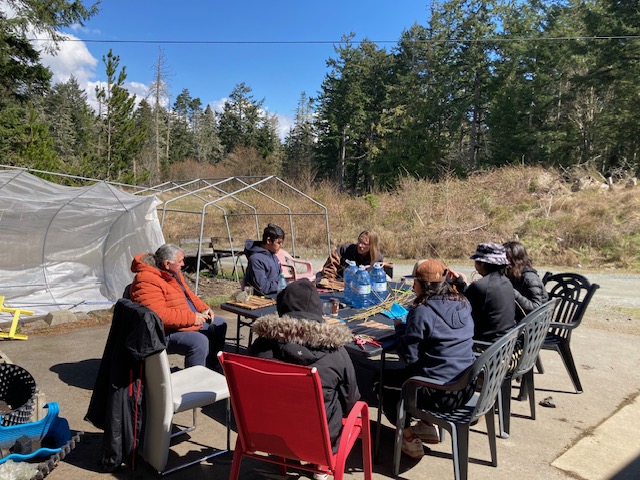
Today, Tsawout Elder and knowledge keeper, Earl Clayton Jr., ran a workshop for IndigeMind participants teaching them how to propagate cuttings from native plants and how to make a traditional rooting liquid. The workshop ran out of our ‘home base,’ which is now known to participants as the ‘shop’ in Beecher Bay on the Sc’ianew reserve. The ‘shop’ is a beautiful open space with native and medicinal plants in every corner. The shop began as a meeting space for youth from the Sc’ianew nation to come and get involved in ecological restoration work on the reserve. In the past few years the area around the shop has been completely restored to its natural habitat.
We start each day sitting in circle. Not only is this culturally appropriate and respectful but also allows space for our youth to introduce themselves to the presenter and helps to create an environment where our youth voices can be heard. Speaking up in a public setting in front of community is a starting point on the journey of climate action leadership development that IndigeMind strives to foster and encourage.
Earl Claxton began by telling our participants stories of his youth and changes in the natural environment that he has observed coming from a family of fisherman and harvesters of the land. The stories provide context for the youth prior to engaging in that days activities. They are “stories and metaphors grounded in local culture and language…and valorize collective identity” (Kirmayer et al., 2011, p. 84). After discussion about the importance of ecological restoration and the role of Native plants in restoring harmony to the landscape we took off on a nature walk. Earl taught participants how to identify native plant species including salal, ocean spray, alder, white willow, salmon berry, and oregon grape to name a few. He then taught the group how to properly take a cutting of a branch to propagate. Each youth was encouraged to pick a native species in the area and each went around to take a cutting to bring back to the shop.
When the group returned to the shop, Earl demonstrated how to shave off an adequate amount of the stems epidermal layer to encourage rooting once placed into soil. Five gallon containers with mixed compost and soil where prepared so participants could take their plants home after the days completion.
Next, Earl took the group back out on a walk to show them how to harvest willow tree branches to make a traditional rooting hormone used to help propagated cuttings ‘catch’ and root in new soil. Participants each took rocks and smashed pieces of willow branches and placed the pieces into small mason jars they were given to bring home. The jars were then filled with water that the youth were instructed to leave out in sunshine for 2-3 days to allow the rooting hormone to be released. As an experiment, participants were encouraged to use the hormone on their propagated cutting to see if it would help expedite the rooting process.
The workshop, like every program day, ended in circle where youth were encouraged to share one thing that they were grateful for. As per protocol, Elder Earl Clayton Jr., was thanked by myself, as a representative of the Victoria Native Friendship Center, and the youth for his willingness to share his Traditional Ecological Knowledge, stories, and time and was gifted prior to his departure.
As IndigeMind continues to unfold, I am reminded of the importance of land based programming and traditional ecological knowledge not only as an essential component of climate action but as a tool to develop the next generation of Indigenous youth climate action leaders. Wildcat et al. (2014) remind us that “land based education… [should] reconnect Indigenous peoples to land and the social relations, knowledges, and languages that arise from the land” (p. I). IndigeMind’s purpose is to foster an environment for Indigenous youth leaders to learn how to carry the teachings of their ancestors and elders in order to restore our damaged ecological systems and bring back connection to cultural land based practices.
References
Kirmayer, L. J., Dandeneau, S., Marshall, E., Phillips, M. K., & Williamson, K. J. (2011). Rethinking Resilience from Indigenous Perspectives. The Canadian Journal of Psychiatry, 56(2), 84–91. https://doi.org/10.1177/070674371105600203
Wildcat, M., McDonald, M., Irlbacher-Fox, S., Coulthard, G. (2014). Learning from the land: Indigenous land based pedagogy and decolonization. Decolonization: Indigeneity, Education, and Society, 3(3), I-XV.